


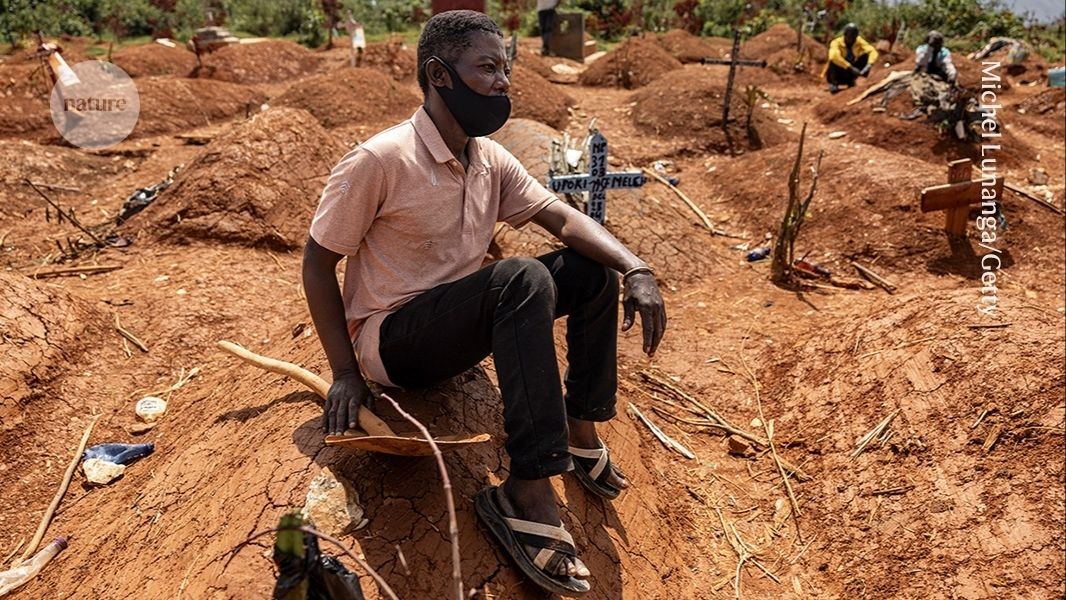
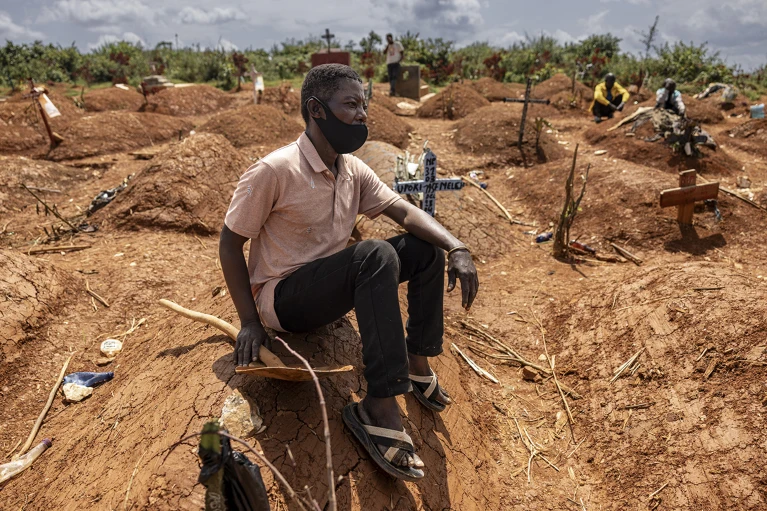
More than 100 suspected deaths have already been reported in the current Ebola outbreak in the Democratic Republic of the Congo (DRC). Here, Bora Moise sits beside the grave of his nephew at a cemetery in Ituri province, in eastern DRC, where the highest number of cases have been reported.Credit: Michel Lunanga/Getty
By the time both the Democratic Republic of the Congo (DRC) and Uganda declared an Ebola outbreak on 15 May, officials said that they had recorded 246 suspected cases and 80 suspected deaths. A few days later, on 18 May, an international research team released the results of a modelling study suggesting that the true number of infections could be vastly higher.
Those data points are shocking researchers and public-health specialists: the director-general of the World Health Organization (WHO), Tedros Adhanom Ghebreyesus, said on 19 May that he is “deeply concerned about the scale and speed of the epidemic”. That’s because, compared with past outbreaks, these numbers stand out. For example, in March 2014, when Guinea initially declared what would eventually become the largest recorded Ebola epidemic so far, it reported only 49 suspected cases and 29 suspected deaths (see ‘Alarming trajectory’).

Source: WHO and WHO disease outbreak news reports/Resolve to Save Lives
The virus causing the latest outbreak, a rare species called Bundibugyo virus, has clearly been spreading unidentified for weeks. “The virus has a big head start,” so efforts to contain it will face an uphill struggle, said Tom Frieden, former director of the US Centers for Disease Control and Prevention, during a 20 May talk organized by news outlet MedPage Today. But does that mean that this outbreak will become one of the largest yet?
A state of emergency
The startling size of the outbreak — along with its occurrence in urban and semi-urban areas in the Ituri and North Kivu provinces of the DRC, where people travel and interact a lot — prompted the WHO to declare the outbreak a Public Health Emergency of International Concern on 17 May. “In light of all these risks, I decided it was urgent to act immediately to prevent more deaths and mobilize an effective and international response,” Tedros said at a 20 May briefing. But he said that the outbreak does not constitute a pandemic emergency.
Ebola outbreak is a global health emergency: what happens next
Epidemiologists are now racing to find out when the outbreak began. Evidence suggests that the Bundibugyo virus has been spreading for approximately two months, WHO officials said at the briefing. Investigators in the DRC have identified a person who died on 20 April and are provisionally treating them as the first case, said Abdi Rahman Mahamud, the WHO’s director for health emergency alert and response operations. After a 5 May ‘super-spreading event’, investigators found reports on social media of further deaths that they now suspect were caused by the virus.
All Ebola viruses are transmitted through contact with blood and other bodily fluids, and can cause influenza-like symptoms, vomiting and diarrhoea, and — eventually — internal and external bleeding and liver and kidney malfunction. The Bundibugyo virus species has, in the past, killed 30–50% of infected people, so it is less lethal than the more common species Zaire virus, which killed around 40% of infected people during the massive 2014–16 outbreak and 66% of infected people during a large outbreak in the DRC in 2018–20.
On 20 May, Tedros said that there were 61 confirmed and nearly 600 suspected cases, however many researchers think that this is likely an undercount. On the basis of case-fatality rates from previous Bundibugyo outbreaks and the number of deaths so far registered in the current one, there could already be upwards of 900 cases, according to the modelling study by infectious-disease epidemiologist Ruth McCabe at Imperial College London and her colleagues. But uncertainties in that estimate means that case numbers could exceed 1,000.
Another major unknown is how fast case numbers are growing, which could indicate when the outbreak started and how big it could get. “It’s so important to get resources to the region, to the people in the affected areas, to be able to help prevent onward transmission and prevent further mortality,” McCabe says.

