


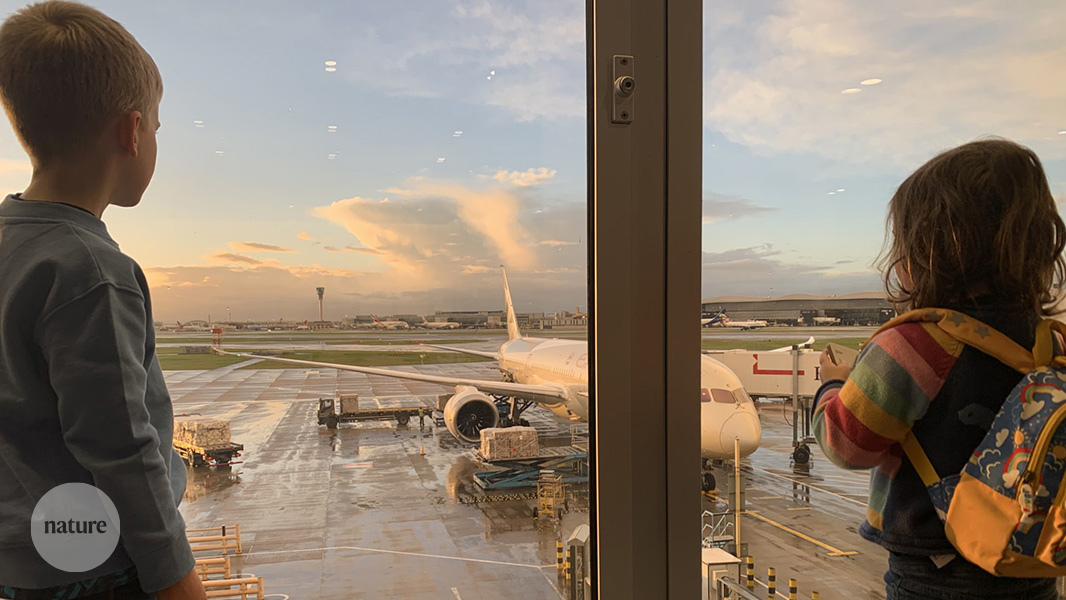

Researcher Laura Carter’s children look out at the tarmac at Heathrow Airport, before the family boards a flight for a research trip to Australia.
A trip in November 2025 brought home just how complex my family life has become. For a moment, my husband and I were in the air at the same time, crossing the Indian Ocean in opposite directions. Two work-related trips, two long-haul flights and one very full calendar. Our children, aged five and eight, were being looked after by a combination of grandparents and close friends.
After landing in Manchester, UK, and making my way home, it struck me how symbolic this was of a much larger reality that we are navigating: the constant negotiation required to sustain two academic careers alongside parenting. I am an environmental chemist and my husband lectures in psychology, meaning that both of us find ourselves in an academic system that assumes a much simpler reality.
Most in academia will be familiar with the ‘two‑body problem’: the challenge of a couple trying to secure positions a commutable distance from each other. But the reality, at least for me, has never felt even that tidy or contained. Once children entered the picture, there was a third body (and a fourth, in fact) that completely reshaped our approach and ability to work.
Because there are two of us juggling conferences, fieldwork, project meetings and deadlines, while coordinating childcare and school routines, it becomes a complex logistical challenge. My husband and I have calendars layered on calendars, travel plans negotiated with military precision and a constant mental tally of who can be where, when and with what kind of back-up plan (see ‘Packed schedule’).

For example, when I was in China for a conference towards the end of 2025, I knew that my husband was managing school drop-offs, evening activities and shifting work commitments, while preparing for his own upcoming conference in Indonesia. Once he left for that meeting, we crossed into entirely uncharted territory, relying on our parents along with carefully choreographed contingency plans to keep everyday life running.
This trip was the first time that we had both been away at the same time. With two school-age children, that’s no small feat. I find that there’s a unique kind of stress that comes with leaving your children behind. It’s not just the emotional weight: it’s the logistical puzzle of school runs, endless activities and bedtime routines. For me, being in a different time zone adds further worry; if something goes wrong, it is not always easy to get home or to make new plans.
The necessity of travel
Travel is a crucial part of academic life. Conferences, workshops and collaborations are an essential component of our jobs for sharing research, building networks and staying engaged with the latest developments in our fields.
Conference dates are rarely flexible. Meetings happen when they happen, and we’re left to juggle everything around them. Why they always seem to cluster in the spring and summer months, at least here in the Northern Hemisphere, is something I might never understand. Although that might suit academic calendars, it often coincides with school holidays, creating a particular challenge for parents.

How I managed my work and personal life as a sole parent during the pandemic
For us, it can mean back-to-back meetings at precisely the time when our normal childcare disappears. Instead of spreading commitments more evenly throughout the year, these periods become especially intense, with competing demands on our time at work and at home.
Trying to balance it all often leads to some truly absurd scheduling on my part: early flights, late returns and tight turnarounds. My personal record is four connecting flights in a single trip simply because that complicated route got me home two hours earlier than a more direct one, just in time for my children’s bedtime. This is all in the name of being present both professionally and personally.
Whenever possible, I’ve reached out to hosts or collaborators to ask whether there’s any wiggle room with scheduling. In practice, that has sometimes meant shifting a talk by a day to align with childcare, or clustering several commitments into a shorter visit to reduce time away. I’ve been fortunate that, when it comes to people with whom I have a strong working relationship, those conversations have gone well. But that’s the key: you need that trust to even ask. People’s personal circumstances differ, and small adjustments can make a big difference. For many of us, it’s not about doing less; it’s about finding a way to do it all without burning ourselves out in the process.
Financial support is not a magic answer
We have both, at times, turned down opportunities to avoid being away simultaneously, because extended travel quickly exposes how few sustainable options exist for dual-academic households. We’re incredibly fortunate to have family support, but it is neither guaranteed nor simple. Our parents have to travel for more than three hours each time they’re drafted in to help, as well as balancing their own caring responsibilities for older relatives.
This highlights a broader reality: academic mobility rarely rests on individual effort. It is often enabled by a hidden — and complex — network of support. I was never told that an academic career might depend on having parents nearby to care for children. Should that really be an unspoken condition of success?

Collection: Juggling scientific careers and family life
Relocation further complicates this. Moving internationally can mean losing the informal support systems that make family life workable.
Our set-up does offer some comforts: a shared understanding of the pressures, rhythms and emotional demands of an academic career. My partner and I sympathize with each other when it comes to travelling away from home and attending conferences. We both intuitively understand the guilt and pressures that we put on ourselves to be present at home and at work.

