


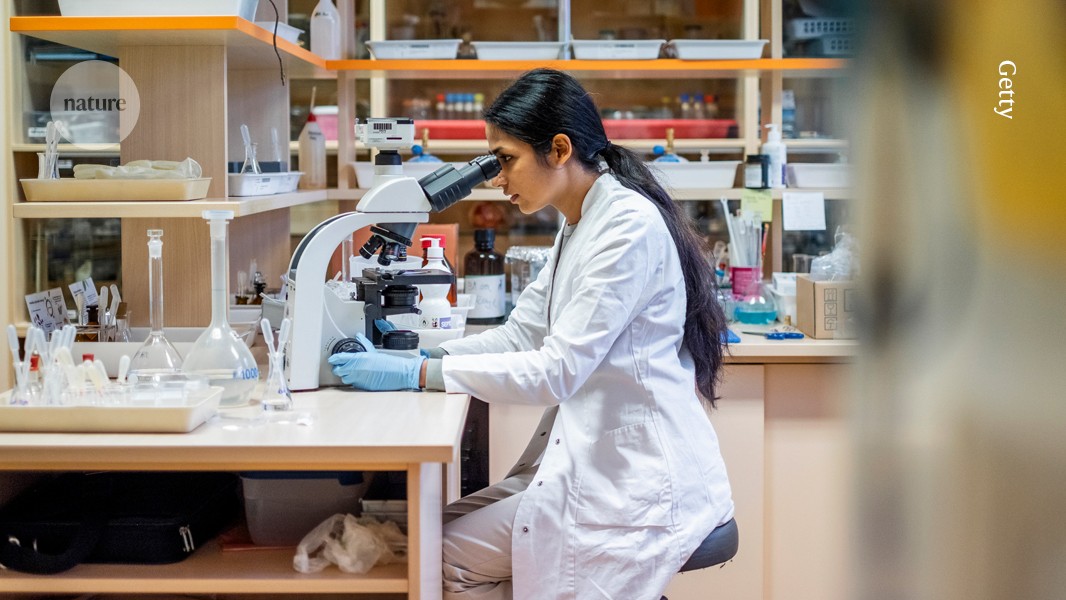

Private firms will host US doctoral students in a scheme announced by the US National Science Foundation.Credit: Getty
The US National Science Foundation (NSF) has kicked off a sweeping effort to deepen the ties between PhD students and industry. The pilot programme will provide participants with hands-on industry research experience and funding from universities, companies and the NSF. It will serve more than 250 students, who will receive funding for four years.
The programme aims to “help graduates better apply their research to real-world challenges”, an NSF spokesperson said. The effort will give companies the chance “to invest directly into how our doctoral researchers are trained”, Michael Kratsios, director of the White House Office of Science and Technology Policy, said in a statement, noting that the majority of US recipients of PhDs in science, technology, engineering and mathematics do not remain in academia.
Researchers expressed a mixture of excitement and concern about the programme, called the Industry-Integrated PhD (I-PhD) Scholars Program, which was announced last week.

Pay, perks and culture shocks: a toolkit for scientists moving to industry
Such training provides benefits for both students and employers, says Wojtek Chodzko-Zajko, Dean of the Graduate College at the University of Illinois at Urbana-Champaign, which already offers PhDs programmes that partner with industry. “I really like the idea that NSF is moving in that direction,” he says. “It’s one that’s always been possible, but it’s probably been underutilized at most research universities.”
But with industry PhDs already available and graduates flocking to industry jobs, NSF money should be spent to “support basic science that industry won’t support”, wrote chemistry Nobel laureate Carolyn Bertozzi at Stanford University in California on the social-media platform Bluesky. The pilot announcement comes as the NSF plans to claw back funds from its core science programmes, Nature reported last month.
The NSF declined to comment on internal budget deliberations but said that it “remains committed to supporting curiosity-driven research and our high standards of merit review”.
Four-year funding scheme
Students on the programme will receive one year of funding from their universities and three years from the NSF. Industry partners will host at least one year of dissertation research at the company’s site and contribute at least US$100,000 per student. In the final three years, students will receive tuition support and yearly stipends of $37,000.
If students take longer than four years to complete their degree, it is the university’s responsibility to ensure they have funding for the extra time, according to Tony Boccanfuso, president and chief executive of the University–Industry Demonstration Partnership (UIDP), a non-profit organization that supports collaborations between universities and industry and that will lead the programme.
NSF plans cuts to core science programmes to fund White House initiative
Students in the I-PhD programme will “continue to complete all of the academic requirements of a traditional PhD, including a dissertation that meets their university’s standards,” says Gretchen Bollar Fiorenza, programme manager at the UIDP. They will also submit an annual programme report, which will document activities such as industry-based research experiences.
The NSF will spend $47 million over the next five years on the pilot project. More than 30 universities, including Columbia University and New York University in New York City and Northwestern University in Evanston, Illinois, have already signed letters of intent to participate, as have industry partners such as Procter & Gamble, BP and Rolls Royce.
Many US universities already have strong industry ties. What’s new is the NSF “being the conduit for the activity and providing some leverage,” says Peter Beling, a data scientist at the University of Virginia in Charlottesville.
Timeline questions
The programme is exciting and could help to foster collaborations between academia and industry, says Chodzko-Zajko. But a “four-year guaranteed PhD seems a little unrealistic,” he says. “PhDs depend on faculty committees and the progress of the research, and that’s to some degree unpredictable.” On average, it takes 5.6 years for students in the United States to complete a PhD in science or engineering.

