


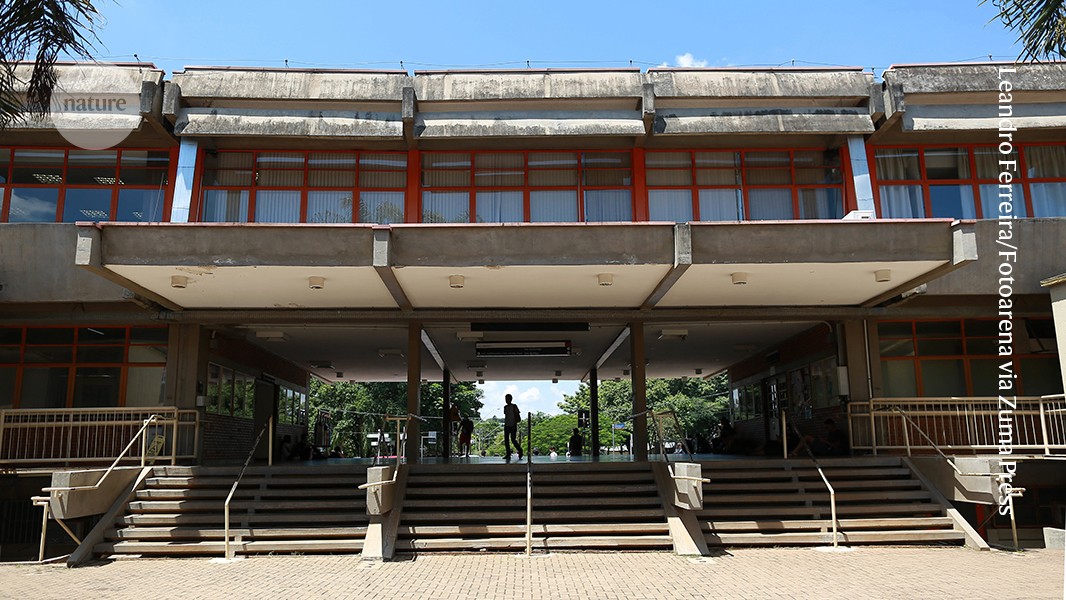

Researchers at the State University of Campinas, in Brazil, noticed in February that virus samples had gone missing from a high-security biosafety laboratory.Credit: Leandro Ferreira/Fotoarena via Zuma Press
Brazil’s federal police arrested a researcher late last month for allegedly taking samples of viruses from a high-security biosafety laboratory at a leading Brazilian university. The researcher, Soledad Palameta Miller, a virologist at the State University of Campinas (Unicamp), was released on bail on 24 March and faces charges including theft.
COVID prompts global surge in labs that handle dangerous pathogens
Police have now recovered the missing samples — which included viruses such as chikungunya, dengue, and Epstein–Barr, according to the Brazilian news programme Fantástico — from other locations on Unicamp’s campus. Brazil’s National Health Regulatory Agency (Anvisa) said earlier this month that it had evaluated the recovered samples and that they did not pose a risk to people’s health.
But the news has caused a stir among members of the Brazilian virology community, who are wondering how the lapse could have happened at a lab designated biosafety-level-3 (BSL-3), the second-highest security classification.
The community is “perplexed”, says Paulo Sanches, a virologist at São Paulo State University in Araraquara, Brazil. “No sample can be removed from a lab with this biosafety level without authorization.” The news comes as Brazil is building support for the construction of its first BSL-4 lab — the highest level of biosafety facility — only a few kilometres away from Unicamp.
Miller did not respond to a request for comment from Nature. In a statement, Unicamp said that it is cooperating fully with the police and is conducting its own internal investigation.
Police investigation
The samples were allegedly stolen from Unicamp’s Laboratory of Virology and Applied Biotechnology. Such BSL-3 facilities are equipped with air filters and containment systems to allow researchers to safely study potentially lethal and inhalable pathogens. Sanches, who coordinates a separate BSL-3 laboratory in Brazil, says that access to this type of facility is tightly controlled.
Although incidents such as this one are not tracked in Brazil, they are likely to be extremely rare, Sanches says. For comparison, a US programme that tracks incidents at biosafety labs and publishes annual reports, hasn’t recorded any thefts since the reports began in 2015.

Although the university has not stated which viruses went missing from a laboratory on its campus, a report from the Brazilian news programme Fantástico suggests that one of them is chikungunya (red particles shown infecting a cell).Credit: O. Schwartz, M. Sourisseau, MC. Prevost, Institute Pasteur/Science Photo Library
Miller, who works in Unicamp’s School of Food Engineering, would not have had permission to take materials from the BSL-3 facility, even though she once worked there as a postdoctoral fellow. Her husband, Michael Edward Miller, is currently a PhD student in the laboratory.
According to a court document obtained by Nature, a researcher at the Unicamp lab noticed that several virus samples were missing in February. Fantástico reported that security-camera footage had showed Michael Miller leaving the facility at unusual times, “late at night or very early in the morning, always carrying something”. Lab members raised concerns with university officials, and federal police were notified.
On 21 March, the police conducted searches at Unicamp and found the missing samples, according to the court document. Some of them were in a lab at the School of Food Engineering that Soledad Palameta Miller shares with other researchers. She was arrested on 23 March, after the police determined that she had attempted to dispose of evidence after the initial searches, the document says. Michael Miller has not been arrested or charged.
“As the material was stored in the School of Food Engineering, where the suspect professor worked, [the responsibility for] this conduct rests with her,” the head of the federal police in Campinas, André Ribeiro, told Fantástico. “Whether her husband or anyone else assisted her will be determined over the course of the investigation.”
Michael Miller did not respond to Nature’s request for comment.
The Brazilian Society for Virology said in a statement that it is monitoring the situation closely. The society emphasized that the biosafety systems in place had proved effective: the samples were quickly recovered and contained and appropriate measures were taken promptly by authorities.
Safety concerns
Clarice Weis Arns, who is the head of the laboratory from which the samples disappeared, declined to answer Nature’s queries, saying she has been advised by Unicamp not to speak to the media.

