


Y-shaped biomolecules called antibodies are scientific workhorse tools that researchers use to bind to and track specific proteins.Credit: Nemes Laszlo/Science Photo Library
Catalogue entries for more than 100 antibodies sold by the research services and supply company Thermo Fisher Scientific contain images that have apparently been manipulated, according to a pair of researchers who specialize in scientific integrity issues.
On 28 May, the researchers documented their findings online in a database that includes 127 “problematic images” associated with the company’s antibodies. Issues with the images — which are included in the catalogue to demonstrate antibodies’ quality and performance — range from minor alterations that make the images look nicer to extensive changes that raise questions of data soundness. The effort was led by Reese Richardson, a metascientist at Northwestern University in Evanston, Illinois.

How to spot suspicious papers: a sleuthing guide for scientists
Science sleuths have uncovered numerous manipulations in images from published scientific papers, but the latest discoveries are the first set of issues found in a vendor catalogue. Image alteration does not necessarily mean the underlying products are defective.
Antibodies — specialized Y-shaped biomolecules — are a crucial tool for researchers in the biological sciences, who use them in experiments to bind to and track specific proteins. But for decades, scientists have complained about the quality and performance of antibodies sourced from commercial suppliers, calling it a reliability crisis. A 2023 eLife survey1 of 614 commercial antibodies found that more than half of them did not work as specified.
“We take this matter seriously and have initiated a comprehensive internal review,” says Sandy Pound, the chief communications officer for Thermo Fisher, headquartered in Waltham, Massachusetts. “Moving forward, where an original image is not present or available, we will ensure that website users are informed that antibody images may have been optimized for presentation and clarity on the website.”
Since the sleuths posted their findings online, some researchers have been asking whether companies are not carefully validating their products and therefore contributing to the antibody reliability crisis. “I can’t help but feel that at some level this does potentially indicate some shortcomings of the reagents themselves,” says Jennifer Byrne, a cancer researcher at the University of Sydney in Australia.
Others, though, say there is probably no link. “My answer would be no,” says Carl Laflamme, lead scientist for Antibody Characterization through Open Science (YCharOS, pronounced ‘Icarus’), a programme that tests antibodies sold by commercial vendors, including Thermo Fisher. The antibody reliability crisis has existed for years and is not due to some apparently altered images on a company’s website, says Laflamme, who is a cell biologist at McGill University in Montreal, Canada.
A crisis of reliability
Last year, the global antibody market was valued at more than US$250 billion, with hundreds of companies collectively selling more than seven million antibodies. Thermo Fisher’s catalogue alone includes more than 250,000 primary antibodies.
To advertise and validate the performance of their antibodies, companies add supporting data to their catalogues. These data include western blots, which are generated using a technique that detects proteins in a mixture. The technique uses antibodies to effectively ‘label’ certain proteins by binding selectively to them. If an antibody performs as it should do, a protein shows up as a distinct band in the test. Less-selective, weak antibody binding can result in multiple bands or fuzzy blobs.
A few weeks ago, Sholto David, a molecular biologist who specializes in research integrity issues based in Oxford, UK, was looking for western blots of a protein in a particular cell line when he happened upon an odd image in Thermo Fisher’s catalogue. Multiple bands in a western blot had a “squiggly” shape that was “distinctive”, David says. They looked identical, although appeared flipped or rotated. The same specific shape should not occur repeatedly in a western blot, he adds, which suggests that they were likely copied, transposed and pasted. David shared his findings on social-media platforms such as BlueSky, but didn’t investigate further. “I just thought it was probably a one-off,” he adds.
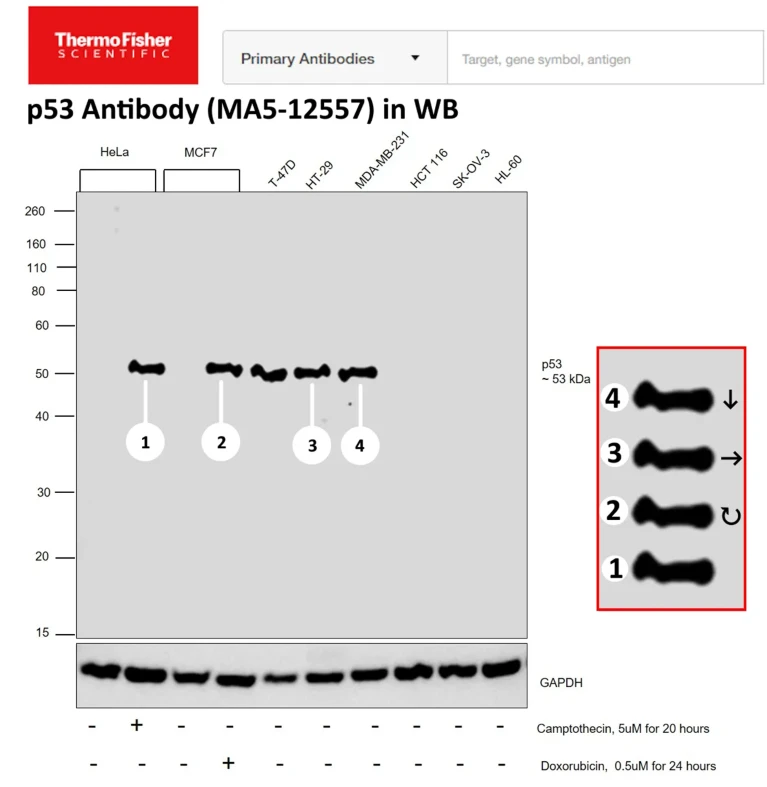
This is the western blot from Thermo Fisher’s catalogue that Sholto David spotted with distinctively shaped protein bands. He labelled it to show how one of the bands could have been duplicated and then flipped and transposed in three other places.Credit: Sholto David adapted from Thermo Fisher Scientific
Commenters on social media reacted, many voicing frustrations about the antibody reliability crisis. Working with antibodies is “notoriously complicated”, Bryan Jones, a neuroscientist at the University of Pittsburgh in Pennsylvania, posted on BlueSky. “This… this does not help. Do better Thermo Fisher.” On the LabRats channel of the Reddit platform, one commenter wrote: “Full audit required. This can’t be the only one.”
Other researchers, including Richardson, joined that audit. Within a week, Richardson had identified 105 more apparently altered images. Some included duplicated protein bands. More than 20 had their backgrounds manually ‘painted’ to obscure streaks or flaws. Most striking, though, were 50 separate blots that had visually identical backgrounds. “It’s just not possible that this many images all have the same background,” Richardson says.

