


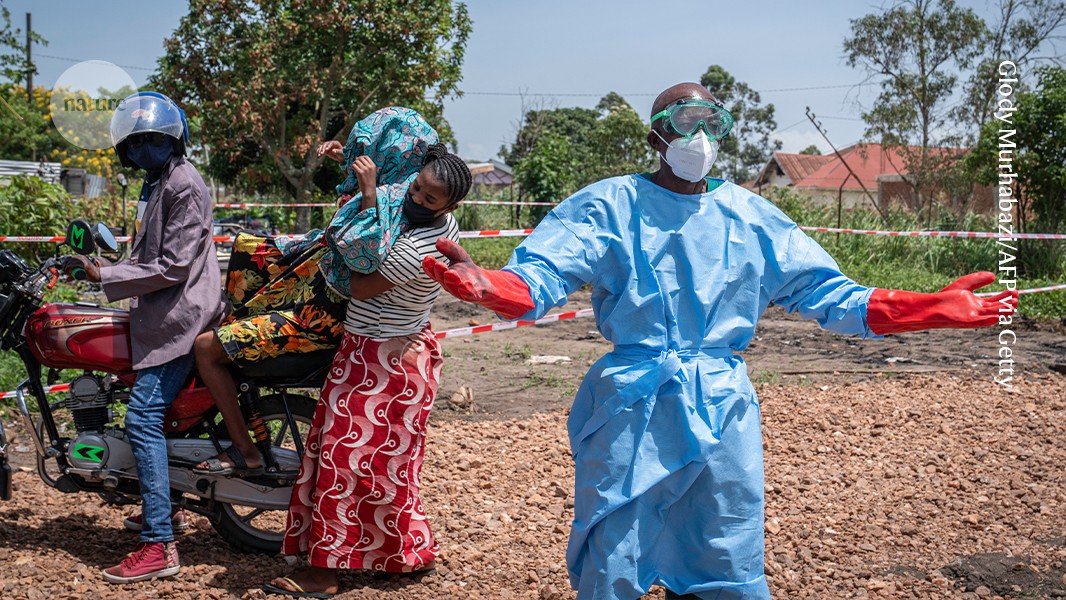

A health worker at a hospital in Ituri province in the Democratic Republic of the Congo asks for help in receiving a person suspected of having Ebola.Credit: Glody Murhabazi/AFP via Getty
The tally of people with suspected and confirmed cases of Ebola in central Africa is rocketing upwards with shocking speed — from 256 cases on 16 May to roughly 1,000 as of 27 May. According to the World Health Organization (WHO), some 240 people have died — and the outbreak shows no signs of slowing down (see ‘Ebola’s surge continues’).
But specialists say that they have tools to help to control the outbreak, which is for now confined to the Democratic Republic of the Congo (DRC) and Uganda, thanks to hard-won expertise gained during previous Ebola epidemics.
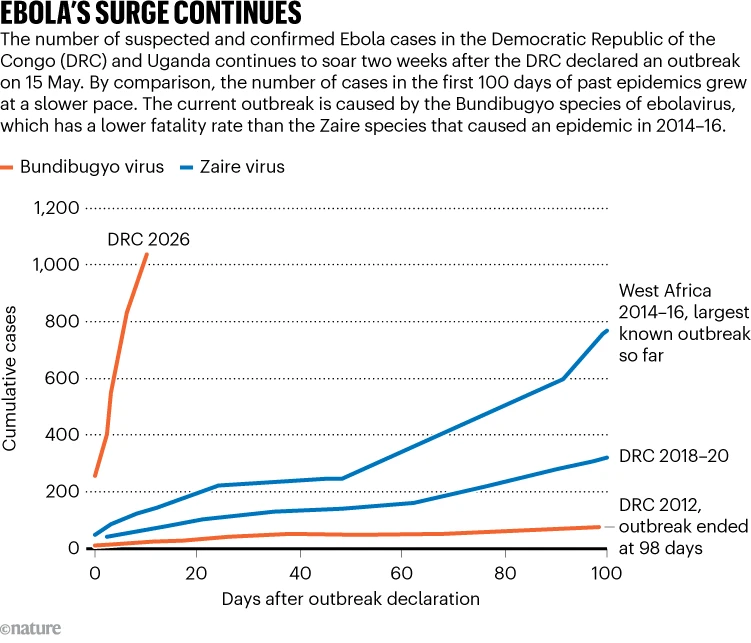
Source: WHO and WHO disease outbreak news reports/Resolve to Save Lives
The DRC, which is the epicentre of the current outbreak, has contended with several outbreaks of Ebola over the years, notes Chima Ohuabunwo, an epidemiologist at Morehouse School of Medicine in Atlanta, Georgia. As a result, the DRC is one of the world’s most experienced countries in handling the virus species that cause the disease. “We should be in a better position to respond” than during previous outbreaks, Ohuabunwo says.
One challenge is that there is neither a vaccine nor a targeted treatment for the specific virus causing this outbreak, the Bundibugyo species of ebolavirus. This means that other measures will be needed to stop the virus’s march. Here are some of the measures that specialists recommend.
Increase testing and contact tracing
Ramping up the laboratory capacity to diagnose Ebola is essential to quickly identifying who is infected so that they can be isolated before they spread the virus to others, says Robert Garry, a virologist at Tulane University in New Orleans, Louisiana. Garry helped to respond to the largest Ebola epidemic on record, which caused more than 11,000 deaths in West Africa between 2014 and 2016.
But the current outbreak is straining the region’s testing capacity. “My understanding is that the main laboratory doing the tests is struggling” to keep up, says Garry. Of the 1,038 cases that had been reported by 27 May, 132 had been confirmed by lab testing as the Bundibugyo species. The DRC’s Ministry of Public Health, Hygiene and Prevention did not respond immediately to a request for comment.
According to the WHO, lab testing capacity is already being scaled up. The biotechnology company BioFire Defense in Salt Lake City, Utah, which produces a highly sensitive test that can detect multiple Ebola species, including Bundibugyo, announced on 19 May that it is increasing its production capacity.
Ebola outbreak is a global health emergency: what happens next
Garry notes that using rapid antigen tests — similar to the technology used in the common home tests for COVID-19 — could also help, even though they are not designed to detect the Bundibugyo species and might have a low specificity. “If you test enough people, it will help you with the surveillance and you can do that in 10–15 minutes. You don’t need a laboratory or expensive infrastructure,” he says.
More testing capacity is also needed for an intervention called contact tracing, in which public-health workers identify individuals who might have been exposed to an infected person. Those contacts are then also asked to test and to limit their movements. Health workers advise contacts about signs of infection and continue to check on them, which builds trust in the health system.
Alongside testing, contact tracing is crucial to controlling the outbreak, public-health experts say, and is usually the first step towards containing a virus. “If we don’t do that, you’re basically fighting a losing battle because the cases will continue to grow,” says Salim Abdool Karim, an epidemiologist who chairs the Emergency Consultative Group of the Africa Centres for Disease Control and Prevention in Addis Ababa.
Nearly two weeks after the outbreak was declared, contact tracing has yet to start in many towns where Ebola cases are suspected or confirmed, say health-care specialists in the DRC’s Ituri province, the source of most of the cases so far. “We have not seen anybody come to provide technical support” and run contact tracing, says Tony Ukety, medical director of the Tropical Disease Research Centre in Rethy, in Ituri province.
Provide supportive care
Even in the absence of specific drugs for the Bundibugyo species, adequate supportive care can drastically increase the survival chances of infected people, specialists say. During the West Africa Ebola epidemic in 2014–16, the risk of death within a month of symptom onset was 74% lower for people who had been hospitalized with Ebola than for those who did not receive any medical treatment, according to an analysis1 of around 600 cases reported in Liberia in 2014.

