



Buoyed by the successful Artemis II mission around the Moon in April, NASA has been ramping up its plans to explore the lunar surface and build a base there. Now, those Moon dreams are in trouble, as one of the aerospace companies heavily involved in executing them — Blue Origin in Kent, Washington — experienced a spectacular explosion during a rocket test in Florida on 28 May.

Historic Artemis II Moon fly-by: Nature’s live coverage as it happened
No one was hurt in the blast, but the company’s rocket design is now being re-assessed and its launch facilities are heavily damaged. That leaves NASA at least temporarily without a key partner for its ambitious Moon base plans. A Blue Origin mission was supposed to launch to the Moon later this year using a rocket of the type that just exploded. The mission would have landed near the lunar south pole with an array of scientific and technical instruments, and NASA administrator Jared Isaacman had optimistically rebranded it ‘Moon Base I’ earlier this week to invoke the agency’s ultimate goal of establishing a sustained presence on the Moon.
“We will provide information on any impacts to the Artemis and Moon Base programs as it becomes available,” Isaacman wrote in a statement after the Blue Origin explosion.
But some scientists are still optimistic about NASA’s Moon plans. “What impact this will have on Artemis and the Moon-base development remains to be seen,” says Clive Neal, a lunar scientist at the University of Notre Dame in Indiana. “However, I believe that Blue Origin is certainly on track to take our astronauts to the Moon.”
Ambitious overhaul
Over the past three months, Isaacman had revised the next set of Artemis missions, adding one in which humans are supposed to test equipment in space next year, and introduced plans to build a US$20-billion Moon base by 2032. The changes have sent scientists and engineers scrambling to adjust.

I was with Artemis II’s scientists during the Moon fly-by. Here’s what I saw
The new plans rely in part on Blue Origin, owned by billionaire Jeff Bezos, being able to deliver hardware to the Moon. Just this week, NASA awarded the company a $188-million contract to deliver two rovers for astronauts to use on the lunar surface by 2028. Billed as “key” parts of the agency’s Moon base plans, the rovers are being built by other firms. Blue Origin is also supposed to carry a robotic rover named VIPER to the lunar south pole next year, where it would hunt for ice in shadowy craters. Lunar scientists had been particularly looking forward to that mission, which is crucial to finding water ice on the Moon, says Benjamin Greenhagen, a planetary scientist who chairs a lunar-exploration community group that provides input to NASA.
Another major company involved in NASA’s Moon goals is also struggling. SpaceX, an aerospace firm owned by billionaire Elon Musk that is based in Starbase, Texas, has not yet got its flagship rocket, Starship, into a complete Earth orbit. Its most recent test flight, on 22 May, yielded mixed results; the main portion of Starship flew most of the way around Earth as expected, but a rocket booster malfunctioned before it splashed into the Gulf of Mexico. The US Federal Aviation Administration has grounded Starship until the mishap has been investigated.
Joy and anxiety
The Artemis programme is the portion of NASA’s lunar exploration plans that involves sending humans to the Moon, and Artemis II set the bar high. Between 1 and 10 April, the mission sent four astronauts around the Moon and back, taking them farther from Earth than humans have ever travelled. The mission demonstrated that NASA’s heavy-lift rocket and Orion crew capsule can successfully take people into deep space, doing so for the first time since the Apollo era ended in 1972. Artemis II also captured the public’s imagination with stunning imagery of the Moon’s far side, a solar eclipse and fresh views of the Earth — collectively birthing the term ‘Moon joy’ to describe the experience.
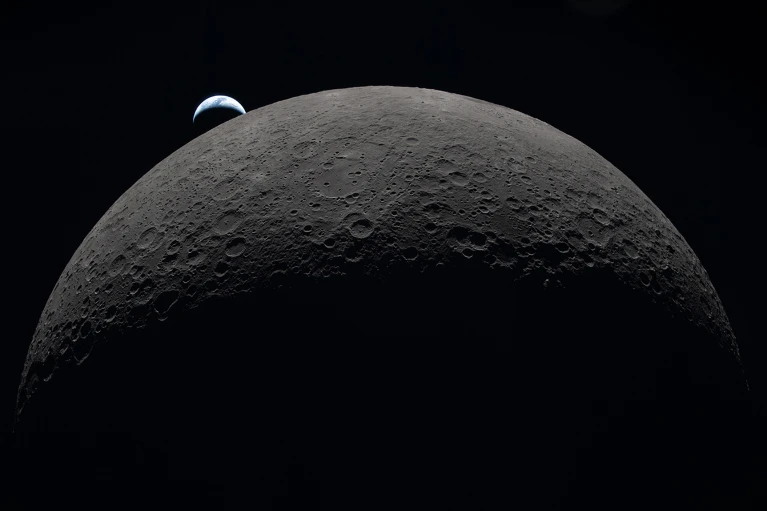
The astronauts aboard Artemis II captured this and other spectacular images of Earth setting over the Moon.Credit: NASA

