


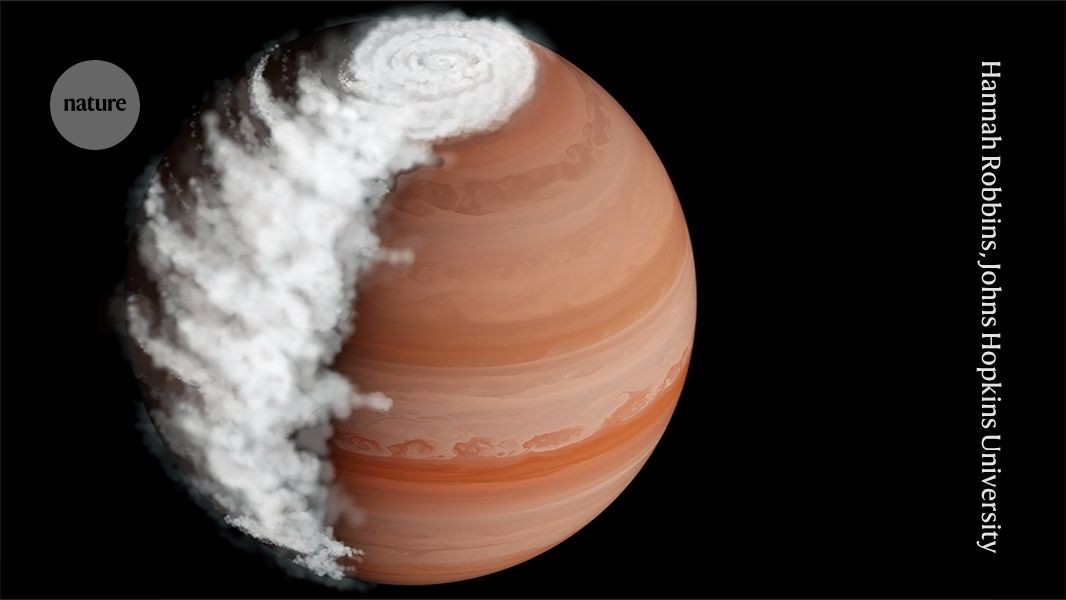

An artist’s representation of the exoplanet WASP-94 A b, showing clouds building up on the night side of the planet.Credit: Hannah Robbins, Johns Hopkins University
On the night side of a distant planet, thick clouds continuously form. But as winds carry them from the cool night side to the lit day side, the clouds quickly dissipate. Astronomers have been able to detect this weather pattern on the planet WASP-94 A b just by studying the light of its star coming from 210 parsecs (690 light years) away. The results show how tracking different phases of a planet’s rotation can can improve researchers’ understanding of planetary atmospheres, say the authors of the study published today in Science1.
Researchers can usually detect the presence of an extrasolar planet only indirectly — for instance, when the planet passes in front of its star, as viewed from Earth. Starlight filtered through a planet’s atmosphere can be analysed for clues about the planet’s chemistry, its weather patterns and even its origins. But even large planets block only 1% or so of the star’s light, and a much smaller amount of that light filters through the planet’s atmosphere. This leaves only feeble imprints on the star’s spectrum of light against a much brighter background.
JWST reveals first evidence of an exoplanet’s surprising chemistry
When Sagnick Mukherjee, an astronomer now at Arizona State University in Tempe, and his collaborators pointed the James Webb Space Telescope at the star WASP-94 A, they were in for a surprise. “We found this really amazing asymmetry in the data,” says Mukherjee. The telescope revealed tiny differences in the starlight’s spectrum between the start, middle and end of the planet’s transit in front of its star.
The measurements showed that during each transit, the part of the atmosphere that crosses first in front of the star is covered with thick clouds — probably made of droplets of minerals rather than water, given that the planet’s dayside temperature is at least 1,600 kelvin. But by the end of the transit, the trailing part of the atmosphere that crosses last is clear. Together, this suggests that as wind blows around the planet, clouds continuously form on the night side, cross into the day side and then dissipate.

