


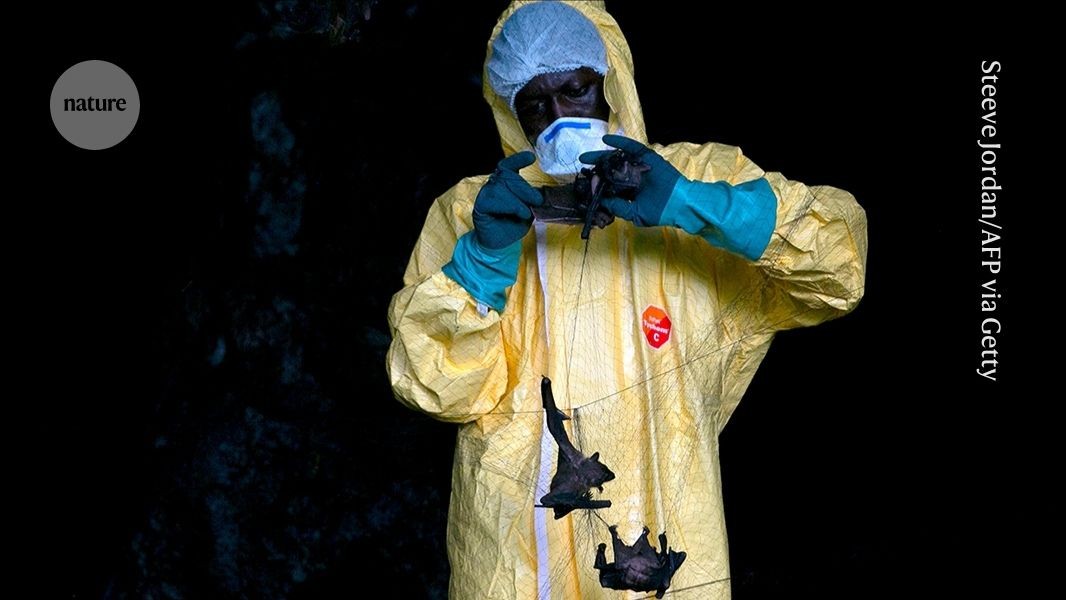

A researcher retrieves bats from a net inside a cave in central Africa.Credit: Steeve Jordan/AFP via Getty
The Ebola outbreak in the Democratic Republic of the Congo (DRC) might have caught most people by surprise, but not James Baguma. He has studied the interactions between wildlife and people in Uganda’s Bundibugyo district, where the species of Ebola virus behind the current outbreak was first identified some two decades ago.
The latest outbreak is the 17th outbreak of Ebola in the DRC since the virus was first identified in 1976. So far, 51 people have tested positive for the Bundibugyo species; another 600 people have suspected infections and 139 are thought to have died from the disease, according to the latest update from the World Health Organization’s director-general, Tedros Adhanom Ghebreyesus. Infections are expected to rise further, he says.
The origin of the latest outbreak in the Ituri province in the DRC is unknown, but fruit bats are suspected. They are a reservoir of Ebola viruses and are common in the region. Past Ebola outbreaks have been caused by ‘spillover’ events, in which the virus jumps from bats to other animals or people.
Baguma, who is based at Makerere University in Kampala, Uganda, talks to Nature about what makes the region high risk for zoonotic spillover events.
Why is this region so at risk from Ebola outbreaks?
People in Bundibugyo live close to national parks. These parks have a high number of fruit bats, along with primates such as monkeys and baboons. These animals interact with the communities. People go out to these national parks to hunt, and animals go to people’s gardens for food. Physical contact with wildlife is common, and some people eat these creatures. The ecosystem is tightly interlinked, which increases the possibility of a spillover through direct contact.
Uganda’s border with the Democratic Republic of Congo (DRC), where the current outbreak is taking place, is very porous. People move in and out freely, often without passports or other forms of identification.
There are bushmeat markets between the DRC and Uganda where people sell the meat of monkeys, baboons and bats.
People from these communities tell us they eat this meat often and don’t get sick, which makes it difficult to effect sustained behaviour change. All you can do is guide people. But I think that is how these outbreaks start.
Having bats living in homes is another risk. They can contaminate food and water without people noticing. Their droppings and urine accumulate in floors in houses, and people might drop food and then pick it up and eat it without washing it.
Children might pick up fruits from gardens that were partially eaten by bats, increasing infection risk.
Are people aware of the risks?
There is increased awareness about these diseases. But people have other problems to be worried about. When there is no active outbreak, people focus on immediate needs, like food and income.
How do you increase awareness?
The entry point for these conversations is to engage trusted local leaders. These include district leaders and health authorities, and religious leaders. These respected figures mobilize people and deliver messages. Messages are drafted by technical experts, but translated into local languages and framed in ways people can relate to.
Special emphasis is placed on interacting with women’s groups. Women are central to day-to-day home management: looking for food, preparing it, caring for children, managing household affairs.
They are also more responsive to health messages than men. By working through women, messages about safer practices around bats can reach households more effectively.

