




LSD and other psychedelic substances are in clinical trials for use as treatments for various mental-health conditions.Credit: Alfred Pasieka/SPL
When cognitive scientist Félix Schoeller met Joshua White, the founder of a psychedelic support phone line, at a conference in 2024, they immediately hit it off. The two developed an idea for an artificial-intelligence-powered tool called Lucy, to improve training for people administering psychedelic-assisted therapy. Trained faciliators are needed to assist individuals who are undergoing psychedelic therapy for mental-health conditions.
Several psychedelic drugs, including psilocybin, MDMA (also known as ecstasy), ibogaine and LSD, are in clinical trials for conditions ranging from post-traumatic stress disorder (PTSD) and depression to substance-use disorders. Rigorous clinical trials require trained professionals to administer these drugs and oversee hours-long therapy sessions that are often emotionally challenging for both client and facilitator.
As treatments that use psychedelic drugs gain further clinical approval, and as more US states consider legalizing the use of psychoactive substances for therapy purposes, the demand for facilitators is likely to increase. Today, adults in Oregon and Colorado can legally consume psilocybin if supervised by licensed facilitators, and New Mexico plans to launch a programme for the medical use of psilocybin this year. Yet, there is a global shortage of mental-health providers, and this is likely to be even more severe in psychedelic-assisted therapy because it is an emerging field that requires specialized training.
Schoeller discusses the approach to designing Lucy, how the AI platform is revealing what effective psychological support looks like and how data from Lucy could inform public-health policies around drug regulation.
What inspired Lucy?
Joshua told me about his non-profit organization Fireside Project, which operates a free support phone line, run by trained volunteers, for people seeking guidance during their psychedelic experiences. Fireside Project records its calls for training purposes, and its database contains thousands of support sessions.
Moreover, it’s a high-quality database. After the calls are recorded and anonymized, the volunteers document the techniques that they used during the conversation, such as reflective listening and crisis de-escalation; the drugs and dosages that the callers took; any adverse events that the callers were experiencing; and the mental-health conditions that the callers were trying to address by taking psychedelics.
I immediately understood it to be an incredible epidemiological data set on the consumption of psychedelics in the United States. Joshua and I came up with the idea of using the database to create Lucy and improve training for psychedelic-assisted therapy.
What training issues does Lucy address?
Many training programmes are based on role play, so they are limited by the instructors’ real-life experiences with sessions that involve psychedelic-assisted therapy. Built on thousands of calls with real people, Lucy can present trainees with a range of diverse scenarios and create AI ‘clients’ that speak and sound like an actual person in an altered state of consciousness. Because Lucy is web-based, trainees can practise easily. The format might lower costs and help to scale up the number of people who can be offered training.
How did your team approach developing Lucy?
We analysed Fireside Project’s recordings and caller surveys to understand which techniques were most effective. We also reviewed 29 existing training programmes — including ones used in clinical trials of psychedelic treatments and at services facilitating psilocybin use in Oregon and Colorado — and compared the methods that they used with what we saw in the database.
Then, we designed a scenario builder in the Lucy platform that allows users to tailor the simulated scenarios to their needs. For example, trainees could choose whether they want to practise various skills or learn one skill very well that could be used across drugs and mental-health conditions. They could select to speak with an individual who is using psilocybin for depression, for example, or someone with PTSD taking MDMA. Facilitators will have vastly different experiences depending on the client’s circumstances.
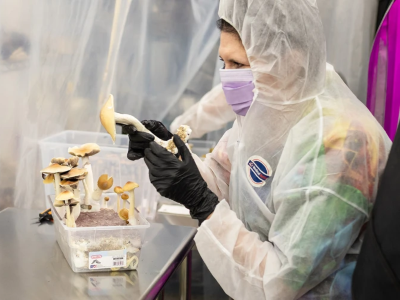
My fight to unlock cannabis and psychedelic drugs for use in medical research
Once the trainees make their selections, large-language models (LLMs) running in the background on the Lucy platform search the repository of Fireside Project transcripts to create a realistic voice model that trainees can role play with. After the simulation, LLMs also analyse the training session’s transcript so that Lucy can offer feedback.
The pilot version is being tested by 400 clinicians, researchers, social workers and educators. Through Lucy’s simulations, they can get a feel for the unusual cognitive and emotional presentations that can occur when a person has taken psychedelic drugs. These include confusion, outbursts, anger and cognitive looping (when someone becomes fixated on one thing). The goal is to provide trainees with many scenarios so that they will feel confident and know how to respond during an actual session.
How might Lucy improve psychedelic research?
Usually in clinical trials of psychedelic treatments, researchers design training courses for facilitators from scratch for the purpose of a single study. Just as drugs and dosing are standardized during a clinical trial, Lucy might help to standardize training, which could make it possible to compare data on safety and outcomes across studies.
One of the scientists Fireside Project is collaborating with is trauma researcher Rachel Yehuda at the Parsons Research Center for Psychedelic Healing in New York City. Yehuda is designing a course for therapists who are administering MDMA to people with PTSD, and Fireside Project is creating simulation modules to complement the course’s instructions on role play. The modules involve various scenarios that therapists might encounter while assisting people before, during and after taking MDMA.

Cognitive scientist Félix Schoeller helped to design and develop an artificial-intelligence tool to train people to facilitate psychedelic-assisted therapy.Credit: Courtesy of Felix Schoeller
Because facilitators must be capable of regulating their own emotions before they can help people who are experiencing an emotional crisis effectively, Lucy’s feedback assessments could improve research. For example, Lucy could flag obstacles to effective facilitation, such as signs of depression and empathy burnout in therapists.
What are you learning from the database?
The Fireside Project data set is giving good indications about effective ways to do psychedelic-assisted therapy. We’ve built a machine-learning model into the Lucy platform that can predict which interactions will result in positive events, such as psychological insights and emotional breakthroughs, or, on the flip side, lead to medical emergencies.
The most important factor for helping someone to manage their stress is genuine human connection. You can say all of the right things, but if you don’t really mean them, and you don’t engage, it doesn’t matter. Trying to measure that is an important challenge, because knowing how best to connect with a client will help in training facilitators to truly empathize with others.

