



I graduated in 2017 from one of the last stand-alone botany departments in the United States. My undergraduate studies gave me training in plant and fungal taxonomy that grounds my research as a PhD candidate in fungal ecology, and taught me how to engage directly with organisms through fieldwork and microscopy.

We must train specialists in botany and zoology — or risk more devastating extinctions
Yet, that department no longer exists, its courses having been folded into a generic biology programme. Initially, I saw its disappearance as a loss for students who wouldn’t receive the kind of training I did. Now, I am beginning to see the dismantling of these pipelines as a deeper problem. It is one that technology companies need to recognize if they want to fulfil their dreams of a biotechnology revolution assisted by artificial intelligence.
My research depends on my ability to locate and identify truffles — fungi that fruit underground — in the Sierra Nevada mountains in California. When I remove a truffle from the soil, its identity is rarely obvious. Many species are undescribed. Establishing the lineage of each specimen requires interrogating the colour and texture of its outer rind, the scent and density of its internal tissue, the microscopic ornamentation of its spores and the identity of its host tree overhead. These skills require years of sustained, organism-focused training. But in a typical general-biology programme, students might spend just one day on plant biology and another on fungi.
Biologists have long warned that research on organisms depends on reliable taxonomy. Without knowing what we are looking at, we cannot meaningfully monitor — and protect — biodiversity. Yet the expertise to identify, delimit and describe species is vanishing worldwide. The consequences now extend into AI systems that use biological data.
Taxonomy distils the work of collecting, examining and describing organisms into a formal, scientifically meaningful name. That name enters the literature, on which large language models (LLMs) are trained. For species with no name, there is nothing more a model can learn. But most of Earth’s biodiversity remains to be described — especially fungi, of which less than 10% of species have been formally named.
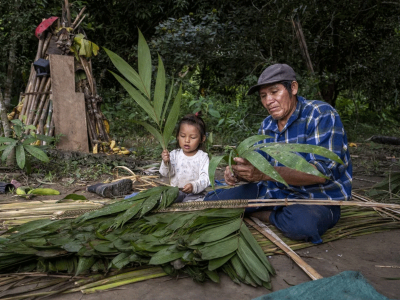
No basis for claim that 80% of biodiversity is found in Indigenous territories
That matters when tech giants are increasingly pivoting to biology to revolutionize medicine and agriculture. This month, for example, the US-based AI company Anthropic acquired Coefficient Bio, a biotech AI start-up firm in New York City, for US$400 million. OpenAI in San Francisco, California, has also announced investments in the life sciences, targeting applications in areas such as drug discovery and protein-structure prediction and design.
Yet, without knowing which species an organism is from, an AI model trained on existing data might not be able to distinguish a benign organism from one that produces toxins that are dangerous to humans. In drug discovery, agricultural management and biosurveillance applications, those gaps can become a matter of public safety.

