



You have full access to this article via your institution.
Hello Nature readers, would you like to get this Briefing in your inbox free every day? Sign up here.
Researchers serving on the National Science Board, which advises the US National Science Foundation, received a brief e-mail on Friday telling them that they had been dismissed.Credit: Briscoe Savoy for Nature
On Friday, all 22 members of the board that advises and oversees the US National Science Foundation (NSF) — a leading funder of basic science — were fired by the administration of US President Donald Trump, without explanation. The National Science Board was founded by Congress in 1950 and can officially be dissolved only by Congress. The Trump team did not respond to Nature about the reason for the firings or whether the board members would be replaced. The move fits into a pattern of the Trump administration’s approach to science advice, which is being “systematically either dissolved or eviscerated”, says astrophysicist Keivan Stassun.
Researchers have collated data from more than 18,700 online advertisements selling research-paper authorships online into the largest database of its kind. The team found that the going rate for a first-author slot on a fake article was anywhere from US$57 to more than $5,600. This database could help publishers determine which journals and research topics are most likely to be targeted by paper mills — businesses that produce fake or low-quality research — says metascientist and study co-author Reese Richardson.
An enigmatic blob pulled from the depths of the sea near Alaska in 2023 seems to belong to an equally mysterious marine creature. Scientists say that the ‘golden orb’ is a remnant of the dead cells that formed at the base of a giant deep-sea anemone, Relicanthus daphneae, to attach it to the rock. The creature itself was only discovered in 2014 to be in a previously unknown order of animals within the subclass Hexacorallia, which also includes anemones.
Reference: bioRxiv preprint (not peer reviewed)
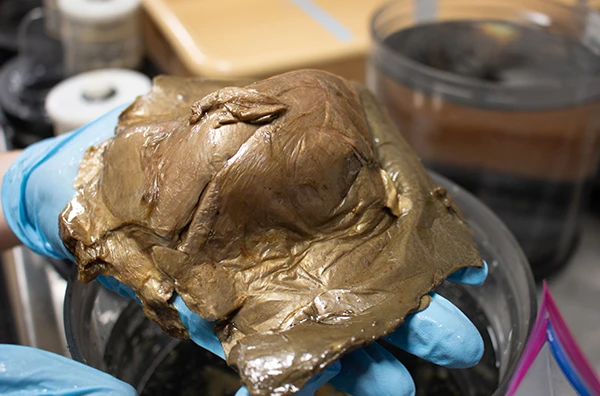
A National Oceanic and Atmospheric Administration (NOAA) expedition used a remotely operated vehicle to pull the smooth, soft object off a rock about 3.2 kilometres below the surface of the Pacific Ocean.Credit: NOAA Fisheries
Features & opinion
In his latest book, science historian Helge Kragh explores how conceptual models of the Universe have evolved, from those of the ancient Greeks to today’s. Universe offers an “elegant and insightful overview of the evolution of cosmological theorizing”, writes space historian David DeVorkin in his review. But the numerous astronomers who have worked to reveal the secrets of the Universe are sidelined in favour of a philosophical focus. Kragh’s “account is lucid, coherent and captivating”, says DeVorkin. But “as the concepts grow more complex, they become less familiar and more challenging to comprehend”.
AI agents can scour a researcher’s entire body of work and everything to do with a funding panel, and generate a grant application to match, all in minutes with little oversight, note Geraint Rees and James Wilsdon. The result? “In our roles as leaders of research and innovation institutions, we’ve both heard anecdotally from the dozens of funders that we work with that the volume of grant applications they receive has risen sharply,” they write. “Meanwhile, the quality of proposals seems to have improved, making it harder to discriminate between them.” A mere ban on AI is inadequate, they argue — instead, they suggest a shift from written proposals to a more holistic view of a research team’s work.

Source: G. Rees & J. Wilsdon
On Friday, Leif Penguinson is hiding amongst the forests, lakes and abundant outcrops of serpentinite rock in the Parco Naturale Mont Avic in Italy. Did you find the penguin? When you’re ready, here’s the answer.
Thanks for reading,
Flora Graham, senior editor, Nature Briefing
With contributions by Jacob Smith
• Nature Briefing: Careers — insights, advice and award-winning journalism to help you optimize your working life
• Nature Briefing: Microbiology — the most abundant living entities on our planet — microorganisms — and the role they play in health, the environment and food systems
• Nature Briefing: Anthropocene — climate change, biodiversity, sustainability and geoengineering
• Nature Briefing: AI & Robotics — 100% written by humans, of course
• Nature Briefing: Cancer — a weekly newsletter written with cancer researchers in mind
• Nature Briefing: Translational Research — covers biotechnology, drug discovery and pharma


