


You have full access to this article via your institution.
Hello Nature readers, would you like to get this Briefing in your inbox free every day? Sign up here.
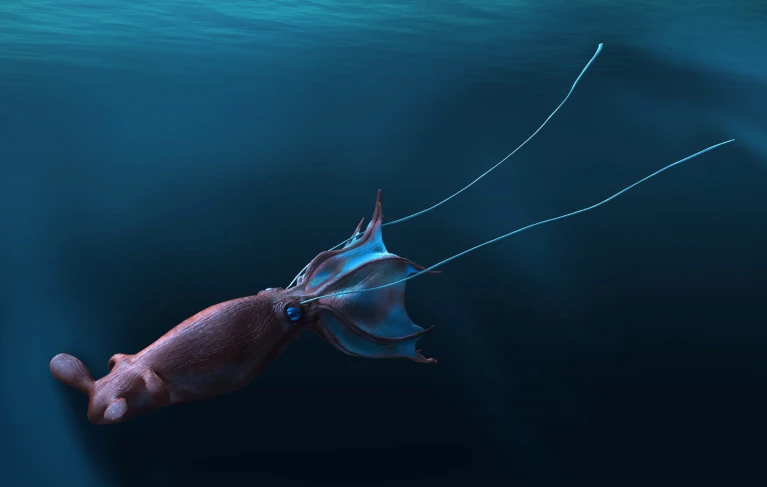
Artist’s impression of an extinct Nanaimoteuthis species, often called krakens, which could have rivalled large marine reptiles in terms of size.Credit: Masato Hattori/Science Photo Library
In the age of dinosaurs, giant octopuses — sometimes named krakens after the mythological monsters — might have grown to nearly 19 metres in length. The estimate is based on fossilized jaws, which researchers say show patterns of wear that came from devouring animals that had hard shells and skeletons. The team suggest that these giant cephalopods might have sat at the top of the marine food chain in the Cretaceous period alongside huge marine reptiles such as mosasaurs. But other researchers say that estimates about the size of the soft-bodied creatures, and how they hunted, should be taken with a pinch of salt.
In mice, the mechanical action of the heart beating stops tumours from growing — which could explain why heart cancers are so rare in all mammals. Researchers compared a non-beating heart that had been transplanted onto the necks of mice with the ‘native’ hearts in the animals. After being injected with cancer cells, the external hearts were swiftly taken over by the disease, while the beating hearts stayed much closer to cancer-free. But there is a downside: pumping also seems to stop the heart from regenerating like other tissue can.
The National Science Library of the Chinese Academy of Sciences (CAS) has quietly stopped publishing its influential journal ranking, taking many researchers by surprise. The ranking has had a central role in research evaluation in the country for more than 20 years. Last month, some of the team who used to run the CAS system published a new privately-run index, called Xinrui Scholar, using the CAS ranking methodology. But no one’s sure if it will catch on, and some scholars would seize the moment to move research evaluation beyond journal metrics.
Two thousand graduate student workers went on strike at Harvard University this week, calling for higher wages, protections for international students at risk of deportation and other changes. The aim of the strike is to halt scientific research at the university, says Laila Norford, a PhD candidate who studies biomedical informatics. “We’re doing essential work that is bringing funding into this university,” she says, “and we’re not seeing the respect returned to us.” A separate union, which represents postdocs, lecturers, teaching assistants and more, could soon join the strike.
Features & opinion
As scientists reel from the news that data from the influential UK Biobank system was found listed for sale on the Chinese e-commerce site Alibaba, Nature Medicine investigates how the geopolitics driving artificial intelligence superpowers is reshaping biomedical data sets, and who has access to them. Ultimately, says computational medicine researcher Alex Frangi, a balance must be struck between protecting national data and ensuring global inclusivity to ensure data are “a tool for universal clinical progress rather than a source of new health inequalities”.
BBC | 7 min read & Nature Medicine | 16 min read
An alien enthusiast learns that expectation is better than reality in Waiting for them and feeling becomes an act of rebellion in The memory dealer of Old Jeddah.
Nature | 6 min read & Nature | 5 min read
Andrew Robinson’s pick of the top five science books to read this week includes a scientist’s guide to the magic above our heads and an analysis of the five essential ingredients that make a great scientific team.
‘Ace’, a robotic arm, leverages the power of artificial intelligence to take on elite table-tennis players. A high-speed perception system allows it to predict complex ball movements, all while making sure it doesn’t hit the table, or any surrounding people. But don’t worry table-tennis players, Ace isn’t coming for your job. “This is very much a research project and it was built on the hypothesis that it would challenge us to push the individual component technologies to their limits,” says Peter Dürr, lead engineer on the Ace project.
Nature Podcast | 26 min listen
Subscribe to the Nature Podcast on Apple Podcasts, Spotify or YouTube Music, or use the RSS feed.
Today Leif Penguinson is hiding amongst the forests, lakes and abundant outcrops of serpentinite rock in the Parco Naturale Mont Avic in Italy. Can you find the penguin?
The answer will be in Monday’s e-mail, all thanks to Briefing photo editor and penguin wrangler Tom Houghton.
This newsletter is always evolving — tell us what you think! Please send your feedback to [email protected].
Thanks for reading,
Flora Graham, senior editor, Nature Briefing
With contributions by Jacob Smith
• Nature Briefing: Careers — insights, advice and award-winning journalism to help you optimize your working life
• Nature Briefing: Microbiology — the most abundant living entities on our planet — microorganisms — and the role they play in health, the environment and food systems
• Nature Briefing: Anthropocene — climate change, biodiversity, sustainability and geoengineering
• Nature Briefing: AI & Robotics — 100% written by humans, of course
• Nature Briefing: Cancer — a weekly newsletter written with cancer researchers in mind
• Nature Briefing: Translational Research — covers biotechnology, drug discovery and pharma


