


Fourier-pixel design
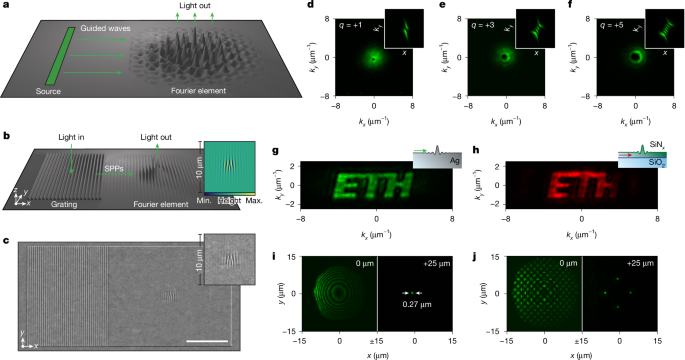
Each Fourier pixel involves the generation, propagation and diffraction of guided waves (Fig. 1a). Although we focus here on SPPs, the design principles also apply to photonic waveguide modes. In our plasmonic Fourier pixels, we used sinusoidal gratings to generate SPPs. The SPPs were launched when the SPP wavevector, \(k_\rmSPP\), satisfied (Extended Data Fig. 1)
$$k_\rmSPP=k_\parallel +ng_\rmm$$
(1)
where \(k_\parallel \) is the in-plane wavevector of photons incident on the grating, \(g_\rmm=2\rm\pi /\varLambda \) is the grating momentum, \(\varLambda \) is the grating period and \(n\) is the diffraction order. The photons have wavevector \(\bfk\) with \(|\bfk|=k=\frac2\rm\pi \lambda \) with wavelength \(\lambda \). If the grating contains multiple spatial frequencies, it can couple photons of different wavelengths simultaneously at the same incident angle, launching SPPs with different \(k_\rmSPP\).
In a Fourier pixel, the generated SPPs propagate in \(x\) across the \(x,y\) interfacial plane with transverse-magnetic polarization. We treat the SPPs as scalar reference waves of the form
$$r(x,y)=\rme^\rmik_\rmSPPx$$
(2)
The SPPs then encounter the Fourier element that creates a desired complex-valued optical wavefront \(g(x,y)\) at a specific output plane through diffraction. For simplicity, we assumed a constant-amplitude SPP wave, neglecting propagation and outscattering-induced attenuation over the extent of the Fourier element. For higher-efficiency designs, such attenuation can be compensated by apodization of the scattering strength, as commonly used in integrated photonics, guided-wave holography and metasurface systems.
The inverse-design process for our Fourier pixels must predict the height profile \(h_\rmp(x,y)\) of the Fourier element that generates the desired \(g(x,y)\). In general, diffraction of light by metallic surfaces can be treated by considering the local optical path differences introduced by the structured interface. We apply a similar diffraction model to describe the interaction of SPPs with our Fourier elements. For amplitude and phase, we use a scalar diffraction model. After the SPP reference wave \(r(x,y)\) interacts with the Fourier element, the optical wavefront at the diffractive surface, \(f(x,y)\), is described by the relation
$$f(x,y)=r(x,y)\,t(x,y)$$
(3)
where we introduced a complex-valued transparency function \(t(x,y)\). It describes how the Fourier element converts the SPPs into the desired wavefront at the diffractive surface. This wavefront then propagates to generate \(g(x,y)\). Equation (3) can be rearranged to give
$$t(x,y)=\fracf(x,y)r(x,y)=f(x,y)\rme^-\rmik_\rmS\rmP\rmPx$$
(4)
Our Fourier elements predominantly affect the local phase, \(\phi (x,y)\), which is a real quantity. Thus, we must consider experimentally realizable transparency functions of the form \(\mathopt\limits^ \sim (x,y)=\rme^\rmi\phi (x,y)\). Further, for shallow profiles (and correspondingly small phase shifts), we can linearize the optical response as
$$\mathopt\limits^ \sim (x,y)=\rme^\rmi\phi (x,y)\approx 1+\rmi\phi (x,y)$$
(5)
In this case, \(\rmI\rmm\\mathopt\limits^ \sim (x,y)\=\phi (x,y)\), which is a tuneable experimental parameter directly proportional to the local height profile, \(h_\rmp(x,y)\). Specifically, \(\phi (x,y)=kh_\rmp(x,y)\) in the limit of shallow profiles. Consequently, by adjusting \(\phi (x,y)\), we can set the imaginary part of the realizable transparency function \(\mathopt\limits^ \sim (x,y)\) equal to that of the desired transparency function \(t(x,y)\) (set \(\rmI\rmm\\mathopt\limits^ \sim (x,y)\=\rmI\rmm\t(x,y)\\)). From equation (4), we then obtain
$$\rmI\rmm\\mathopt\limits^ \sim (x,y)\=\frac12\rmi[f(x,y)\rme^-\rmik_\rmS\rmP\rmPx-f^\ast (x,y)\rme^\rmik_\rmS\rmP\rmPx]$$
(6)
Plugging our realizable transparency function \(\mathopt\limits^ \sim (x,y)\) into equation (3), we then obtain the realizable output \(\mathopf\limits^ \sim (x,y)\) from equations (5) and (6):
$$\mathopf\limits^ \sim (x,y)=r(x,y)\mathopt\limits^ \sim (x,y)=\rme^\rmik_\rmS\rmP\rmPx\left\{1+\frac12[f(x,y)\rme^-\rmik_\rmS\rmP\rmPx-f^\ast (x,y)\rme^\rmik_\rmS\rmP\rmPx]\right\}$$
(7)
$$\mathopf\limits^ \sim (x,y)=\rme^\rmik_\rmS\rmP\rmPx+\frac12[f(x,y)-f^\ast (x,y)\rme^2\rmik_\rmS\rmP\rmPx]$$
(8)
The realizable output in equation (8) contains three terms: the desired output \(f(x,y)\) and two SPP terms. Only the term corresponding to \(f(x,y)\) produces a wavefront that radiates into free space. The other two terms remain guided SPP modes. However, these modes do not necessarily represent dissipative loss channels. In Fourier pixels, the SPPs propagate in-plane and continuously interact with the Fourier element. Energy can therefore be continuously scattered from the guided mode into free space. These non-radiative SPP components thus act as intermediate guided fields.
Equation (8) states that the realizable Fourier element can create any desired \(f(x,y)\). If the required \(f(x,y)\) is known, the necessary height profile can be determined from equation (6) in the limit of shallow profiles:
$$h_\rmp(x,y)=\frac12\rmik[f(x,y)\rme^-\rmik_\rmS\rmP\rmPx-f^\ast (x,y)\rme^\rmik_\rmS\rmP\rmPx]$$
(9)
The inverse-design process now involves predicting the complex-valued optical wavefront \(f(x,y)\) at the sample plane (at \(z=0\)) that leads to the desired output \(g(x,y)\). For outputs at arbitrary planes (\(z=d\)), we used the Fresnel approximation. For outputs in the far field (or in our case at \(z=2f_\ell \), the back focal plane of a lens with focal length \(f_\ell \)), we used the Fraunhofer approximation. The desired output \(g(x,y)\) was backpropagated through the angular spectrum method or the inverse Fourier transform, respectively, to obtain the corresponding complex-valued wavefront \(f(x,y)\) at the sample plane. In the Fresnel regime, this gives a convolution integral over positional coordinates \((\xi ,\eta )\)
$$f(x,y)=\iint _-\rm\infty ^\rm\infty g(\xi ,\eta )h(x-\xi ,y-\eta ,-d)\rmd\xi \rmd\eta $$
(10)
where the convolution kernel \(h(x,y,z)\) is the Fresnel impulse response
$$h(x,y,d)=\frac\rme^\rmikd\rmi\,\lambda \,d\,\exp \,\left[\frac\rmi\,\pi \lambda \,d(x^2+y^2)\right]$$
(11)
In the Fraunhofer regime, \(g(x,y)\) can be represented as a function of spatial frequencies \(k_x\) and \(k_y\):
$$\mathopg\limits^ \sim (k_x,k_y):= g\left(x=\frack_x\,f_\ell k,y=\frack_y\,f_\ell k\right)$$
(12)
leading to
$$f(x,y)=\rmi\,\lambda \,f_\ell \,\exp (-\rmi2kf_\ell )\,\mathcalF^-1\\mathopg\limits^ \sim (k_x,k_y)\$$
(13)
or
$$f(x,y)=\frac\rmi\,\lambda \,f_\ell 4\,\pi ^2\,\exp (-\rmi2kf_\ell )\,\iint _-\rm\infty ^\rm\infty \mathopg\limits^ \sim (k_x,k_y)\exp [\rmi(k_x\,x+k_y\,y)]\rmdk_x\rmdk_y$$
(14)
With the formulas for \(f(x,y)\) (equations (10) or (14)), we can then determine the required height profile for the Fourier element using equation (9).
The above scalar diffraction model can be generalized to include polarization and treat vectorial Fourier pixels. SPPs are coherently launched along two perpendicular directions \(x\) and \(y\). We define two-dimensional vectors for the desired optical output \(\bfg(x,y)\), the backpropagated counterpart \(\bff(x,y)\) and the reference waves \(\bfr(x,y)\):
$$\bfg(x,y)=\left[\beginarraycg_x(x,y)\\ g_y(x,y)\endarray\right],\,\bff(x,y)=\left[\beginarraycf_x(x,y)\\ f_y(x,y)\endarray\right],\,\bfr(x,y)=\left[\beginarrayc\rme^\rmik_\rmS\rmP\rmPx\\ \rme^\rmik_\rmS\rmP\rmPy\endarray\right]$$
(15)
The realizable system response is described by the transparency matrix
$$\mathopT\limits^ \sim (x,y)=\left[\beginarraycc\mathopt\limits^ \sim (x,y) & 0\\ 0 & \mathopt\limits^ \sim (x,y)\endarray\right]$$
(16)
with
$$\beginarrayl\mathopt\limits^ \sim (x,y)=1+\frac12[f_x(x,y)\rme^-\rmik_\rmS\rmP\rmPx-f_x^\ast (x,y)\rme^\rmik_\rmS\rmP\rmPx\\ \,+\,f_y(x,y)\rme^-\rmik_\rmS\rmP\rmPy-f_y^\ast (x,y)\rme^\rmik_\rmS\rmP\rmPy]\endarray$$
(17)
and
$$\beginarraych_\rmp(x,y)=\frac12\rmik[f_x(x,y)\rme^-\rmik_\rmS\rmP\rmPx-f_x^\ast (x,y)\rme^\rmik_\rmS\rmP\rmPx\\ \,+\,f_y(x,y)\rme^-\rmik_\rmS\rmP\rmPy-f_y^\ast (x,y)\rme^\rmik_\rmS\rmP\rmPy],\endarray$$
(18)
in the limit of shallow profiles. The realizable response at the sample plane is given by \(\mathop\bff\limits^ \sim (x,y)=\mathopT\limits^ \sim (x,y)\bfr(x,y)\). Each polarization component contributes five distinct terms. As in equation (8), only the term containing the desired wavefront couples to free space.
Efficiency of Fourier pixels
The efficiency of Fourier pixels was estimated using focusing pixels (similar to that in Fig. 1i). The optical power that was focused to the desired spot \(I_\rmfocus\) was compared with the total power \(I_\rmtot\) incident on the input grating. An excitation mask selectively illuminated the grating region under oblique incidence, launching SPPs selectively in the direction of the Fourier element. We note that the incoupling gratings act as directional couplers. Efficient excitation of SPPs occurs only when the in-plane momentum of the incident light satisfies the momentum-matching condition \(k_\mathrmSPP=k_\sin \theta _\mathrmin\pm 2\rm\pi /\varLambda \). All Fourier pixels are designed for illumination close to surface-normal incidence (\(\theta _\rmin\,\approx \) 0), such that the coupling condition is fulfilled by an appropriate choice of the grating pitch \(\varLambda \). As a result, the reported efficiencies correspond to specific illumination geometries.
The Fourier pixel chosen for efficiency measurements was designed to act as a sinusoidal Fresnel lens. The height profile followed the function
$$h_\rmp(x,y)=A\,\left\1-\exp \,\left[-\alpha \,\left(x+\fracL2\right)\right]\right\\,\cos \,\left[\frac\pi (x^2+y^2)f_\ell \lambda -k_\rmS\rmP\rmP\,x\right],$$
(19)
where \(A\) is the height amplitude and \(L\) is the side length of the Fourier element in \((x,y)\). The centre of the profile was at \((\mathrm0,0)\). To suppress back reflection and outscattering of the SPPs at the boundary between the grating and the Fourier element, equation (19) includes apodization with \(\alpha =k_\rmSPP/5\). The total incident intensity \(I_\rmtot\) was obtained from a reflection measurement from flat Ag, whereas the reflected intensity from the grating \(I_\rmgrating\) gave the incoupling efficiency \(\eta _\rmin=1-I_\rmgrating/I_\rmtot\). The overall efficiency was determined from the integrated focused intensity at 25 µm above the surface as \(\eta _\rmtot=I_\rmfocus/I_\rmtot\). For blue (\(\lambda \,=\) 450 nm; grating amplitude \(A\,=\) 20 nm), green (520 nm; \(A\,=\) 25 nm) and red (630 nm; \(A\,=\) 30 nm) light, the efficiencies \(\\eta _\rmin,\eta _\rmtot\\) were \(\76.7 \% ,23.8 \% \\), \(\72.6 \% ,42.2 \% \\) and \(\70.2 \% ,41.4 \% \\), respectively. The efficiency for 450-nm light was lower owing to increased plasmonic losses in Ag at shorter wavelengths.
To evaluate the effect of superposing multiple grating harmonics within a single incoupler, we fabricated a composite grating containing spatial frequencies for blue, green and red coupling under normal incidence. The corresponding modulation amplitudes were \(A\,=\) 20 nm, 25 nm and 30 nm, respectively. The measured incoupling efficiencies for the combined structure were 32.0% (blue), 50.2% (green) and 38.0% (red). Compared with single-harmonic gratings, the reduced efficiencies are attributed to the introduction of more diffraction and SPP outscattering channels arising from the superposition of multiple periodicities.
Stokes polarimetry
Arbitrary incoming light fields can be separated into their polarization components
$$A_x=a_x\rme^\rmi\varphi _x,A_y=a_y\rme^\rmi\varphi _y,$$
(20)
where \(a\) and \(\varphi \) are amplitude and phase, respectively. The Stokes parameters describe the polarization state of light, defined by
$$S_=A_x^2+^2=a_x^2+a_y^2,$$
(21)
$$S_1=A_x^2-^2=a_x^2-a_y^2,$$
(22)
$$S_2=2\mathrmRe\A_x^* A_y\=2a_xa_y\cos (\varphi _y-\varphi _x),$$
(23)
$$S_3=2\rmIm\A_x^* A_y\=2a_xa_y\sin (\varphi _y-\varphi _x)$$
(24)
We assumed a uniform polarization state over the Fourier-pixel area. For detection, we used a linear polarizer along the diagonal, 45° from both \(x\) and \(y\) axes. We measured the intensities in Fourier space corresponding to the isolated \(x\) and \(y\) components of the incident field, that is, \(I_x,y=a_x,y^2/2\). From these quantities, we retrieved the first two Stokes parameters,
$$S_=2(I_x+I_y),$$
(25)
$$S_1=2(I_x-I_y)$$
(26)
For the other two Stokes parameters, we recombined the incoupled light fields with tailored phase shifts \(\varphi _\rmout\) between the \(x\) and \(y\) directions. In general, the total intensity becomes
$$I(\varphi _\rmout)=\frac12^2$$
(27)
By choosing the phases \(\varphi _\rmout=\0,\rm\pi /2,\rm\pi ,3\rm\pi /2\\), we isolated the remaining Stokes parameters,
$$S_2=I(0)-I(\rm\pi ),$$
(28)
$$S_3=I(3\rm\pi /2)-I(\rm\pi /2)$$
(29)
Extracting large phase profiles from phase-gradient maps
The phase profile \(\varphi \) was reconstructed from discrete phase-step maps \(m_x\) and \(m_y\), which represent the local-phase differences between adjacent sampling points. To recover a globally consistent phase, a self-consistency equation between the phase profile and its gradients was solved:
$$\nabla ^2\varphi =\frac\partial m_x\partial x+\frac\partial m_y\partial y:= M$$
(30)
where the middle of equation (30) was obtained from finite differences of the measured phase-step maps. This self-consistency procedure avoids the accumulation of noise that occurs when the phase is retrieved by direct integration. The equation was converted to the spatial-frequency domain using a two-dimensional fast Fourier transform (2D FFT). In the discrete Fourier domain (denoted by the ^ symbol), the solution is
$$\hat\varphi =\frac\hatM2\cos (k_x)+2\cos (k_y)-4,$$
(31)
with the zero-frequency component set to zero to fix the arbitrary phase offset. An inverse 2D FFT then yielded the phase profile \(\varphi \).
Fabrication of plasmonic Fourier pixels
Plasmonic Fourier pixels were fabricated using thermal scanning probe lithography (TSPL)16. Poly(phthalaldehyde) (PPA) was used as the thermally sensitive resist. Si (100) wafers (2-in. diameter; 1-mm thickness; Silicon Materials) were first cleaned with oxygen plasma (GIGAbatch; PVA TePla) at 600 W for 2 min. Subsequently, 400 μl of a 12 wt% solution of PPA (Allresist) in anisole (AR 600-02; Allresist) was spin-coated onto the wafers using a two-step procedure: (1) 5 s at 500 rpm with a ramp of 500 rpm s−1; and (2) 40 s at 2,000 rpm with 2,000 rpm s−1. After baking the PPA layer on a hot plate at 110 °C for 2 min, a uniform film thickness of 350–400 nm was obtained. To pattern the PPA, the Fourier-pixel height profiles were loaded into the TSPL tool (NanoFrazor Explore; Heidelberg Instruments) as 8-bit bitmaps (256 depth levels in \(z\) for each 20 × 20 nm2 region in \(x,y\); ref. 16). In practice, owing to the tip shape, heat transfer, material flow and so on, continuous surface profiles were obtained at our length scales. Specific parameters (depth range, writing time per pixel and feedback gains) were adjusted depending on the design. The writing depth was controlled through electrostatic actuation between the cantilever and substrate. For feedback during writing, the TSPL tool used in situ topography data.
To replicate the obtained pattern in a plasmonic material, a layer of Ag more than 600 nm thick was deposited onto the patterned PPA by thermal evaporation (NANO 36; Kurt J. Lesker) using Ag pellets (99.999%; 1/4-in. diameter × 1/4-in. length; Kurt J. Lesker). The deposition rate was maintained at 2.5 nm s−1 under high vacuum (3 × 10⁻⁷ mbar)39. Subsequently, we attached a 1-mm-thick glass slide (Paul Marienfeld) on top of the Ag surface using ultraviolet-curable epoxy (OG142-95; Epoxy Technology). The glass slide was allowed to rest on the epoxy for 5 min before exposure to ultraviolet light (2 h), which minimized PPA contamination on the Ag. The cured glass/epoxy/Ag stack was stripped from the PPA substrate using a razor blade13, revealing the surface structure in Ag (inverted from the original PPA pattern). A final cleaning step in anisole (AR 600-02; Allresist) for 2 min removed any residual PPA from the Ag.
Fabrication of dielectric Fourier pixels
Dielectric Fourier pixels were fabricated on Si substrates coated with dielectric thin films. Si (100) wafers (525-μm thickness; Si-Mat Silicon Materials) were first thermally oxidized to form a 2.85-µm SiO2 layer (TS3604; Tempress), followed by deposition of a 225-nm high-stress SiNx film by low-pressure chemical vapour deposition. For the low-pressure chemical vapour deposition process, dichlorosilane (70 sccm) and NH3 (210 sccm) were used as precursor gases at 800 °C and 200 mTorr. The wafers were then diced into 15 × 15 mm2 chips. Before resist coating, the chips were cleaned in acetone for 2 min, isopropanol for 2 min and oxygen plasma for 5 min at 600 W. A 12 wt% solution of PPA was spin-coated in a single step at 6,000 rpm, resulting in a resist thickness of 258 nm. Greyscale Fourier-pixel patterns were subsequently written into the PPA using TSPL. The pattern was then transferred into the SiNx layer by reactive ion etching (PlasmaPro NPG 80, Oxford Instruments) using CHF3 (50 sccm) and O2 (5 sccm) at 100 W. The selectivity for etching was 1.4. After etching, the chips were cleaned again in acetone for 2 min, isopropanol for 2 min and oxygen plasma for 5 min at 600 W.
Design parameters
The sinusoidal grating pitch, \(\varLambda \), was 509 nm for all Fourier pixels in this study, except those in Fig. 1h (353 nm) and Extended Data Figs. 4h (417 nm, 509 nm and 618 nm) and 7b,g (495 nm). The sinusoidal grating amplitude, A, was 25 nm for all Fourier pixels, except for those in Fig. 1h (23 nm) and Extended Data Fig. 4h (20 nm, 25 nm and 30 nm). The depth, \(h_\rmp\), of the Fourier element was 50 nm for the pixels in Fig. 1i,j and Extended Data Figs. 5, 7, 8 and 10h; 140 nm for the pixel in Fig. 1h; 150 nm for the pixels in Figs. 1d–g, 2c,d, 3b,g and 4a,d,e and Extended Data Figs. 4a–g, 9c–f and 10a; 200 nm for the pixel in Extended Data Fig. 10j; and 250 nm for the pixels in Fig. 2e,f and Extended Data Fig. 4h.
Optical measurements
The optical setup is depicted in Extended Data Fig. 3. Fourier pixels were measured using a home-built optical apparatus based on an inverted optical microscope (Eclipse Ti-U; Nikon) equipped with a 50× air objective (TU Plan Fluor; Nikon; numerical aperture of 0.8). A filtered (LLTF Contrast; NKT Photonics; 420–1,000-nm accessible wavelengths; linewidth of approximately 1.5 nm) supercontinuum laser (SuperK FIU−15; NKT Photonics) allowed illumination of the sample at different wavelengths. After passing through a short-pass optical filter (FESH0750; Thorlabs), the laser beam was then collimated with a 10× objective (L1; TU Plan Fluor; Nikon; numerical aperture of 0.3). This objective was used to reduce chromatic aberrations, which could cause a spread of incoming angles at the sample. The collimated beam was focused onto the back focal plane of the microscope objective by a 400-mm defocusing lens (L2), resulting in a 100× demagnified Gaussian illumination spot on the sample. Laser-cut cardboard masks (Extended Data Fig. 3d) were placed in the excitation path to selectively illuminate the incoupling gratings. A rotatable linear polarizer in the excitation path controlled SPP launching from the two orthogonal incoupling gratings (Fig. 2a). More specifically, SPP launching was maximized for one grating by aligning the incoming polarization with its corrugations or evenly divided over two orthogonal gratings by orienting the polarization at 45° between them. Diffracted light off the substrate was passed through a circular aperture in the image plane to isolate light emanating from the Fourier element. For all Fourier pixels designed to project the output to the far field (Extended Data Fig. 3a), the back focal plane of the microscope objective was imaged on a digital camera (Zyla PLUS sCMOS; Andor). For Fourier pixels that project to arbitrary planes (Extended Data Fig. 3b), lens L6 was removed to image the sample plane or a plane displaced along the optical axis, selected by moving the microscope turret relative to the sample.
For measurements with incoherent illumination (Extended Data Fig. 4g), the laser source was replaced by a halogen lamp spectrally filtered with a 10-nm full-width-at-half-maximum bandpass filter. The angular spectrum of the lamp was further restricted by placing a mask in a Fourier plane in the excitation path, ensuring SPP launching into a single direction.
To control the phase of the incoming laser, a liquid-crystal spatial light modulator (SLM; PLUTO NIR011; HOLOEYE) was used (Extended Data Fig. 3c). The SLM display was imaged onto the Fourier pixel by replacing L2 with a 750-mm lens (instead of the 400-mm lens). With the microscope objective, this resulted in a demagnification of 187.5×. The SLM display was subdivided into two regions, and the relative phase between them was systematically varied between \(0\) and \(2\rm\pi \). The two incoupling gratings (Fig. 3a and Extended Data Fig. 10) were illuminated by the two regions of the SLM, thereby tuning the incoming phase difference. This measurement procedure was also used to systematically project parts of large complex phase profiles onto the phase sensors of the Fourier pixel (Fig. 4h,i).
To systematically control the in-plane polarization of the incoming laser (Fig. 4j), a rotatable mechanical mount (PRM1Z8; Thorlabs) was used in combination with a linear polarizer and custom-built control software. This configuration provided adjustable linear polarization, as the laser source is unpolarized in-plane. A quarter-wave plate was used together with the linear polarizer, oriented at −45° or +45°, to generate left or right circularly polarized light (Fig. 3i,j), respectively. In the detection path, a linear polarizer projected the diffracted light onto the axis at 45° between the gratings to extract the Stokes parameters.
Potential for unwanted crosstalk in multifunctional Fourier pixels
When multiple diffractive surface profiles are superposed in a Fourier pixel, one must consider the possibility of crosstalk. In principle, superposition of spatial frequencies in the Fourier element can generate undesired mixed diffraction orders. To address this possibility, we performed a quantitative analysis of the expected crosstalk based on the spatial frequency content of our diffractive Fourier elements. Taking the Fourier pixel in Extended Data Fig. 2a,b as an example, which has a maximum modulation depth of \(h_\rmp=\) 150 nm, we determined the contribution of individual spatial frequencies by computing the 2D FFT. After normalization to the physical height modulation, we found an effective depth per spatial frequency component of approximately 0.5 nm, indicating that the total surface relief is distributed across many spatial frequencies.
To estimate the crosstalk, we consider a simple scalar diffraction model consisting of two sinusoidal gratings with spatial frequencies \(g_1\) and \(g_2\) and depth \(h\) equal to the depth extracted above. Superposition can generate undesired higher-order contributions, such as \(g_1+g_2\). The diffraction efficiencies \(\eta _m,n\) of the different orders \(mg_1+ng_2\), where \(m\) and \(n\) are integers, can be found from
$$\eta _m,n\propto J_m(kh)^2J_n(kh)^2$$
(32)
where \(k\) is the free-space wavevector, and \(J_i\) is the Bessel function of the first kind of order \(i\). We defined the desired first-order efficiency as \(\eta _\mathrm1,0\) and the mixed-order efficiency as \(\eta _\mathrm1,1\). We then calculated the resulting efficiency ratio \(\eta _\mathrm1,0/\eta _\mathrm1,1\) as a function of modulation depth in the pattern. For the depth extracted from the Fourier element (\(h\,\approx \) 0.5 nm), the ratio exceeded 105, indicating that crosstalk is more than five orders of magnitude weaker than the desired diffraction process.
The above argument relies on the fact that the Fourier element contains many spatial frequencies, which is the case for all of the devices in this study. If a structure (for example, a sinusoidal grating) had only a handful of spatial frequencies, crosstalk could become more important.
In addition, using guided surface modes as the reference wave further suppresses undesired diffraction losses. The momentum of these guided waves lies outside the free-space light cone, whereas the desired optical output is typically near the surface normal. As a result, diffraction from a single spatial frequency produces only one propagating free-space order; other orders remain evanescent and do not contribute an optical signal.

