


You have full access to this article via your institution.
Hello Nature readers, would you like to get this Briefing in your inbox free every day? Sign up here.

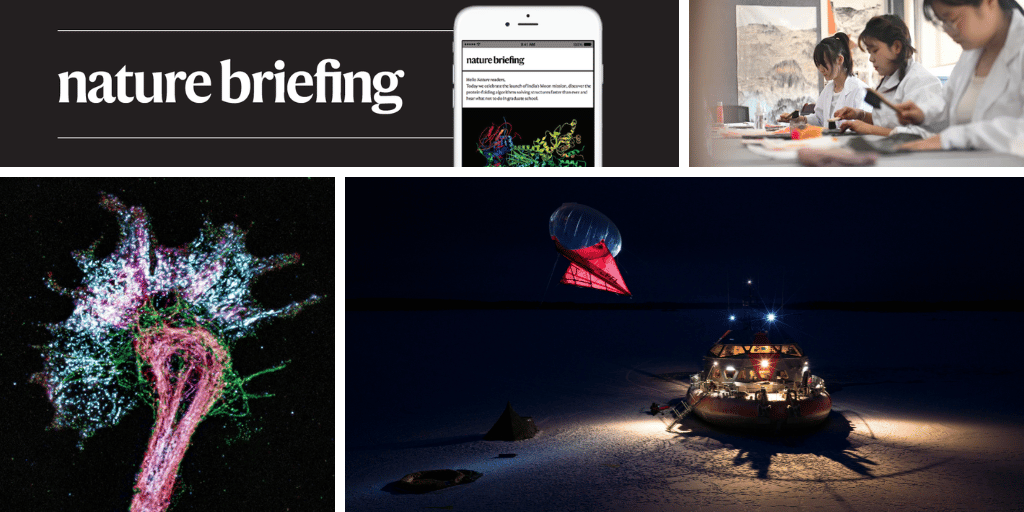
High-resolution images can be produced by increasing the size of a nerve cell before fluorescence-microscopy imaging.Credit: Arthur Chien/SPL
Researchers have mapped the position of individual amino acids in proteins using a conventional light microscope. The team used an improved version of a technique called expansion microscopy, which enlarges biological samples by carefully pulling them in every direction. The upgrade expands protein samples up to one billion times their original size — 1,000-fold larger in each dimension. The stretch pulls protein molecules apart to a point that they can be visualized without costly and complicated techniques such as cryogenic electron microscopy. “This is the democratization of structural biology,” says neuroscientist and study co-author Silvio Rizzoli.
Reference: bioRxiv preprint (not peer reviewed)
Extreme heat is disrupting lives across Europe, with yesterday the hottest day ever recorded in France. “We know beyond a shadow of a doubt that heat wave events such as this have been made more likely and more severe due to climate change,” said Peter Thorne, the director of the ICARUS Climate Research Centre in Ireland. “But nevertheless many of the records being set, particularly in the UK and France, are mind-bogglingly crazy.”
There has been progress on adaptation, from cooling centres to early warning systems, some inspired by a heat wave 23 years ago that caused 70,000 deaths across the continent. But more is needed, says the World Health Organization: two weeks ago, it noted that more than 200,000 people across Europe died from heat-related causes over the past four years.
And a 1976 heat wave and drought that is burned into the national memory of the United Kingdom, because of its severity, would be even worse today because of climate change, models suggest.
Euronews | 6 min read, The New York Times | 6 min read & BBC | 7 min read
Reference: WHO statement
Isolated groups of sperm whales (Physeter macrocephalus) in the Mediterranean Sea seem to have developed their own dialects of their species’ primary social vocalization, a pattern of clicks and pauses. Researchers analysed 20 years of audio recordings and found that whales in the Hellenic Trench, near Greece, use a faster version of the pattern than do whales around the Balearic Islands, between Gibraltar and Italy.
YaleEnvironment360 | 3 min read
Reference: Proceedings of the Royal Society B paper
Image of the week

This flying-saucer-shaped research vessel is the Tara Polar Station, which is designed to drift through the Arctic for years, frozen into the pack ice (its oval shape helps it to resist the crushing pressure of the ice). The 26-metre long vessel — shown here during tests in Finland last winter — will launch from its home port in France next month. (Science | 8 min read) (Maéva Bardy – Fondation Tara Ocean)
Features & opinion
“As science and technology race ahead, the world needs humanities research to understand the reasons and implications,” writes historian Xin Fan. At undergraduate level, humanities education fosters skills such as creativity and ethical awareness in science students, and teaches them the social context of their work. Universities and governments must ensure that investment in science and technology doesn’t come at the expense of the humanities. Fan’s institution, ShangaiTech, is leading by example. “The aim is not to oppose science, but to enrich it,” he writes.
When journalist Amanda Petrusich’s baby was only 13 months old, her husband had a fatal seizure, sparking a conflagration of grief. But can grief be so ceaseless that it becomes pathological? And how should this most-universal of injuries be healed? Petrusich delves into the research surrounding debilitating long-term grief and takes stock of emerging treatments, including one that helped her, called eye movement desensitization and reprocessing (EMDR).
Read more about the enigmatic mechanisms of EMDR in this Nature News & Views article by neuroscientist Andrew Holmes (10 min read, from 2019)
Today I’m rooting for the ‘Seasquatches’ — giant sunflower stars (Pycnopodia helianthoides) that have up to 24 arms and can grow to the size of a bicycle tire. These animals were thought to be possibly extinct following a huge die-off ten years ago, caused by sea star wasting disease. Now 18 have been spotted by a sea-star-search expedition off the California coast. “For those who’d seen them prior to wasting disease, it must have been akin to seeing an old friend, but I felt more like a stunned paleontologist seeing a dinosaur,” says marine scientist Tyler Mears.
Now, a correction: yesterday, we told you that a liquid ‘renewable battery’ harvested electrons from light. That’s not the case — there are no electrons in light. Instead, light prompts one type of molecule in the liquid to donate an electron to another, which causes the goo to solidify into a jelly.
This newsletter is always evolving — tell us what you think! Please send your feedback to [email protected].
Thanks for reading,
Flora Graham, chief editor, Nature Briefing
With contributions by Jacob Smith
• Nature Briefing: Careers — insights, advice and award-winning journalism to help you optimize your working life
• Nature Briefing: Microbiology — the most abundant living entities on our planet — microorganisms — and the role they play in health, the environment and food systems
• Nature Briefing: Anthropocene — climate change, biodiversity, sustainability and geoengineering
• Nature Briefing: AI & Robotics — 100% written by humans, of course
• Nature Briefing: Cancer — a weekly newsletter written with cancer researchers in mind
• Nature Briefing: Translational Research — covers biotechnology, drug discovery and pharma

