


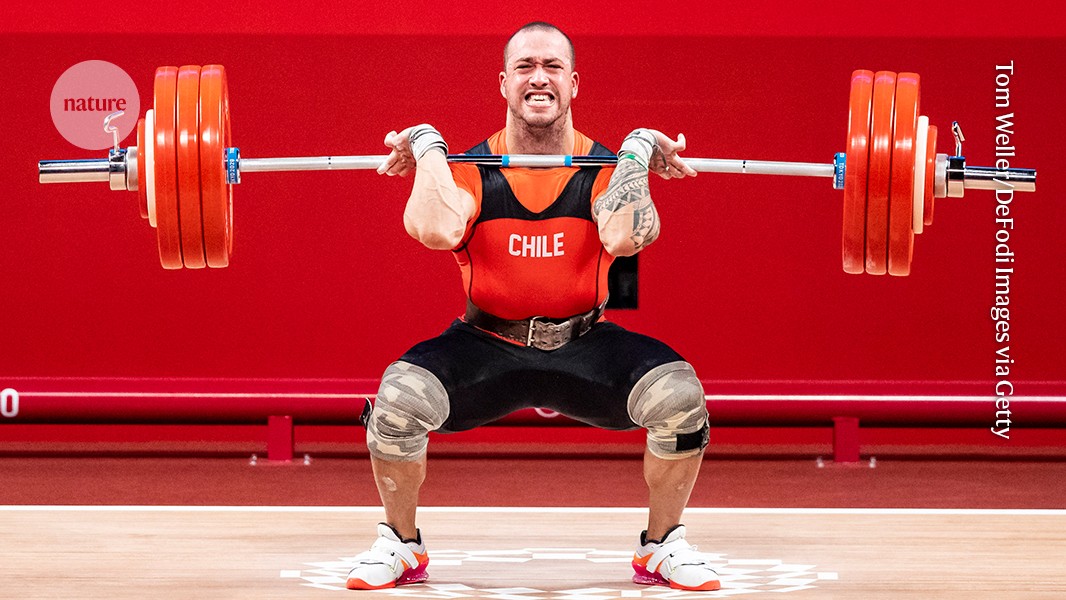

Chilean weightlifter Arley Méndez Pérez is set to compete at the Enhanced Games.Credit: Tom Weller/DeFodi Images via Getty
Can the boundaries of human performance be pushed through science and technology? That’s what tech entrepreneur Aron D’Souza set out to test by founding the Enhanced Games — a sporting event that will permit, even encourage, athletes to use drugs to enhance their prowess. On 24 May in Las Vegas, Nevada, around 50 athletes are set to compete in swimming, athletics and weightlifting, unbound by normal anti-doping rules.

Can the ‘steroid Olympics’ show the sporting community how to support athletes better?
Organizers stress that performance-enhancing drugs will be used under medical supervision, and that only substances that are approved in the United States will be allowed. But such drugs are authorized for medical purposes, not athletic enhancement. Anabolic steroids, for example, might be prescribed legally for delayed puberty or for hypogonadism, in which the testes produce little to no hormone. And, so far, no details on treatment protocols for the athletes have been disclosed.
Besides, although medical oversight might reduce immediate risks, it does not eliminate the adverse effects associated with doping in sport, including psychiatric complications, infertility and musculoskeletal injury. These are well documented in scientific and medical research.
What drugs might the athletes take? Testosterone is a likely candidate. A natural sex hormone, it increases muscle mass and strength. But boosting levels with pharmaceuticals risks cardiovascular and endocrinological complications, dependence, and psychiatric effects such as aggression, mood instability and depression.

Testosterone therapy is trending. Who really needs it, and why?
Another likely substance is rEPO. Erythropoeitin (EPO) is a hormone that occurs naturally in the body, where it stimulates the production of red blood cells and thereby increases oxygen-carrying capacity. Its synthetic counterpart, rEPO, is known to improve aerobic endurance and has been notoriously used by cyclists. But it risks blood thickening that could lead to cardiovascular incidents.
As head of King’s College London’s Drug Control Centre — the UK laboratory for sports testing, accredited by the World Anti-Doping Agency — I know that the scientific challenge today is not to understand what these substances can do but rather how to improve detection methods, mitigate their harms and protect athletes’ welfare.
And physiological boosts from drugs that alter body composition or increase strength do not automatically translate into competitive success. This is particularly true at the elite level, at which years of training and technical skills are just as important. By allowing performance-enhancing drugs, the Enhanced Games disregard discipline, technical mastery, psychological control and collective trust in shared rules. I think that limiting sport to a biomedical experiment underestimates the scientific and ethical complexity surrounding human performance and doping practices.

