


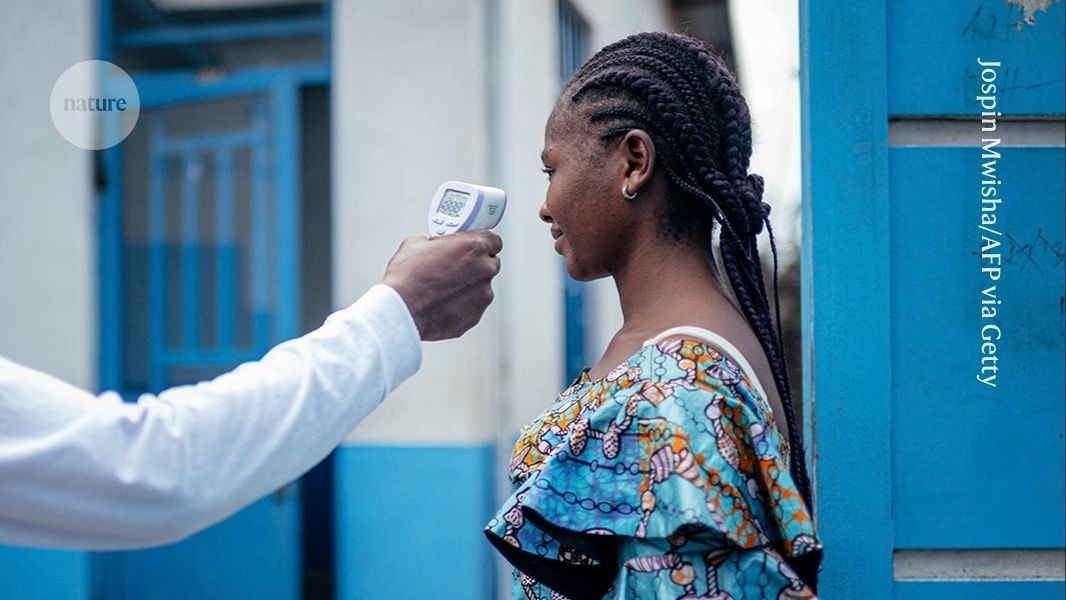

The World Health Organization (WHO) declared an outbreak of Ebola in the Democratic Republic of the Congo (DRC) a public health emergency of international concern on 17 May.Credit: Jospin Mwisha/AFP via Getty
Scientists are racing to trial experimental treatments and potentially vaccines against a rare Ebola species that is spreading in the Democratic Republic of the Congo (DRC) and Uganda.
There are no approved treatments or vaccines against Ebola Bundibugyo virus, which has been linked to 336 suspected cases and 88 deaths, according to data from the US Centers for Disease Control and Prevention as of on 17 May.
Nature has learnt that a World Health Organization (WHO)-sponsored clinical trial of two experimental treatments for Ebola Bundibugyo virus disease is in the works, pending approval by the governments of DRC and Uganda. Health officials are also considering whether an approved vaccine for another species of Ebola virus could be trialled in the current outbreak.
“I think we’re in a really strong position to quickly launch trials,” says Amanda Rojek, a clinical researcher at the University of Oxford, UK, who is part of the treatments trial. “We’re working day and night at the moment.”
Investigational therapies
Rojek, who is part of a WHO effort to rapidly trial treatments against filoviruses, which includes Ebola and Marburg viruses, during outbreaks, says the trial will focus on two therapies.
One is the broad-acting antiviral called remdesivir, which is manufactured by Gilead Sciences in Foster City, California. The other is a treatment called MBP134, which is a mixture of two antibodies that recognize diverse Ebola viruses and was developed by Mapp Biopharmaceuticals in San Diego, California.
Remdesivir was trialled in a 2018–19 DRC outbreak of another species of Ebola virus called Zaire1, as well as against SARS-CoV-2 during the global pandemic, where its efficacy was modest. MBP134 was administered in a 2022 outbreak of the Sudan species of Ebola in Uganda, but this was done outside of a clinical trial under ‘compassionate use’ in which patients with a life-threatening disease can get access to investigational therapies. It was not possible to determine whether the drug worked or not.

Hopes rise for coronavirus drug remdesivir
However, there are strong data in monkeys and other animals for the effectiveness of MBP134, including against Bundibugyo virus, says Thomas Geisbert, a virologist at the University of Texas Medical Branch in Galveston. In a 2019 study, his team found that MBP134 led to profound recovery in 5 of 6 monkeys that were infected with Bundibugyo virus and showing symptoms such as fever2.
“It’s a true therapeutic — we’ve used it against Bundibugyo and it works fantastically, and you can wait until they’re very sick,” he says. “It really mimics someone that walks into a clinic and is very sick.” Plans to test MBP134 and remdesivir in the ongoing outbreak make a lot of sense, Geisbert adds.
Larry Zeitlan, chief executive of Mapp, says that the company has enough doses of MBP134 for a trial, and that the drugs are owned by the US government’s Biomedical Advanced Research and Development Authority.

