


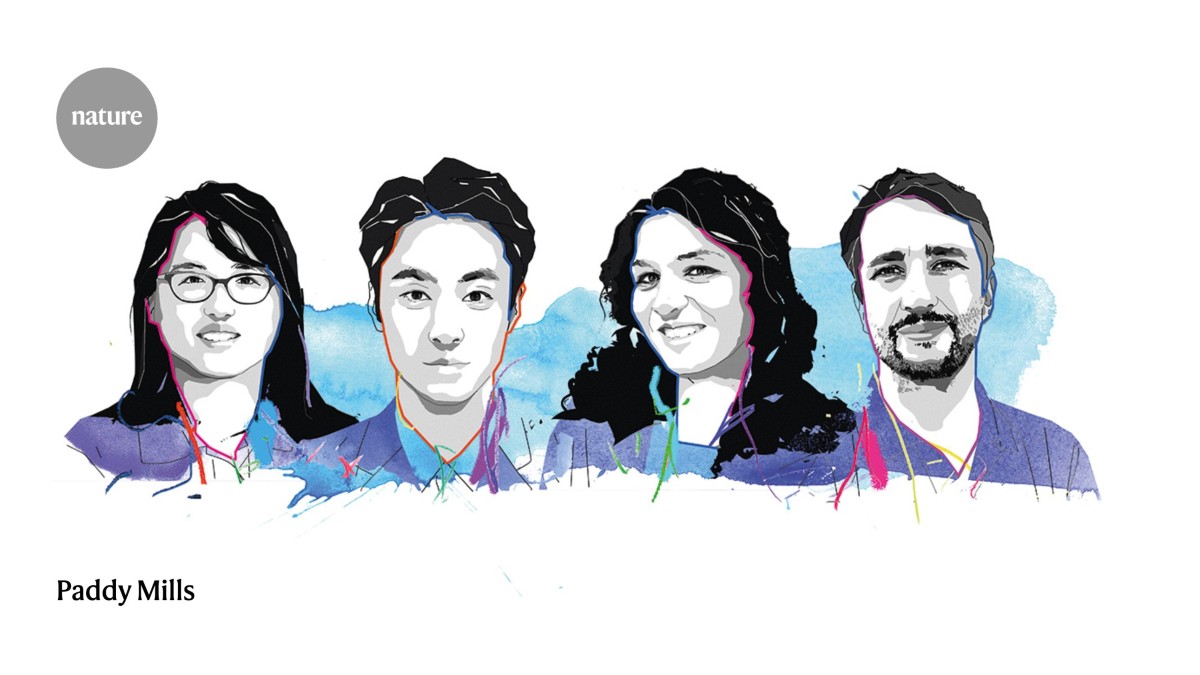
In laboratories and hospitals around the world, a new generation of cancer researchers is working on the treatments and technologies of tomorrow. Some have turned their focus to improving imaging techniques for diagnostics; others are developing minimally invasive tests for early detection. Despite the differences in their work, they are united in achieving a common goal — better survival rates for people with cancer.
AYESHA NOORANI: Genome pattern sleuth

Ayesha Noorani maps DNA mutation patterns to learn how cancer develops over time.Credit: Paddy Mills
As a medical student at the University of Cambridge, UK, Ayesha Noorani planned to pursue a career as a vascular surgeon. But when an uncle back home in Karachi, Pakistan, died of oesophageal cancer in his early 50s, she chose a different path. “I was struck by how little we could do for my uncle, and how little was known about the disease,” she says. Now a clinician scientist at the Wellcome Sanger Institute in Cambridge, Noorani studies two of the most aggressive cancers — gastric and oesophageal — which arise in closely connected organs and share many of the same risk factors and treatment paths.
Many biological processes can increase a person’s risk of developing cancer, such as cumulative damage from ageing, chronic inflammation or certain defects in DNA repair. Noorani wants to understand the genetic factors that determine why these risks lead to some people developing cancer while others remain unaffected by the disease. The key, she says, is finding specific genetic signatures in a patient’s genome and monitoring them over time. “I’m very much interested in the evolution of cancer — the fact that it’s dynamic and changes with time,” says Noorani.
Working with patients at high risk of oesophageal cancer allows Noorani to map genetic changes in oesophageal cells before cancer develops and explore how those changes might contribute to the disease. Two conditions that are particularly important for this work are achalasia — a swallowing disorder that limits food and drink from moving down the oesophagus into the stomach — and Chagas disease — a parasitic illness that can cause heart failure and digestive complications — because they are linked to an increased risk of oesophageal cancer.
Nature Index 2026 Cancer
Discovering genetic signatures and how they affect risk in healthy people could be a “game-changer”, says Noorani. Detection before symptoms appear is crucial, she adds, because oesophago-gastric cancer is increasingly affecting people in their 30s and 40s.
Noorani is also investigating how oesophageal adenocarcinoma, a common type of oesophageal cancer that originates in gland-forming cells, develops over time. In a 2020 study1, she and her colleagues compared the genetic profile of tissue samples collected from the primary tumour and metastatic sites in patients with oesophageal adenocarcinoma during treatment and shortly after death. This allowed them to trace the cancer’s evolution “in a very detailed way”, Noorani says.
The team found that rather than spreading in a stepwise manner through the lymph nodes as previously assumed, the cancer seemed to disperse quickly from the original tumour to multiple sites. “This was a new model of metastasis,” Noorani says. The findings support the modern approach to chemotherapy, which extends treatment after surgery to remove residual metastatic cells that could fuel further spread.
Thinking back on her childhood, when she watched her parents, a transplant surgeon and gynaecologist, run a small hospital in Karachi, Noorani says she was struck by the team’s “everyone’s in this together” camaraderie. She encounters that collaborative spirit in her own surgical and research teams today, and says it’s one of her favourite parts of the job. She also felt it during her PhD work at the University of Cambridge, where she was part of a team that brought together oncologists, hospice staff and patient groups in setting up one of the United Kingdom’s first ‘warm autopsy’ programmes, where patients can donate their bodies so researchers can obtain tissue samples shortly after death.
Some days, cancer research can feel like an uphill battle, says Noorani. “But at least you make a little dent on that cancer wall that we are all trying to chip away together.” — Sandy Ong
CHENG XU: Tumour illuminator

Cheng Xu is advancing imaging technologies that could enable earlier, less invasive cancer detection.Credit: Paddy Mills
In cancer imaging, fluorescent markers — molecules that emit light after absorbing energy — are an indispensable tool. When injected into the body, they bind to specific markers on cancer cells, which can be used to highlight abnormal growths and tumours during the screening process, distinguish cancerous and healthy tissue during surgery and enable real-time monitoring of treatment responses.
But fluorescent probes have a major limitation, says chemical and biomedical engineer Cheng Xu. The signal depends on continuous external illumination, such as shining a specific wavelength of light onto the skin, in order to keep glowing.
A trained physician, Xu did his master’s degree at the China Pharmaceutical University in Nanjing, studying how nanoparticles can be used in cancer therapy. In 2020, he joined a lab at Singapore’s Nanyang Technological University (NTU) that had been making waves by enhancing a technique called afterglow imaging. The team had developed a type of nanoparticle-based probe that continues to glow even after the light source is removed2. “Previously, afterglow imaging was achieved with inorganic molecules, but these are potentially toxic, as they use heavy metal ions like chromium and zinc,” says Xu, who is now a research fellow at the lab.
The ‘afterglow probes’ that the NTU team pioneered seemed like a suitable alternative, except for one issue: light can only penetrate up to two centimetres of biological tissue, which made deeper sites imperceptible. To overcome this, Xu and his colleagues turned to ultrasound, which doubled the detectable depth of the afterglow probes.
In 2022, the team reported3 that they had developed multiple ‘sonoafterglow’ probes, or ‘SNAPs’. Each comprises two components: the first absorbs ultrasound to generate a reactive oxygen species (ROS), an unstable molecule that easily reacts with others; the second interacts with the ROS to generate an afterglow. The researchers later added a ‘quencher’ molecule to the nanoprobe to form a ‘Q-SNAP’ probe. This molecule is removed once it encounters a killer T cell within a tumour, restricting the glow-linked reaction to cancerous conditions4. “This gives us information on whether a mass is benign or malignant,” says Xu, which could one day eliminate the need for invasive biopsies.
In 2024, the NTU researchers created a different probe, tested on mouse models, that uses X-ray energy to activate markers in tissue up to 15 centimetres deep5. Xu says this should make it useful for detecting deeper tumours.
Afterglow imaging is “quite promising”, says Xu, because “our imaging probes using X-rays or ultrasound can potentially detect small early-stage tumours better, which may help diagnose cancer earlier”. He is now working with physicians in China to bring SNAPs to clinics.
As someone who lost a relative to advanced pancreatic cancer at the age of 50, Xu hopes that his lab’s innovations will one day extend the lives of those with the disease. “Watching what happened to him strengthened my determination to do research on cancer and to reduce the suffering of cancer patients,” says Xu. — Sandy Ong
SIMON HEEKE: Tailoring treatments

Simon Heeke is developing liquid biopsies as an alternative to more invasive methods for cancer detection.Credit: Paddy Mills
As the leader of the liquid biopsies team at the MD Anderson Cancer Center in Houston, Texas, Simon Heeke says the past decade has shown just how impactful this approach can be. Rather than putting patients through an invasive tissue biopsy, liquid biopsies allow scientists to use samples of blood, saliva or urine to detect disease signals and guide treatment decisions.
A blood-based liquid biopsy6 that flagged circulating tumour DNA from non-small cell lung cancer was approved in 2016. Heeke, then a PhD student at the Laboratory of Clinical and Experimental Pathology at Louis Pasteur Hospital in France, was immediately sold on its potential. “It was an area of rapid growth and development, which was very exciting to me as a young student,” says Heeke. “It allowed me to grow with the field and build my own niche.”
Today, Heeke’s research focuses on head, neck and lung cancers. His team looks for genetic biomarkers — DNA sequence variations associated with the disease — that can be detected using liquid biopsy-based tests. Lung cancer in particular has greatly benefitted from biomarker identification, he says, but there are some subtypes that remain understudied, either because they’re more challenging to investigate or are less common. For example, small cell lung cancer (SCLC), a highly aggressive cancer linked to smoking, accounts for around 15% of lung cancer cases in the United States7, yet there are no genetic biomarkers to help guide treatment.
Heeke says that in a perfect world, clinicians could sequence a person’s genome, identify a biomarker based on a single cancer-causing mutation, and then develop a liquid biopsy based on this biomarker to check if the person has cancer. But cancer is rarely caused by a single mutation. Instead, it often involves multiple genes and changes in gene activity.
By combining genetic sequencing with machine learning, it is now possible to generate genetic profiles of SCLC patients to analyse the ratios of gene expression in healthy and cancerous cells more deeply than ever before, says Heeke. “There’s a lot of information held inside our cells, and we’re getting better at pulling that data out and making sense of it.”
Although SCLC has long been treated as a single disease, studies over the past few years have revealed that there are biologically distinct subgroups that have different weaknesses to treatments. Heeke and his team have identified 13 biomarkers in blood plasma that show differences between healthy people and those with cancer and they have used those biomarkers to create a DNA-based blood test that can sort SCLC patients into one of four genetic subtypes8.

