


Since launching the Health Silk Road in 2017 as part of its Belt and Road Initiative, China’s engagement in African health has shifted from short-term aid missions towards more complex, long-term collaborative projects.
Beyond continued support for African hospitals, health-care workers and rural medical services, China’s expanding involvement in African health includes building joint hospitals and medical centres and strengthening its relationships with pan‑African health and regulatory bodies, including the Africa Centres for Disease Control and Prevention (Africa CDC) and the African Medicines Agency.
China is also investing in African pharmaceutical and vaccine production. Chinese company Shanghai Fosun Pharmaceutical is developing a €50 million (US$58.8 million) facility near Abidjan, Côte d’Ivoire to produce antimalarial and antibacterial medicines, for example, and Jijia International Company of China, a Beijing-based medical equipment firm, is working with Zambia to establish the country’s first cholera vaccine plant.
Nature Index 2026 China
At the 2024 Summit of the Forum on China–Africa Cooperation (FOCAC) in Beijing — the largest gathering of African and Chinese leaders in the capital since 2018 — Chinese President Xi Jinping emphasized China’s commitment to “jointly advance modernization that is open and win–win” through its partnership with Africa across health and other sectors. “China and Africa account for one-third of the world population. Without our modernization, there will be no global modernization,” Xi said.
This deepened commitment to Africa coincides with a sharp decline in US support for aid programmes in low‑ and middle‑income countries, including for health and collaborative research in Africa. In March 2025, the US government announced that 83% of programmes run by the US Agency for International Development (USAID) would be cancelled. Sub‑Saharan Africa was USAID’s largest recipient region in 2024, receiving an estimated $12.3 billion of the agency’s roughly $35 billion in total allocations1.
China cannot replace US contributions in Africa, says Han Cheng of the Max Planck Institute for the History of Science in Berlin, who studies China’s global engagement. “If you think about the scale and scope of US aid on the ground, China can’t match that.”
But the shift does raise the question: will China’s collaborations with Africa bolster local health systems at a moment of acute need? Or will challenges around transparency, diplomacy and long-term support undermine efforts to establish locally driven priorities?
Renewed commitment
Like many nations, China tracks disease outbreaks in regions where its bilateral trade, travel and population flows are strongest. With an estimated 500,000 Africans living in China and between 1 million and 2 million Chinese people living in Africa, the control of diseases such as Ebola, mpox and Lassa fever is a strategic priority. As a result, China has increasingly focused on strengthening local surveillance and outbreak-response systems across the continent.
During the Ebola outbreak of 2014–16, in addition to sending a medical team to Sierra Leone to train staff and treat patients at local hospitals, China fast-tracked the construction of the Sierra Leone–China Friendship Biological Safety Laboratory, or Jui Lab, in Freetown to be completed within three months2. With continued support from China, the lab has expanded its testing capacity to include a range of pathogens and is the only high-containment facility of its kind in the country. In early 2020, Jui Lab was appointed the national testing site for the SARS-CoV-2 virus.

Source: Nature Index
The COVID-19 pandemic itself prompted several initiatives from China to strengthen Africa’s response to the virus. As well as donating 240 million vaccine doses and other supplies to African hospitals and medical centres, China helped to establish vaccine production facilities in Africa, and accelerated the construction of the Africa CDC headquarters in Addis Ababa, Ethiopia. Completed in 2023, the Chinese-built facility is now a prominent symbol of African-led public-health leadership.
These efforts reflect a broader strategic shift from China. Since sending its first medical team to Algeria in 1963, Beijing has provided support to African countries when needed. Now, rather than relying on Chinese teams to manage disease responses from within the continent, China is investing in systems that can operate independently on the ground.
There are advantages for both sides in this approach. African researchers gain access to equipment and infrastructure, and Chinese scientists gain access to large and diverse data sets — an invaluable resource for working on shared health challenges, such as cancer and antimicrobial resistance.
“For Chinese scientists, especially in public health, tropical medicine and vaccine development, conducting research in Africa provides irreplaceable real-world settings to study disease-transmission dynamics, drug efficacy under diverse conditions and host–pathogen interactions,” says Liangman Gao, director of the Center for Sub-Saharan African Studies at Tsinghua University, Beijing.
Adapted strategies
It’s also a good opportunity for China to showcase its public-health models in overseas settings, says Jennifer Bouey, an epidemiologist who specializes in global health at Georgetown University in Washington DC. A key example of this is China’s 1-3-7 model for malaria control, which aims to report cases within one day of diagnosis; investigate them within three days; and take action to stop further spread within seven days. The 1-3-7 model was implemented domestically between 2013 and 2020, and played a major role in China gaining malaria-free status from the World Health Organization in 20213.
In 2015, China, with funding from UK organizations, began collaborating with African research teams to explore how this approach could be tailored to local conditions across the continent, which accounts for roughly 95% of global malaria cases. In 2024 alone, Africa recorded 265 million cases and more than 570,000 deaths, most of them among children.
Tanzania was China’s entry point into malaria-control research in Africa, says Yeromin Mlacha, a vector biologist at the Ifakara Health Institute in Dar es Salaam, Tanzania. The original model, he says, required adaptation. A streamlined 1-7 approach — cases reported within one day and infection sites investigated within a week — proved more feasible for Tanzania’s health system to implement.
The initial pilot, which ran from 2015 to 2017, was led by the Chinese Center for Disease Control and Prevention (China CDC) in Beijing, with the Ifakara Health Institute as the local partner, and £1.7 million (US$2.3 million) in funding from the UK government. In pilot sites in Rufiji district, southern Tanzania, malaria prevalence fell by 81% following the intervention4. Similar projects have since been implemented in Zambia, Senegal and Burkina Faso. Mlacha and his African colleagues have published several papers5,6 with researchers from the China CDC and other international partners documenting reduced malaria transmission at these sites.
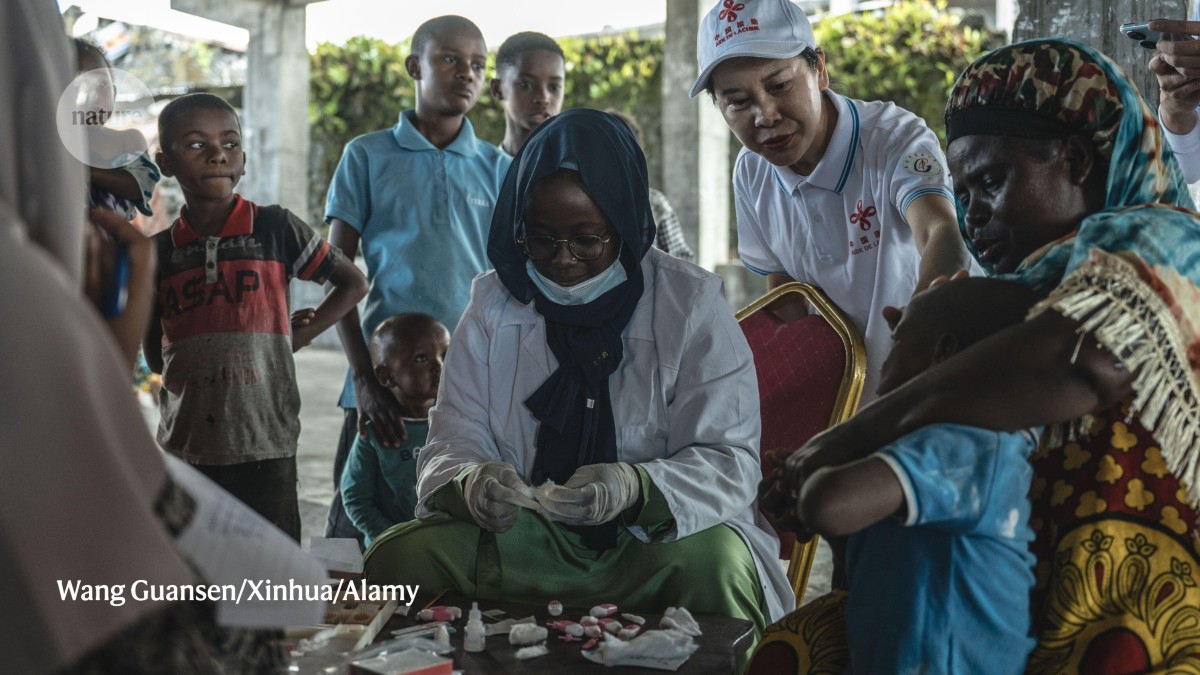
Another approach that China has implemented in Africa is mass drug administration, which involves providing a full course of antimalarial treatment to all eligible members of a community at the same time, regardless of whether they show signs of infection. Early success was achieved in Comoros, an archipelagic country off the east coast of Africa, following the widespread administration of artemisinin-piperaquine, a Chinese-made malaria treatment, in 20077. Cases have rebounded since, however, and Chinese medical teams are still being sent to the island to support local health services.

A Chinese doctor performs acupuncture on a patient at a clinic in Antananarivo, Madagascar.Credit: Imago/Alamy
Beyond malaria, China is collaborating with Africa to showcase and explore alternative approaches to health management, including traditional Chinese medicine. This is seen as an opportunity to demonstrate how “China has unique technology that has advantages over Western medicine”, says Bouey. Acupuncture, for example, is increasingly popular among African patients. Jia Fan, an acupuncture researcher at the University of Cape Town in South Africa, works with Chinese colleagues to study combined physiotherapy and acupuncture for stroke patients. Strokes are the leading cause of death in China, and rates are rising in South Africa. Preliminary results suggest that a combined approach could produce better outcomes than either treatment alone, Fan says.
Although China’s approach has been shifting towards working with African researchers on the ground rather than sending its own teams, certain challenges are slowing progress. Fan says data sharing between African and Chinese teams can be particularly troublesome. Chinese institutes require government approval before they can share information with African partners, he says — a process he describes as “quite strict” compared to the institutional-level sign-off that is more common in collaborations with the United States and Europe.
Cheng agrees that the Chinese government’s involvement in research partnerships has made things more difficult than when countries keep such arrangements strictly at the institutional level. “Chinese engagement is always done through official channels,” he says. Cheng adds that such engagement can come with explicit political requirements, such as recognizing Beijing’s position on Taiwan, and “unwritten rules” about procuring Chinese equipment and supporting China in United Nations votes.
Funding poses additional obstacles. According to Gao, most China–Africa projects begin with formal requests from African governments. “During high-level visits — like FOCAC summits or bilateral state meetings — African leaders often present ‘wish lists’ of priority sectors” for investment, he says.

