


You have full access to this article via your institution.
Hello Nature readers, would you like to get this Briefing in your inbox free every day? Sign up here.

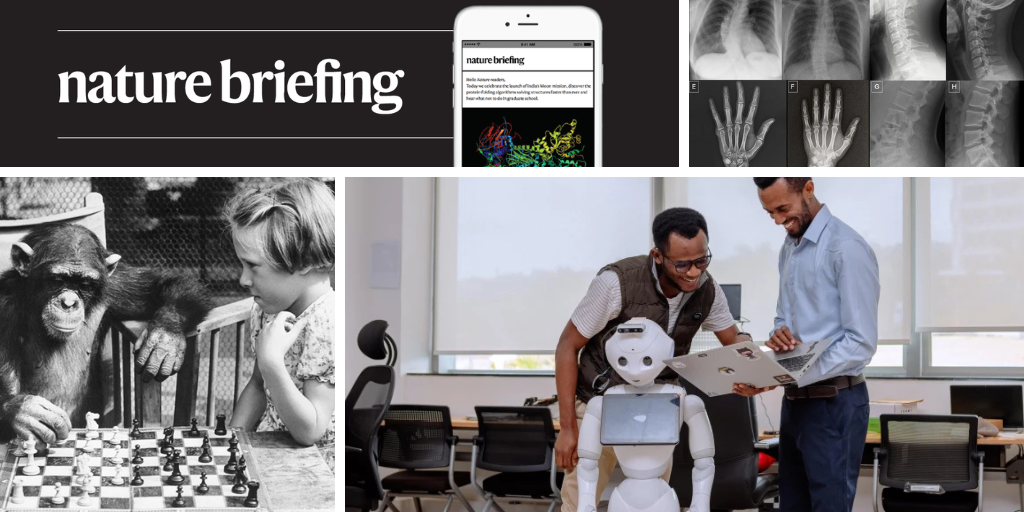
Real X-ray images of different body parts are on the left, AI-generated X-rays are on the right. Can you spot the difference?Credit: Radiological Society of North America (RSNA)
Radiologists and large language models (LLMs) both struggle to discern real X-ray scans from those generated by artificial intelligence. In a study that asked 17 radiologists about the technical quality of a series of X-ray images, only 41% raised concerns that AI scans had infiltrated the data. When asked to identify fake images, LLMs such as ChatGPT were only 57–85% accurate. These AI‑generated images could pollute the scientific literature or compromise insurance claims, says radiologist and study co-author Mickael Tordjman. Such images could also creep into the training data of AI models being used to read medical imaging data, distorting their output.
DNA from the remains of ten Neanderthals, including 17 tiny bones from a fetus, have revealed the genetic bottleneck that might have contributed to the downfall of the species. The DNA shows that the population shrunk about 65,000 years ago, when most Neanderthals sheltered in a relatively ice-free ‘glacial refugium’ in what is now southwestern France. Those who later spread out across Europe emerged from that genetically similar group. Their homogeneity might have been a fatal weakness when later climatic changes and other factors drove the species to extinction around 40,000 years ago, researchers suggest.
National Geographic | 7 min read
Eco-hydrologist Emily Fairfax traded muddy fieldwork for the red carpet at the premier of Hoppers, an animated kids’ movie about beavers. As the film’s scientific advisor, Fairfax did not let any clangers slide: her notes about how the animals sit (on top of their tails) and the colour of their teeth (definitely not pearly white) strongly influenced the film. She’s even got a cartoon cameo as a biology professor. “Honestly, it’s surreal,” she says. “Sometimes I’m sitting here and I’m like, ‘Well, none of that could have possibly been real. Back to my everyday life.’”
Image of the week

Robotics and AI engineer Birhanu Shimelis Girma (right) works with a colleague on programming a humanoid robot called Pepper, in the robotics lab at Carnegie Mellon University Africa in Kigali, Rwanda. Girma contributes to a project called Culturally Sensitive Social Robotics for Africa, which aims to develop programming that understands local gestures, greetings and cultural norms. In Rwanda, for example, Girma says that pointing at someone with an index finger is considered to be disrespectful. (Nature Africa | 5 min read)
Read more about advances like this in Nature Briefing: AI & Robotics — our free fortnightly newsletter. (CMU-Africa)
Features & opinion
In Animate, science writer Michael Bond explores how human relationships with other animals have changed over time. The relatively modern belief that humans are set apart from animals — partly by the possession of a soul — helped people to ease anxieties about our mortality, and legitimize the widespread use of animals for labour, warfare and entertainment, Bond argues. His mix of storytelling, case studies and research shows how long-standing cultural assumptions “are beginning to shift towards a more inclusive and less human-centric world view”, writes social psychologist Brock Bastian in his review.
As the volume, processing speed and variety of data continue to grow, the storage capacity is struggling to keep pace. “This is a problem that libraries have been dealing with for as long as libraries have existed,” says librarian Kristin Briney. “There has to be some curation that determines what is worth keeping and what is worth throwing away.” For example, the Wellcome Sanger Institute — which holds some 90 petabytes in its DNA database — has purged almost all of the data for which it doesn’t have sufficient metadata.
The first ever ‘ransomware’ — a type of computer virus that demands payment from the victim — was handed out on floppy discs at a 1989 HIV-research conference by an evolutionary biologist named Joseph Popp. Today, ever-more-sophisticated scams have brought storied institutions such as the British Library, which is still recovering from a 2023 attack, to their knees. In We Know You Can Pay a Million, political economist Anja Shortland warns that we are “mostly blind or indifferent” to “a previously unimaginable level of catastrophic risk”.
Today I’m excited about what my colleague Elizabeth Gibney calls “the most boring spectacular thing ever”: the first time scientists have transported antimatter. From the outside, a rather innocuous truck on a half-hour jaunt around the roads around CERN in Geneva, Switzerland. But inside, a historic technological marvel: 92 antiprotons, enclosed in a specially designed bottle that traps them using superconducting magnets. Not only that, the bottle was cooled to a chilly 4 kelvin (−269 °C) and kept in a strict vacuum to stop antimatter meeting any stray matter particles and annihilating on the way. What a beautiful example showing that “it’s what’s inside that counts”.
Please help me keep the contents of this newsletter in perfect balance by sending us your feedback! Your e-mails are always welcome at [email protected].
Thanks for reading,
Flora Graham, senior editor, Nature Briefing
With contributions by Jacob Smith and Nicola Jones
• Nature Briefing: Careers — insights, advice and award-winning journalism to help you optimize your working life
• Nature Briefing: Microbiology — the most abundant living entities on our planet — microorganisms — and the role they play in health, the environment and food systems
• Nature Briefing: Anthropocene — climate change, biodiversity, sustainability and geoengineering
• Nature Briefing: AI & Robotics — 100% written by humans, of course
• Nature Briefing: Cancer — a weekly newsletter written with cancer researchers in mind
• Nature Briefing: Translational Research — covers biotechnology, drug discovery and pharma

