


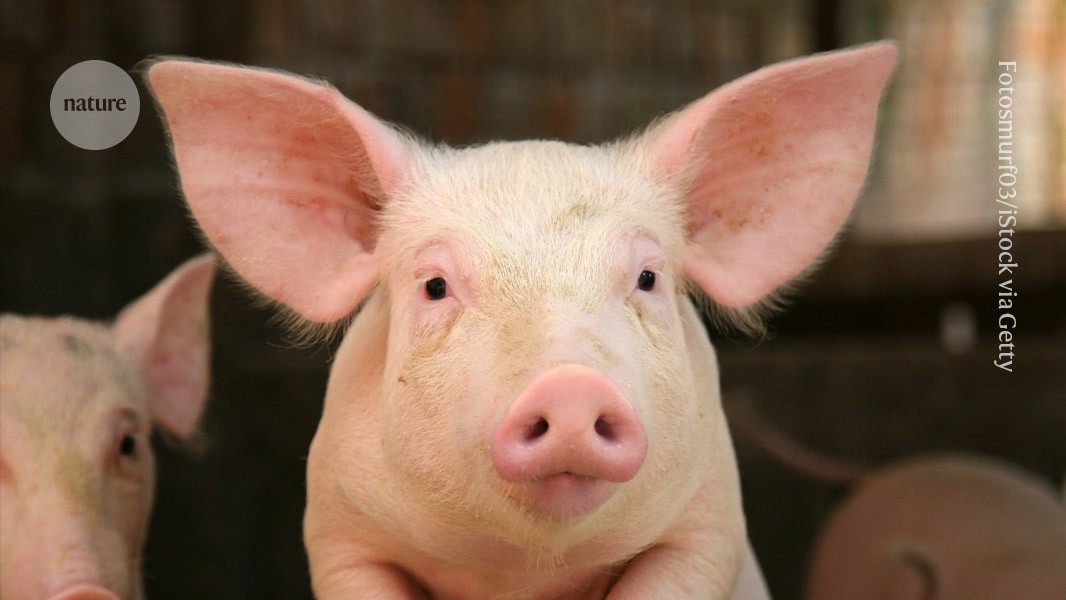

Pigs that received bioengineered oesophagi were able to swallow food normally.Credit: Fotosmurf03/iStock via Getty
Scientists have used stem cells to make bioengineered oesophagi that they successfully implanted into pigs, restoring the animals’ ability to swallow and eat. Similar lab-grown structures could be used to treat people with cancer or other conditions affecting the muscular tube that connects the throat to the stomach, researchers say.
Paolo De Coppi, a paediatric surgeon and researcher at University College London, says his team has been investigating minimally invasive ways to treat children born with a large hole in their oesophagus, a condition called long-gap oesophageal atresia. The current treatment is to move the child’s stomach up to their neck and join it directly to the back of their throat, or to transplant part of their colon to bridge the gap.
De Coppi and his colleagues have previously grown grown mouse cells on a rat oesophagus and implanted them into mice, and have transplanted the pig-based scaffold into rabbits. The team’s latest work, published in Nature Biotechnology today1, involved transplanting sections of oesophagus that had been grown in the lab into pigs, which are better than rodents as a model for humans, because of their size and physiology.
The ability to generate an oesophagus with the necessary components that also functions normally is impressive, says Andrew Barbour, an academic surgeon at the Frazer Institute of the University of Queensland in Brisbane, Australia. The grafts developed some scar tissue — which causes issues with swallowing — but this reduced over time, which is also promising, he adds.
Transplant option
To grow oesophagi in the lab, De Coppi and his colleagues started with small samples of muscle cells and connective tissue from the recipient pigs and used them to make two kinds of stem cell, which can be turned into other types of cell. They also took the oesophagi from 16 other young pigs and removed the original cells to create oesophagus scaffolds. The team injected each scaffold with the recipient pig’s stem cells. Over two months, the cells grew across the scaffold to create a graft. The researchers used 10-kilogram minipigs, in part to approximate the size of the children who could one day be treated with the method.
The surgeons then removed 2.5-centimetre segments of oesophagus from the eight recipient pigs, and replaced them with segments of the oesophagus scaffolds. These were covered with a biodegradable mesh tube to help blood vessels develop.
Five of the pigs survived for the whole six-month study period; they showed functioning muscle, nerves and blood vessels, the team notes, and were able to swallow. The remaining three pigs were killed early for humane reasons.

