


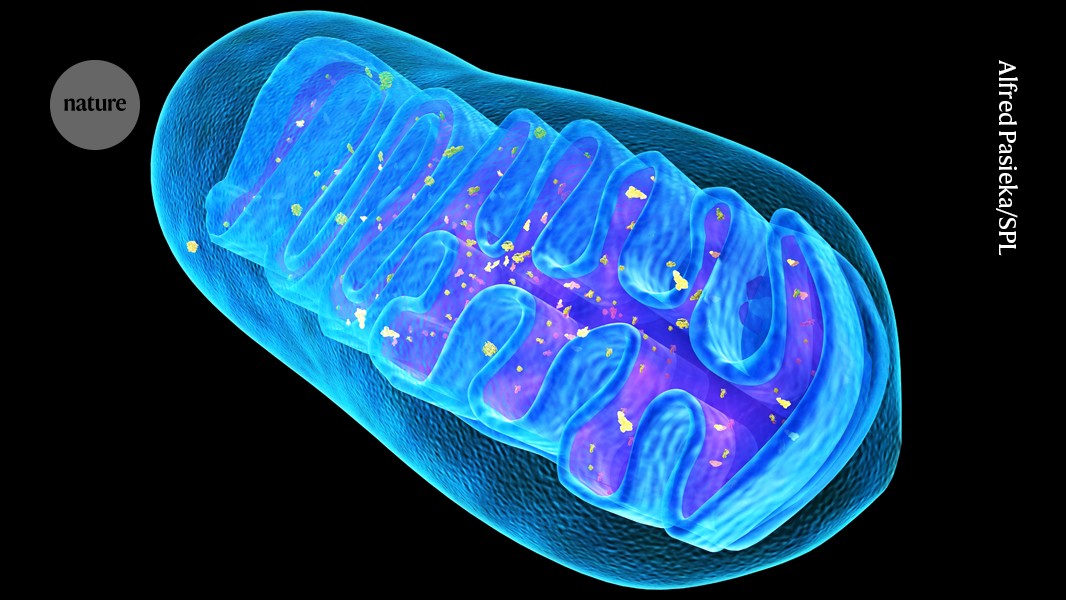

Mitochondria (artist’s impression) wrapped in red-blood-cell membranes can sneak into cells without being tagged for destruction.Credit: Alfred Pasieka/SPL
A well-fitted ‘disguise’ allows transplanted mitochondria to slip into cells whose own mitochondria are defective, scientists reported 18 March in Cell1. Administration of these cloaked mitochondria prolonged the life of mice with a deadly disease caused by abnormal mitochondria.
The scientists found that a mitochondrion wrapped in the membrane of a red blood cell can enter a cell without triggering protective mechanisms that would typically destroy the organelle. The technique “hugely” increased the efficiency of the treatment compared with previous methods, says Mike Devine, a neurobiologist at the Francis Crick Institute in London, who was not involved in the study. The difference is like “night and day”, he says.
But scientists also expressed scepticism about some aspects of the study. The work is a “remarkable advance”, but the conclusion that the method prevents Parkinson’s disease in a mouse model is “overstated,” says Ken Nakamura, a neuroscientist at the Gladstone Institutes in San Francisco, California.
Targeted for destruction
Mitochondria are cellular substructures that produce fuel to power cellular activity. They have their own genomes, and mutations in their DNA cause diseases such as Leigh syndrome, a rare and often fatal disorder that usually strikes during early childhood.
Cancer cells get power boost by stealing mitochondria from nerves
Scientists have long sought ways to transplant normal mitochondria into cells. But when mitochondria are exposed to tissue or blood, they lose the electrical gradient across their outer membrane. Mitochondria that lack such a gradient are recognized by a cell’s internal machinery as damaged and quickly destroyed2.
The vast majority of previous studies involved injecting “naked” mitochondria directly into the bloodstream or tissue sites, says Noa Sher, chief scientific officer at Minovia Therapeutics in Haifa, Israel. But the approach isn’t very efficient, so researchers often have to use “ridiculous” doses of mitochondria that would be infeasible when scaled to a human-sized organism. “It is immediately obvious that you should protect the mitochondria if they’re going to be outside of the cell,” Sher says. “What to put them in is more complicated.”
Shrink-wrapped
The authors of the Cell study settled on using the membranes of red blood cells because the cells lack organelles with their own membranes. Creating the mitochondrial ‘capsules’ was then as simple as mixing ruptured red blood cells and mitochondria isolated using a commercially available kit. The scientists then injected these ‘capsules’ into mice.
The “shell” preserves the mitochondrion’s electrical gradient, says co-author Qi Long, a biologist at Guangzhou Medical University in China. That allowed the organelles to slip into recipient cells undetected.

A ‘capsule’ of mitochondria (central dark circle) is enclosed by a red blood cell’s membrane (outer dark oval).Credit: S. Du et al./Cell
Using previous methods, less than 5% of cells growing in laboratory dishes absorbed the mitochondria, says co-author Xingguo Liu, a biologist at the Guangzhou Institutes of Biomedicine and Health in China. “Our efficiency is super high,” he says. “It’s around 80%.”
In a mouse model of Leigh syndrome, capsules of mitochondria increased survival of the mice by about two weeks. That’s about 20% longer than mice treated with free-floating mitochondria.

