


Clinical samples
High-grade dysplasia, squamous cell carcinoma and macroscopically normal, healthy clinical samples, as well as the corresponding clinical information, were collected following research ethics approval and individual informed consent from patients who underwent oesophagectomy for oesophageal cancer.
The T1A and T1B stage chemo-naive surgical tumour samples were donated by patients who had undergone surgery at the Clinic for Visceral, Thoracic and Vascular Surgery at TU Dresden or at the Medical Department I of the Carl Gustav Carus University Hospital. Macroscopically normal samples adjacent to the proximal resection margin were sampled from cancer resection specimens. The corresponding formalin-fixed, paraffin-embedded material (tumour and healthy tissue) from a total of ten characterized oesophageal squamous cell carcinomas was selected from the archive of the Institute of Pathology of the University Hospital Carl Gustav Carus (EK 59032007) by the Tumour and Normal Tissue Bank (TNTB) Dresden. Studies presented in the manuscript involving early chemo-naive human oesophageal tumour samples from Dresden were approved by the Ethics Committee of TU Dresden, Germany (ref. SR+BO-ff (Mono)-EK-161042025). Studies presenting chemo-naive or post-chemo human oesophageal tumour samples from Guy’s and St Thomas’ (London) and Addenbrooke’s Hospital (Cambridge, UK), respectively, were approved by the East of Scotland Research Ethics approval committee (REC 18/ES/133). Histological sectioning of the tissue samples and haematoxylin and eosin staining of reference slide series for determining the tumour cell content of the individual patient samples were done at the Institute of Pathology, University Hospital CGC Dresden, TU Dresden.
Mice strains
All animal experiments were approved by the local ethical review committees of the University of Cambridge and conducted according to the Home Office project licences PPL70/8866 and PP7037913 of the Cambridge Stem Cell Institute, University of Cambridge.
Unless otherwise specified, C57BL/6J mice (Charles River, strain code 632) were used. Other mouse strains used include: cell-cycle reporter line R26Fucci2aR (Fucci2a)60, provided by I. J. Jackson; PdgfraEGFP (007669, Jackson Laboratory); Sox9flox/flox (ref. 61; MRC-Harwell, on behalf of the European Mouse Mutant Archive; https://www.infrafrontier.eu); K14CreER (005107, Jackson laboratory); R26mT−mG (mTmG, Jackson Laboratory); Col1a2CreER (029567, Jackson Laboratory); R26FlConfetti (ref. 62; 017492, Jackson laboratory, provided by H. Clevers)62; R26nT−nG (nTnG; 023537, Jackson Laboratory); H2B-EGFP (CAG::H2B-EGFP; 006069, Jackson Laboratory); NOD-SCID-γ (NOD.Cg-Prkdcscid Il2rgtm1Wjl/SzJ; 005557, Jackson Laboratory); and PdgfraCreER (018280, Jackson Laboratory)63. Further information about the experimental mouse lines can be found in the Supplementary Methods section Experimental mouse lines.
Recombination of Col1a2CreERR26FlConfetti/WT mice was induced by a single intraperitoneal tamoxifen injection (3 mg per 20 g body weight). The Col1a2CreERR26FlConfetti/WT mice were induced by a single intraperitoneal tamoxifen injection (0.5 mg or 5.0 mg per 20 g body weight). The K14CreERSox9flox/flox received two subcutaneous tamoxifen injections (5 mg per 20 g body weight) 48 h apart. Tamoxifen was prepared by dissolving in ethanol (less than 10% total volume) and diluting in sunflower-seed oil.
All strains were maintained in a C57BL/6 background. All experiments used a mixture of male and female mice with no gender-specific differences observed (unless specified otherwise). For RNA-sequencing experiments, only male animals were used to avoid confounding effects from the oestrous cycle. All animals exposed to the carcinogen and their respective controls were adults between 8 and 14 weeks of age (see the section on chemically induced mutagenesis below). Mice were bred and maintained under specific-pathogen-free conditions at the Gurdon Institute and the Anne McLaren Building, University of Cambridge. All animals were housed at 20–24 °C, 45–65% humidity and a 12 h:12 h light:dark cycle.
Chemical tumorigenesis model
Mice were treated with DEN (Sigma-Aldrich; N0756) at 40 mg l−1 in Ribena-flavoured water for 24 h, three times a week (Monday, Wednesday and Friday) for 8 weeks1,21. Mice received sweetened water between DEN dosages and normal water after the completion of DEN treatment. Control mice received sweetened water as a vehicle control for the length of the treatment. Animals exposed to DEN were monitored for adverse effects as stated in our Home Office project licences (PPL70/8866 and PP7037913) for regulated procedures on protected animals. In summary, animals were weighed daily on weekdays for the first week, weekly for the next month and then monthly thereafter. Animals were also checked every day for any clinical signs or abnormal behaviour. Any concerning animals were weighed every other day or daily, if necessary, until the weight was stable again. If the weight loss approached 10%, animals were weighed daily until stable and received wet mash or palatable diet. Animals showing 15% weight loss measured for 2 consecutive days were killed immediately.
EdU tracing
For EdU labelling experiments, mice received 100 µg EdU in PBS (Life Technologies, A10044) intraperitoneally 2 h before tissue collection. In vitro 3D cultures (see above) received media supplemented with 10 µM EdU and were incubated for 2 h at 37 °C and 5% CO2 before fixation. EdU incorporation in tissue whole-mounts (see above) was detected using a Click-iT EdU kit according to the manufacturer’s instructions (Invitrogen, C10337). EdU+ cells were quantified using confocal microscopy.
Inhibitor treatment in vivo
Mice were treated with Gefitinib for 20 days at 80 mg per kg body weight (or vehicle control) three times a week to inhibit the EGFR pathway. Treatment started 10 days before the end of DEN treatment and ended 10 days after it. Gefitinib was prepared in concentrated form by dissolving it in DMSO and was diluted in corn oil.
Pharmacological inhibition of FN1 fibrillogenesis was achieved by treating mice with functional upstream domain (FUD) peptide64 intraperitoneally for 20 days at a concentration of 12.5 mg per kg body weight. Control mice were treated with scrambled (SCR) control peptide. Treatment started 10 days before the end of DEN treatment and ended 10 days after it. Peptides were synthesized at more than 95% purity (WatsonBio; peptide sequence below). Lyophilized peptides were reconstituted in PBS.
The peptide sequences were:
FUD, – Cys-GSKDQSPLAGESGETEYITEVYGNQQNPVDIDKKLPNETGFSGNMVETEDTKLN;
SCR, – Cys-QGQTGPVNSKVKIDNYELESNPEKIEANDLQVEGTTTYESKFMGDLTGSGNPED.
Whole-mount preparation
The upper gastrointestinal tract (oesophagus and forestomach) from control and DEN-treated mice was dissected at the time points indicated in the main text and/or figure legends. Oesophagi were excised and cut open longitudinally. The muscle layer was then removed and the tissue was flattened under a dissecting microscope using fine forceps. Stomachs were cut open longitudinally and rinsed twice with PBS to remove any food remains. The glandular stomach was excised away and the forestomach kept and flattened for downstream analysis. For epithelial-only and stromal-only whole-mounts, tissues were incubated in 5 mM ethylene-diamine-tetraacetic acid (EDTA) (Life Technologies, 15575020) in PBS for 3 h at 37 °C. After incubation, the epithelium was gently peeled from the stroma using fine forceps. Subsequently, each of these layers was flattened individually.
Oesophageal and forestomach whole-mounts (either peeled or unpeeled) were fixed in 4% paraformaldehyde (Alfa Aesar, 043368) in PBS for 30 min at room temperature.
Histology
For histology, tissues were fixed in 10% formalin in PBS overnight at room temperature before storage at 4 °C in absolute ethanol. Haematoxylin and eosin staining was done in 7-μm paraffin-embedded sections by the Histology Core Service at the Cambridge Stem Cell Institute and imaged using a Zeiss AxioScan Z1 microscope. Histological analysis of murine tumour samples was done by B. Mahler-Araujo at the MRC Metabolic Diseases Unit (MC_UU_00014/5).
Ex vivo tissue recombination assay
Under a dissecting microscope in a laminar flow hood, oesophagi were dissected and epithelial–stromal layers isolated as described above in the section ‘Whole-mount preparation’. Thereafter, tissues were rinsed in 1% P/S in PBS three times to remove residual EDTA and flattened. Combinations of epithelium and stroma from different experimental conditions (DEN treated and/or control) were prepared by carefully placing the epithelial layer over the relevant stroma (referred to as ‘tissue recombination’ composites). The remaining epithelium was trimmed to match the size of the stroma, and the resulting construct was cut in half. Flattened epithelium–stromal constructs were cultured in six-well plate inserts (ThinCert Greiner Bio-One, 657641). Size-matched polydimethylsiloxane (PDMS) stencil frames were placed around the tissue construct to prevent cell expansion (see the ‘Stencil production’ section below). The tissue was allowed to settle for 10 min before adding 2 ml of minimal medium (mFAD) containing one-part DMEM (Fisher Scientific, 41966029) and one-part DMEM/F12 (Fisher Scientific, 11320033) supplemented with 5 μg ml−1 insulin (Sigma-Aldrich, 15500), 5% fetal calf serum (Fisher Scientific, 26140079), 1% P/S and 5 µg ml−1 Apo-Transferrin (Sigma-Aldrich, T2036), as previously described24,65. The 3D heterotypic cultures were maintained in standard humidified cell-culture incubators at 37 °C with 5% CO2 for up to 7 days. At the end point, samples were fixed in 4% PFA in PBS for 30 min at room temperature and stored for downstream confocal analysis.
Stencil production
Silicone elastomer (PDMS) was mixed with a curing agent (Avantor VWR; Sylgard 184 Elastomer Kit, 634165S) at a 10:1 ratio and centrifuged at 300g for 10 min to remove the bubbles. The resulting mix was poured on a dish at around 70 mg cm−2 and left on an even surface to polymerize overnight at 37 °C. The next day, the resulting polymer was cut into 2 × 5 mm rectangle-shaped frames, sterilized in 70% ethanol overnight, and treated with 1% pluronic acid (Sigma-Aldrich, P2443-250g) in PBS for 1 h at 37 °C. The frames were then left to air dry before use.
In vivo tissue recombination grafting
Tissue recombination composites (as described above in the section ‘Ex vivo tissue recombination assay’) of DEN-treated oesophageal stroma and untreated (control) oesophageal epithelium were prepared for in vivo grafting adapting the strategy described above. Before separating the epithelium from the stroma, all visible tumours were marked with a partial incision using a punch biopsy tool (1 mm diameter; Merck, WHAWB100040). After separating the tissue layers, all the stromal compartments were assessed for peeling efficiency under a fluorescence dissecting microscope (Leica M165 FC), and any remaining epithelium, identified by the dense epithelial nuclei clusters, were excised from the tissue using a 1 mm biopsy punch. For heterotypic tissue constructs, 2 mm biopsies (Selles Medical, instrument BP20F) of tumour or control stroma were excised and a 2 mm healthy untreated epithelium biopsy placed above. Composites were cultured overnight as described above and grafted in the back skin of anaesthetized shaved NSG female mice (two constructs per incision, and two incisions per animal). Longitudinal incisions for grafting were approximately 5 mm in length. The wounds were closed with GLUture glue (Fisher Scientific, NC0632797) and the mice were left to recover. Then, 3–6 months later, the mice were killed and the back skin fixed with 4% PFA in PBS for 30 min at room temperature and stored for downstream confocal analysis.
Primary mouse fibroblast isolation and migration assay
Oesophagi were dissected as described above and cut in half. Tissue was incubated in 0.5 mg ml−1 Dispase (Sigma-Aldrich, D4818) for 10 min at 37 °C while rotating. After incubation, the epithelium was peeled away and the stroma was minced finely and incubated in Trypsin-EDTA (0.25%) (ThermoFisher, 25200056) for 15 min at 37 °C while rotating. The resulting suspension was mixed by pipetting and DMEM supplemented with 10% FBS and 1% P/S was added (1:1 v/v). The suspension was passed through a 70 µm filter (PluriSelect, 43-10070-40) and cells were pelleted by centrifugation at 300g for 5 min at 4 °C. Pellets were resuspended in 0.5% FBS, 1% P/S in DMEM, and seeded on 8.0 µm pore transwell insert (24-well plates; ThinCert Greiner Bio-One, 662638). The lower compartment of the transwell contained 1% P/S DMEM supplemented either with 0.5% FBS, 2% FBS, 10% FBS or 2% FBS with 1 µg ml−1 Amphiregulin (AREG) (R&D, 989-AR-100/CF). Primary fibroblasts were cultured for 48 h before fixation in 4% PFA in PBS for 10 min. Membranes were incubated with 1 µg ml−1 DAPI (Sigma-Aldrich, D9542) in PBS for 30 min at room temperature, cut and mounted in 1.52 Rapiclear mounting medium (SUNJin Lab, RC152001) keeping their original orientation, followed by confocal analysis. Further information on quantification can be found in the Supplementary Methods section ‘Analysis of fibroblast migration assay’.
Keratinocyte cultures and fibronectin treatment in vitro
Oesophagi were cultured using the 3D epithelioid organ culture approach65. In brief, tissues were dissected, cut into 3 × 5 mm rectangles and placed on a transwell insert with the epithelium side up. The tissue was left to settle for about 5 min. Explants were expanded in complete medium (cFAD) containing mFAD supplemented with 1 × 10⁻¹⁰ M cholera toxin (Sigma-Aldrich, C8052), 10 ng ml−1 EGF (Fisher Scientific PeproTech, AF-100-15), 0.5 μg ml−1 hydrocortisone (Calbiochem, 386698). Tissue explants were removed by aspiration 5 days after culture set-up and maintained in mFAD for 2 weeks to confluence. Soluble fibronectin (Fisher Scientific Corning, 356008) was added to the medium for 24 h at 100 μg ml−1 after diluting it in mFAD with 25 mM HEPES (Fisher Scientific, 15630056). Samples were fixed with 4% PFA in PBS for 30 min at room temperature, after a 2 h EdU chase, and kept for downstream confocal analysis.
Keratinocyte and fibroblast interaction assay
Epithelioids were set up as described above and maintained in mFAD until keratinocyte migration started. The original tissue was then removed and the explant left overnight before adding freshly isolated oesophageal fibroblasts (as described above). DMSO as vehicle control or 2 µM of Gefitinib prepared in DMSO were added together with the fibroblast suspension. Then, 3 days after the fibroblasts were introduced to culture, samples were fixed with 4% PFA in PBS for 30 min at room temperature and kept for downstream confocal analysis.
Immunostaining
After fixation, epithelial–stromal composites or human tissue whole-mounts were incubated for 30 min in permeabilization buffer (PB1; 0.5% bovine serum albumin (VWR International, 126575-10), 0.25% fish-skin gelatin (Sigma-Aldrich, G7765), 1% Triton X-100 (Fisher Scientific, 10102913) in PBS), then blocked for 2 h in PB1 containing 10% donkey serum (DS) (Scientific Laboratory Supplies, D9663). Next, tissues were incubated with primary antibodies diluted in 10% DS in PB1 for 3 days at 4 °C followed by four washes of 30 min each with 0.2% Tween-20 (Promega UK, H5151) in PBS. Thereafter, tissues were incubated overnight with secondary antibodies diluted 1:500 in 10% DS in PB1 at room temperature. Unbound antibody was removed by four washes with 0.2% Tween-20 in PBS throughout the next day. Antibody details are provided in Supplementary Table 15. To stain cell nuclei, tissues were incubated with 1 µg ml−1 DAPI in PBS at 4 °C overnight. Afterwards, samples were rinsed three times in PBS and mounted in 1.52 RapiClear mounting media for imaging.
Immunolabelling of individual tissue layers (epithelium or stroma) or sections consisted of an incubation for 30 min in permeabilization buffer (PB2; 0.5% bovine serum albumin, 0.25% fish-skin gelatin, 0.5% Triton X-100 in PBS). Tissues were then blocked for 2 h in PB2 containing 10% DS. Next, samples were incubated overnight at room temperature with primary antibodies diluted in 10% DS in PB2 followed by three washes with 0.2% Tween-20 in PBS for 30 min each. Secondary antibodies were diluted 1:500 in 10% DS in PB2 and incubated with tissues overnight at 4 °C, after which unbound antibody was removed by three washes with 0.2% Tween-20 in PBS, and staining continued as above. Thick cryosections of fixed tissues embedded in optimal cutting temperature compound (OCT; Thermo Scientific, 12678646), cut with a thickness of 50 µm onto glass slides, were immunolabelled using the same protocol. Likewise, 7-μm paraffin-embedded sections were immunolabelled according to the protocol described above, after antigen retrieval performed by heating of tissue sections in either 1 mM EDTA buffer (pH 8.0) or 10 mM sodium citrate buffer (pH 6.0) for 10 min at 95 °C.
When staining with primary antibodies raised in the same host, one of the antibodies was acquired as preconjugated with a fluorophore or conjugated in house following the manufacturer’s instructions (Invitrogen, A20186/A20187). The staining proceeded as described above with the unconjugated primary antibodies. After incubation with the corresponding secondary antibodies, the samples were blocked for 3 h at room temperature with 10% DS in PB with the IgG from the relevant host species (1:500). Afterwards, samples were incubated with conjugated antibodies diluted in PB containing 10% DS and the relevant host IgG (1:500) overnight at room temperature. At this point, staining proceeded as described above. Immunostained samples were analysed by confocal imaging.
Confocal imaging
Confocal images were acquired using either an inverted Leica SP5 microscope with standard laser configuration or a Stellaris 8 FALCON FLIM microscope with a white-light laser using LAS X 4.7.0.28176 or 3.5.5.19976 software. Typical confocal settings used included: bidirectional scanning, a 40× immersion objective lens, an optimal pinhole size (as defined by the software), a scan speed of 400–600 Hz with 2–3× line averaging, optimal Z-step size (as defined by the software) and a resolution of 512 × 512 or 1,024 × 1,024 pixels, unless stated otherwise. Then, sD reconstructions from optical sections and their corresponding image renders were generated using Volocity 5.5.5 (PerkinElmer) and Volocity 7 (Quorum), Zen 3.2 and Arivis 3.5.1. Further information about specific types of image analysis, such as second-harmonic generation imaging, can be found in the Supplementary Methods.
Transcriptomics
Library preparation and scRNA-seq
Sample preparation methods for libraries can be found in the Supplementary Methods in the section ‘Single-cell and RNA isolation for single-cell RNA-sequencing (scRNA-seq)’.
The scRNA-seq libraries were generated using the 10× Genomics Chromium Next GEM Single Cell 3′ Reagent Kit (v.3) and sequenced at the Genomics Core Facility of Cancer Research UK (CRUK), Cambridge Institute. Libraries were generated in two different batches. Information about library batches can be found in Supplementary Table 2. Control samples were included in both batches to provide a reference to assess potential batch effects. The cells for each biological replicate were loaded into a 10× Chromium microfluidics chip channel to generate one library from each. In total, 17 libraries were sequenced on either an Illumina HiSeqx4000 or a NovaSeq6000 system using one SP, two S1 and two S2 flow cells. Note that, given the punch biopsy approach used, DEN samples could contain sporadic tumour cells from tumours not visible under the dissection microscope.
scRNA-seq preprocessing, dimensionality reduction and visualization
The raw scRNA-seq data were processed with CellRanger (v.7.0.1). Reads were aligned to the mouse reference genome (mm10 2020-A), empty droplets were filtered and unique molecular identifiers were counted to generate gene-expression matrices. Doublets were identified using Scrublet66 (v.0.2.3) and removed, along with low-quality cells, on the basis of per-sample quality-control metrics (Supplementary Table 2); cells with more than 15% mitochondrial reads or genes expressed in fewer than three cells were excluded, resulting in 91,347 high-quality cells. Count matrices were processed using a standard Seurat workflow67 (v.5.0.3) up to dimensionality reduction. Data were integrated by tissue of origin (oesophagus or forestomach) using Harmony68 (v.1.2.3), and the integrated embeddings were projected in two dimensions using Seurat’s RunUMAP function. Further details on data clustering, annotation, and trajectory and communication analysis can be found in the Supplementary Methods and on the Alcolea lab’s GitHub page.
Low-input targeted DNA sequencing
Oesophagi from control and DEN-treated animals were dissected as described above. Tissues were flattened with the epithelial side up and visible tumour lesions were marked with a partial incision using a 1 mm diameter punch tool under a dissecting microscope. Tissues were then incubated in 5 mM EDTA for 3 h at 37 °C while rotating. After incubation, the epithelium was removed, the stroma was flattened and tissues were fixed as described above.
Immunofluorescent labelling against KRT14 was done as described above. Only tumour stroma footprints negative for KRT14 (lacking epithelial cells) were considered for DNA sequencing to avoid the identification of genetic mutations present in epithelial cells. Tumour stroma matching the criteria was dissected under a fluorescence dissecting microscope (Leica M165 FC) using a 1 mm punch biopsy tool. Punch biopsies of equivalent size were collected from untreated healthy tissues as a control. The DNA from individual biopsies was extracted using the Arcturus PicoPure DNA Extraction Kit (Fisher Scientific, KIT0103) following the manufacturer’s instructions. In brief, proteinase K was reconstituted in 155 µl and the sample was lysed in 20 µl at 65 °C overnight. Thereafter, proteinase K was inactivated by incubation at 95 °C for 10 min.
Samples were then sheared, libraries prepped using the NEBNext Ultra II Fragmentase System, and index tags applied (Sanger 168 tag set). Material was subjected to 12 PCR cycles (initial denaturation; 95 °C for 5 min; 12 cycles of 98 °C for 30 s; 65 °C for 30 s; 72 °C for 2 min; final elongation, 72 °C for 10 min) and quantified (Accuclear dsDNA Quantitation Solution, Biotium). Then, 500 ng of pooled material was taken forward for hybridization capture and enrichment (SureSelect Target enrichment system, Agilent Technologies) using a previously designed bait panel of 192 genes (Supplementary Table 9), including those commonly mutated in squamous cancers22. After clean-up, libraries were normalized to around 6 nM and submitted to cluster formation for sequencing on a Novaseq6000 (Illumina) to generate 100-base pair paired-end reads.
Aligned reads were mapped to the mouse GRCm38 reference genome using BWA-mem (v.0.7.17)69. Duplicate reads were marked using SAMtools70 (v.1.11). Depth of coverage was also calculated using SAMtools to exclude reads that were unmapped, not in the primary alignment, failed platform or vendor quality checks, or PCR or optical duplicates. Bedtools (v.2.23.0)71 was then used to calculate the depth of coverage per base across samples.
Variant calling was done using the deepSNV R package (also commonly referred to as ShearwaterML; v.1.21.3; https://github.com/gerstung-lab/deepSNV). Variants were annotated using VAGrENT. R v.3.3.0 was used7,72.
Mutations called by deepSNV ShearwaterML were filtered using the following criteria: first, positions of called single nucleotide variants (SNVs) have a coverage of at least 100 reads; second, germline variants called from the same individual are omitted from the list of called variants; third, adjustment for false discovery rate and mutations use support from at least one read from both strands for the mutations identified; and finally, pairs of SNVs on adjacent nucleotides in the same sample are merged into a dinucleotide variant if at least 90% of the mapped DNA reads containing at least one of the SNV pairs also contained the other one. DeepSNV ShearwaterML was run with a normal panel of approximately 12,000 reads.
Statistics and reproducibility
The numbers of biological replicates and animals are indicated in the figure legends (n refers to the number of independent replicates per time point and/or condition). A minimum of three independent mice or ex vivo cultures were used in all cases. All experiments were done independently at least three times with similar results, unless otherwise stated. The reproducibility of all key findings was confirmed in independent experiments conducted on different days and using independent biological samples. For image analysis, a minimum of three independent samples were inspected in all cases. All figures show representative images. The data are expressed as mean values ± s.e.m. unless otherwise indicated.
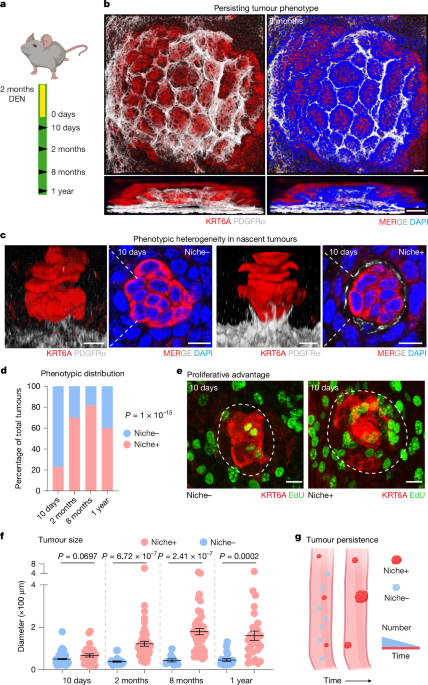
All statistical tests were done comparing biological replicates. Differences in tumour burden were assessed by one-tailed unpaired non-parametric Mann–Whitney U-tests. Differences between Niche− and Niche+ tumour distribution in ageing animals was assessed by one-sided chi-squared test. For large datasets, normality was assessed using a Kolmogorov–Smirnov test; for normally distributed data, differences between two groups were assessed by two-tailed Welch’s t-tests; for non-normally distributed data, a two-tailed Mann–Whitney U-test was used. Differences between more than two groups were calculated using either one-way Welch’s ANOVA, followed by a Dunnett’s T3 multiple-comparison test, or Kruskal–Wallis one-way ANOVA, followed by Dunn’s multiple-comparison test, for normally distributed or non-normally distributed data, respectively, unless specified otherwise. Exact P-values are indicated in the relevant figures with a precision of up to four decimal places. Statistical tests were conducted in GraphPad Prism (v.10.5.0) with 95% confidence intervals. No statistical method was used to predetermine sample size. The experiments were done without randomization. Blinding was done for tumour count per condition and in vitro sample analyses by confocal microscopy. In cases for which quantification was done in tumours and morphologically normal areas, blinding was not possible owing to differences in physical sample appearance.
Reporting summary
Further information on research design is available in the Nature Portfolio Reporting Summary linked to this article.

