


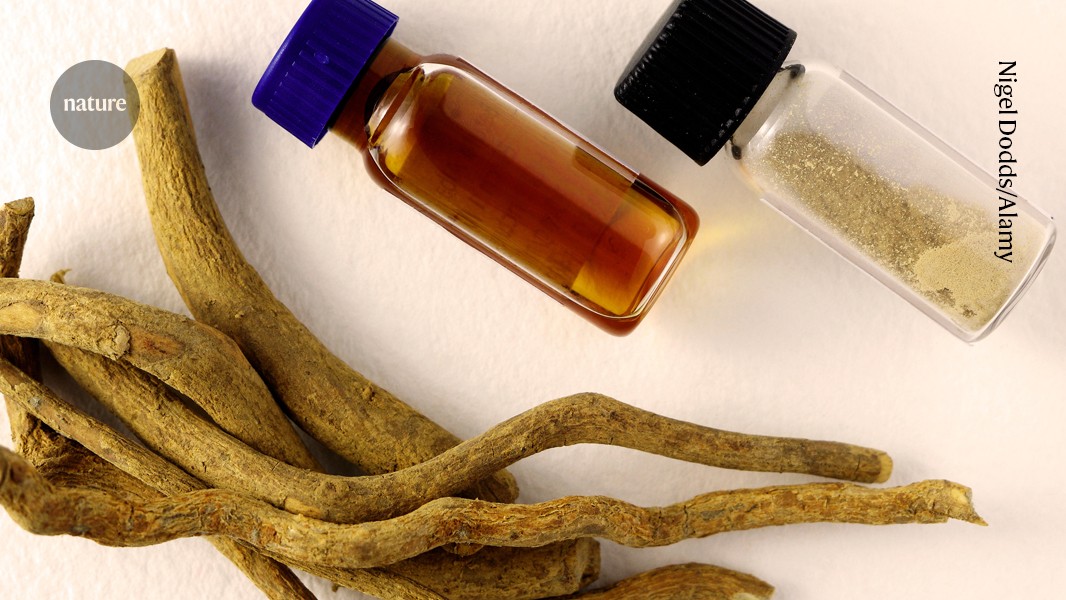
Ibogaine root (left), which has psychedlic properties, can be processesd into either a liquid or powder form. Credit: Nigel Dodds/Alamy
The potent and long-lasting psychedelic ibogaine is something of a scientific mystery, in part because it is one of the most tightly controlled drugs in the United States. But a new directive from US President Donald Trump aims to change that.
On 18 April, Trump signed an executive order to streamline research into ibogaine and other psychedelic compounds and to make it easier for people with certain illnesses to access these drugs. The move has been welcomed by researchers who see potential for the drugs in treating conditions such as addiction, depression and post-traumatic stress disorder (PTSD). Clinical trials have yielded some encouraging results for drugs such as MDMA, also known as ecstasy, and psilocybin, the hallucinogenic compound in magic mushrooms.
Australia to prescribe MDMA and psilocybin for PTSD and depression in world first
But scientists are also concerned about possible side effects, and the impact on health services if the drugs are approved. And the mention of only one compound by name in the executive order has surprised some researchers.
“It’s unusual to me that ibogaine has been called out specifically, given that it’s probably the furthest behind in the process compared to psilocybin and MDMA, which are much closer to approval,” says Alan Davis, a clinical psychologist at the Ohio State University in Columbus.
But scientists also say that the preliminary research on ibogaine has provided intriguing hints about its potential – while also providing cautionary evidence about its hazards. Trump’s orders could help to resolve questions about ibogaine and other psychedelics, they say.
The order is “going to make things easier to advance psychedelic therapies because it lowers barriers that have been slowing progress”, says Rachel Yehuda, a psychiatry specialist at the Icahn School of Medicine at Mount Sinai in New York City.
Strict regulation
Ibogaine, MDMA, psilocybin and other psychedelics are classified in the United States as ‘Schedule I’ substances, a designation that prohibits their distribution and possession except in extremely limited circumstances.
The executive order directs the US Food and Drug Administration to accelerate the review of psychedelic therapies for approval and to set up systems for “eligible patients” to try certain psychedelics, “including ibogaine compounds”. The order also mandates US$50 million in federal funding to match spending by state-level research programmes. A state programme in Texas, for example, seeks to facilitate ibogaine clinical trials.
Ibogaine is made from the bark of a shrub (Tabernanthe iboga) native to Central Africa, where it is used for ceremonial purposes. It produces an altered state of consciousness, often lasting for more than 24 hours.
Gül Dölen, a neuroscientist at the University of California, Berkeley, who has studied the drug, says that ibogaine might temporarily re-open a ‘critical period’ for a longer duration than other psychedelics. The critical period is the windows of time normally seen during early development in which the nervous system is particularly malleable. An extended window could offer people with entrenched conditions, such as severe drug addiction, the best opportunity to reset brain patterns, she says.
MDMA therapy for PTSD rejected by FDA panel
Because ibogaine is tightly restricted in the United States, much of the existing data on its effects come from observational studies of people seeking unregulated treatment abroad. Such studies typically don’t include a control group. One such study, published in 2024 in Nature Medicine2, found that 30 military veterans with traumatic brain injury and post-traumatic stress disorder who took the drug showed reductions in depression, anxiety and disability one month after the treatment.

