


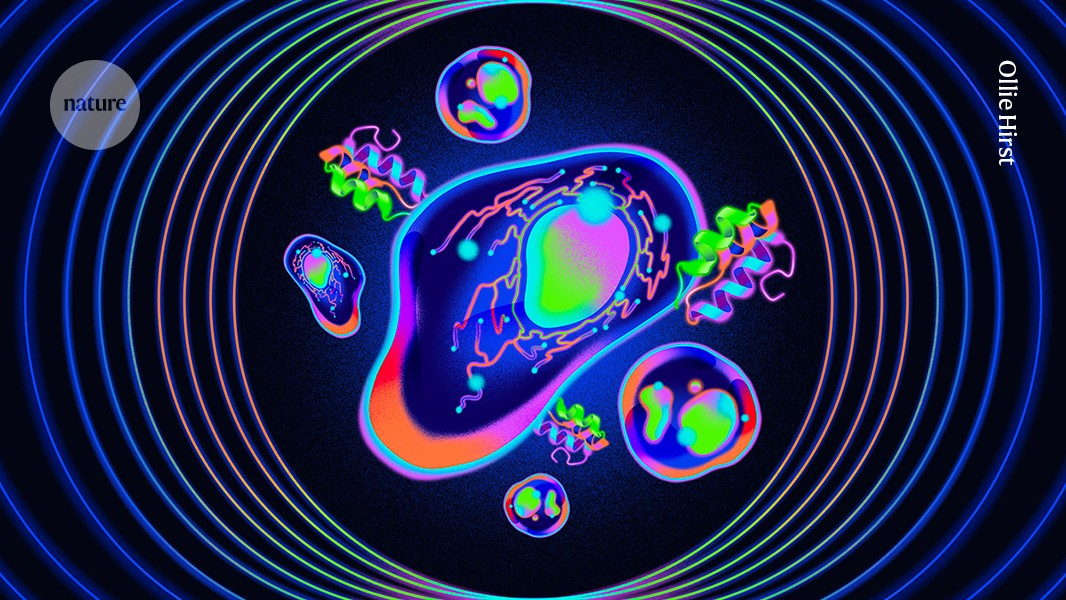
Crystal jellyfish have an eerie beauty: thanks to a natural protein, they emit a faint green glow. For decades, researchers have used that green fluorescent protein and similar molecules to light up the field of biology, tracking what’s happening inside cells.
Quantum computers will finally be useful: what’s behind the revolution
Now these ubiquitous tools are getting a glow-up: their quantum properties are being harnessed to make them similar to the fundamental bits of quantum computing. “These fluorescent proteins that everybody uses as a fluorescent label can actually be turned into a qubit,” says Peter Maurer, a quantum engineer at the University of Chicago in Illinois. The idea “sounds very science fiction”, says Maurer. But the physics isn’t new, and the approach has already been shown to work in principle.
Fluorescent-protein labels are currently one of the most important tools in biology laboratories around the world. They can monitor the location and activity of proteins, sense conditions inside a cell, check whether drug candidates are targeting the right spots and carry out a range of other tasks. But adding a quantum twist offers up fresh and exciting possibilities, say researchers.
Quantum sensors can detect magnetic fields and are exquisitely sensitive, so protein versions might be able to pick up the tiny signals made by firing neurons or flows of ions, or spot minuscule quantities of free radicals that hint at cellular stress or serve as early signs of cancer. And researchers can turn these protein-based quantum sensors on and off remotely, making them useful tools for new imaging technologies and therapies.
Protein labels keep surprising researchers with more capabilities, says Jin Zhang, who develops biosensors at the University of California, San Diego (UCSD). “We often struggle with the sensitivity of fluorescent labels,” she says, so she is intrigued by what as-yet-unimagined science the quantum variants might unleash. “I’m still trying to envision the new applications these might bring.”
The effort is part of a larger field of quantum sensing for biological applications, which observers say is hot and progressing fast. Although the development of protein quantum sensors is at an early stage, the researchers doing this work say that there’s not much standing in its way: some of the proteins that could be used in this way are off-the-shelf, and the equipment for manipulating them is standard fare.
“In the past, it might have seemed like, ‘ah, that’s likely never going to work’,” says Ania Jayich, a physicist at the University of California, Santa Barbara, who works on other types of quantum sensor. “That’s not true any more.”
Diamonds forever?
Quantum physics is currently going through a second revolution. During the first, in the early 1900s, physicists started to unravel the bizarre properties of the quantum world, such as superposition, whereby something exists in several states simultaneously, and entanglement, in which quantum states become mysteriously linked. Now, in the second revolution, researchers are intentionally manipulating individual quantum properties to open the door to information-dense, high-precision applications in computing, communications and sensing.
Quantum computing needs qubits — basic units of quantum information — that aren’t disturbed by the world around them. Quantum sensing, by contrast, relies on qubits that are influenced by external factors, in specific ways that can be measured. Magnetic resonance imaging (MRI), for example, creates an image by manipulating and measuring a quantum property known as spin in the body’s hydrogen nuclei. Superconducting quantum interference devices (SQUIDs) are used to detect magnetic fields in the brain during magnetoencephalography scans in hospitals.

Can quantum computing crack the biggest challenges in health?
One of the most widely used quantum sensors today is the ‘NV diamond centre’ — a defect in a diamond crystal in which one carbon atom has been replaced by a nitrogen (N) and a neighbouring carbon is absent, forming a vacancy (V). The spin states of electrons in this centre can be manipulated using microwaves and lasers, such that magnetic fields, temperature and other environmental factors affect the light that the electrons emit in precise and well-understood ways. These sensors are extremely sensitive, versatile and stable even at room temperature — unlike many qubit systems, which require extreme cold. Today, sheets of NV diamonds or nanoscale crystals are used in the lab and in some commercial products, mainly in the physical sciences — for example, to map the performance of semiconductors.
By comparison, bioscience applications have proved harder to develop, because living systems are “warm and messy”, says Jayich, whose lab focuses on NV diamonds.
But that field is picking up. It is one of a handful of focus areas at the Chicago Quantum Institute at the University of Chicago, for example, and was given a funding boost by the US National Science Foundation in 2023. And it is the sole focus of the UK Quantum Biomedical Sensing Research Hub, launched in December 2024. “We’re at a really exciting time with quantum technologies, where a lot of the lab demonstrations are reaching a point where they’re ready for applications,” says physicist John Morton at University College London, who is co-director of the research hub.
Research teams are investigating, for example, how to use NV diamonds to conduct nanoscale MRI1 or to improve tools used to track magnetic tracers during surgery2. And, by tweaking the exterior of the diamond crystals so that they bind to specific molecules in blood-plasma samples, researchers have developed experimental HIV tests that are 100,000 times as sensitive as standard diagnostics3.
Plenty of researchers are experimenting with putting diamond quantum sensors inside cells. Maurer says about half of his lab is investigating new uses for NV diamonds and will continue to do so.
But NV diamond sensors have limitations: they tend to be clunky, around ten times bigger than a protein, and are hard to place precisely where you want them. Fluorescent proteins, by contrast, are small and can be generated exactly where they are needed inside cells using genetic-engineering techniques, putting them right next to whatever researchers wish to investigate. “The gain you get from that is huge,” says Jayich.
Quantum glow up
Around a decade ago, David Awschalom, director of the Chicago Quantum Institute, and his colleagues started to wonder if they could find molecules that act as qubits. Such qubits, he hoped, could be produced reliably through chemistry instead of being carved out of diamond or semiconductors. In 2020, his team reported in Science4 that it could get a synthesized organometallic molecule to behave like a qubit, and his team soon did the same with other molecules.
That work led Awschalom to team up with Maurer, who had put his physics knowledge to work on biological imaging, in pursuit of biological molecules that might perform the same trick. “It was essentially the same type of idea, but now with a system that was comfortable going into cells,” says Awschalom.
They zeroed in on ‘enhanced yellow fluorescent protein’ (EYFP), an off-the-shelf product that had been enhanced by biologists for a bright yellow glow. From a physics perspective, this molecule has an electron energy structure that is similar to that of existing qubits, says Awschalom.

Tagging with green fluorescent protein makes the nerve cells in this brain tissue glow.Credit: C.J.Guerin PhD, MRC Toxicology Unit/Science Photo Library
Fluorescent proteins glow when their electrons are excited by laser light and then fall back to their relaxed energy state. Biologists typically insert the genetic instructions for the fluorescent-protein label next to the code for a protein of interest. Then, if the target protein is expressed, the label is expressed, too: shine a laser on the sample and it lights up like a Christmas tree. Variants have been developed with different colours. And protein engineers continue to develop versions that are useful sensors: their light can be affected by pH or mechanical forces inside cells, for example, or by the presence of calcium ions, which are crucial to cell signalling, or kinase enzymes involved in phosphorylation, an important on–off switch for protein activity. Fluorescent proteins with no quantum upgrade can’t, however, detect magnetic fields.
A small fraction of the time, the excited electrons in these fluorescent proteins shift into a metastable, non-fluorescent state called a triplet state (so-named for having three possible spin configurations). This causes the light to dim or blink. “People have known that that happens, and they hated it, because it makes your fluorescent beacon less bright,” says Maurer. For his purposes, this was an advantage, not an annoyance, because the triplet state enables the creation of a coherent superposition of spins — and that makes for a potentially useful quantum sensor. NV diamond quantum sensors also rely on a triplet state.
Awschalom says that, after some false starts, it was a relatively simple task to put the EYFP into the desired quantum superposition state using laser light and microwaves. Once the team understood the energy levels of the quantum states involved, he says, “literally the next day, it was working”. As hoped, the fluoresced light was affected by magnetic fields, varying in intensity by about 30%. The team showed that the quantum sensor worked in living bacterial cells at room temperature5.
There are still plenty of hurdles to overcome. One issue is that fluorescent proteins are generally fragile: they degrade over time as you shine light at them. Maurer says that might be fixable. His team is also trying to boost the proteins’ sensitivity. Biologists had previously developed fluorescent proteins that spend as little time as possible in the triplet state; Maurer says they’re now planning on doing the reverse — creating variants and selecting for those that spend more time in the triplet state. They will also work to see whether, like NV diamonds, these proteins can be used to detect changes in other conditions reliably, including pH and temperature.
The ability to detect electromagnetic fields directly is particularly exciting, says Nathan Shaner, a biological engineer at UCSD who develops fluorescent proteins. “Something that’s really difficult to make is a robust, sensitive indicator for the action potential you get when neurons fire,” he says, for example. “It’s a tiny change on a tiny scale.”

