


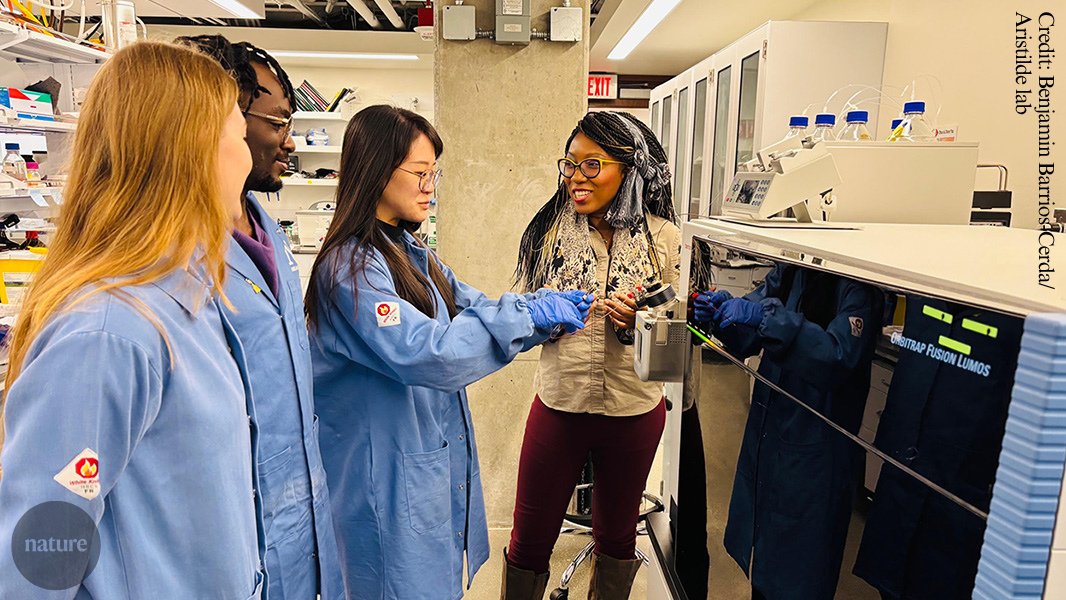

Environmental engineer Ludmilla Aristilde (right) and her colleagues work on developing biotechnology-led solutions to combat pollution.Credit: Benjamin Barrios-Cerda/Aristilde lab
Ludmilla Aristilde has always been aware of how closely tied well-being is to the world around us. Raised in Haiti, she and her family survived two cholera outbreaks stemming from contaminated water. “These were my earliest experiences of realizing that environmental pollution and human health are linked,” she says. “I was really young at the time, but I understood this was a serious thing.”
At 12 years old, she learnt that some environmental damage could be undone. On a school trip to the deforested mountains above Port-au-Prince, Aristilde and her classmates were taught about the impacts of erosion, and they helped to plant around 1,000 saplings in the bare earth overlooking the capital. “It showed us we can do something to reverse the environmental consequences of our actions,” Aristilde says.
Nature Spotlight: Synthetic biology
Now an environmental engineer at Northwestern University in Evanston, Illinois, Aristilde has dedicated her career to working out ways to mitigate environmental harm. She is part of a growing community of synthetic biologists using biotechnology-led solutions to tackle pollution ranging from microplastics and industrial waste to soils laced with heavy metals or explosive residues.
Scientists are doing this mainly with the help of microorganisms containing DNA that the researchers have tailored for a specific function. These engineered microbes not only offer hope for cleaning up the environment, but can also be used in circular industries — ones in which materials are kept in use for as long as possible instead of being discarded — to repurpose pollutants or recover resources from waste streams.
“Things are now feasible that were considered impossible a decade ago,” says Michael Köpke, a synthetic biologist and chief innovation officer at LanzaTech, a company headquartered in Skokie, Illinois, that transforms industrial waste and emissions into useful materials. “These technologies can help us as a society move towards a circular model, in which we use as much waste as possible for production of fuels, chemicals and materials.”
Although synthetic biology offers a potential solution for tackling some of the many pollutants that plague the planet, researchers say that the field is being held back from reaching its true potential by concerns around releasing genetically modified organisms into the environment, and a lack of government funding and incentives. Should these challenges be overcome, however, many specialists think that modified microbes could be key partners for helping humanity to clean up some of the mess it has made of Earth’s water, air and soil.
Microbes in the making
The idea of tinkering with microbes to address environmental problems is not new, says Víctor de Lorenzo, a molecular environmental microbiologist at the National Biotechnology Centre in Madrid. “In the late 1980s, there was this big hype about using engineered bacteria to address pollution, oil spills, you name it.”
However, technological roadblocks and societal pushbacks against the use of genetically modified organisms — mostly because of fears around their effects on health and the environment — caused early efforts to stall, says de Lorenzo. “Little by little, people interested in this field moved into other, more promising areas,” he adds. “The field came to a kind of standstill.”
In the early 2000s, advances in genetics and a growing awareness of the impacts of climate change and pollution sparked renewed interest in the use of microbes for bioremediation (cleaning polluted environments) and biomanufacturing (making useful products out of would-be pollutants). In the past decade, a “confluence of new techniques and approaches” has opened up many more possibilities for creating engineered microbes, says Hal Alper, a chemical engineer at the University of Texas at Austin. New synthetic-biology tools, he adds, have also made it possible to venture beyond Escherichia coli and the ‘baker’s yeast’ Saccharomyces cerevisiae — the microbial workhorses of the laboratory and the original subjects of synthetic biology — to organisms better suited to specific environments and metabolic tasks.

Environmental microbiologists Victor de Lorenzo (left) and David Rodriguez engineer bacteria to degrade toxic pollutants left behind by explosives.Credit: Centro Nacional de Biotecnologia
Synthetic biologists do not usually reinvent the wheel. Instead, they look in nature for microbes that are already capable of degrading or utilizing certain contaminants or complex carbon-rich waste products. “Some bacteria, through natural evolution, learn how to eat these compounds,” de Lorenzo says. Researchers study these naturally occurring organisms to understand the biochemistry underpinning their metabolism of waste, then use that knowledge to create organisms that do the job even better. “We want things to happen faster, more efficiently and at a larger scale than the bacteria do just for their own survival,” Aristilde says. “This is where synthetic biology steps in.”
Using tools such as high-resolution mass spectrometry, which identifies chemicals by measuring their molecular weight, Aristilde and other researchers can track the fate of specially labelled molecules when microbes consume and digest them. They study the enzymatic processes of those molecular meals, and where the bottlenecks occur. This gives them clues about how natural processes might be improved in the lab or be repurposed for new functionality, an approach called rational engineering.
Scientists can insert genes from one type of bacteria into another to give a species a desired set of traits, or they can synthesize genes or even entire bacterial genomes that are essential for a specific application, Köpke says. Technologies are still far from being able to produce perfectly optimized microbes, but artificial intelligence is accelerating progress towards that goal. Hongzhi Tang, a synthetic biologist and environmental microbiologist at Shanghai Jiao Tong University in China, says that researchers have not yet identified microbial genes or enzymes to degrade all pollutants. However, he adds, “AI will be very good for enzyme design, so I think we can solve this soon.”
Metabolic menagerie
Scientists are now working on establishing bioremediation techniques to tackle a range of challenges, including the treatment of waste water generated in food-manufacturing processes, and repurposing industrial waste gas. Köpke and his colleagues, for example, have spent the past 20 years developing carbon-eating microbes that transform carbon monoxide and carbon dioxide emitted from steel mills, oil refineries and agricultural waste into ethanol — which is then converted into aviation fuel and other useful materials. LanzaTech’s technology is now deployed at six commercial plants around the world, Köpke says, producing about 300,000 tonnes of ethanol each year and avoiding roughly half a million tonnes of CO2 emissions.
Other groups are focused on cleaning up contaminants that have already made their way into the environment. De Lorenzo’s lab, for example, is engineering bacteria that degrade nitroaromatic compounds, which are common components of explosives. “They’re super toxic and their chemical structure is very weird,” he says. If left in the environment, they degrade slowly and incompletely, often turning into other toxic intermediates. Plants, animals and microbes that come into contact with them might develop acute toxic effects, leading to long-term problems with biodiversity, nutrient cycling and overall ecosystem functioning.
Engineered solutions to get rid of them, de Lorenzo continues, “can make a qualitative difference”. In a study1 published in April, he and his colleagues focused on degradation of 2,4-dinitrotoluene (DNT), a side product of trinitrotoluene (TNT) that is often found in soil around former ammunition factories and in places where TNT has been detonated. De Lorenzo and his colleagues took genes from a type of bacteria that naturally degrades DNT and transferred them into Pseudomonas putida — a species commonly used in biotechnology. Although the original organism could use DNT to an extent, it did not completely eliminate the compound and became highly stressed while trying to digest it, de Lorenzo says. He and his colleagues allowed the engineered P. putida to evolve for nearly a year under conditions in which DNT was the only food source, which resulted in a unique bacterial strain with mutations that made it optimized for degrading DNT. Compared with the original strain, it degraded DNT “faster and without stress”, de Lorenzo says, and also completely removed the compound under experimental conditions. He hopes that microbes such as this will eventually ensure that vast tracts of land in Ukraine, the Middle East and elsewhere will not be laid waste by contamination.

Bacteria were engineered to digest the pollutant DNT. The lighter coloured wells indicate more DNT degradation.Credit: Centro Nacional de Biotecnologia
Plastic bioconversion, another innovative frontier, kicked off in 2016 when engineer Kazumi Hiraga at the Kyoto Institute of Technology in Japan and his colleagues found that Ideonella sakaiensis, a naturally occurring bacterium that they discovered on plastic waste near a recycling facility, had evolved enzymes that made it able to break down polyethylene terephthalate (PET)2. The finding suggested that researchers could use this natural discovery as a starting point for engineering microbes to recycle or clean up plastic waste more efficiently.
Some 16,000 substances are used in plastics, however, so organisms and enzymes that can break down one polymer will not necessarily work for another. Alper and his colleagues, for example, started by improving enzymes in bacteria that can digest PET, a relatively straightforward plastic to break down, before moving on to more complex ones. Alper says that the team has now achieved significant degradation of polyethylene and polypropylene — plastics that are harder than PET for microbes to metabolize because of the stability of their carbon bonds.
For some labs, the eventual goal is to increase the efficiency of engineered microbes by giving them the ability to tackle several pollutants at once. Last year, Tang and his colleagues described a marine bacterium they created with genetically engineered clusters of genes. The strain had the ability to break down five hydrocarbons: biphenyl, phenol, naphthalene, dibenzofuran and toluene3. Tests they ran on industrial waste water, seawater and contaminated saline solutions confirmed that the organism converted the pollutants into several naturally occurring compounds that wild bacteria could metabolize. Since the paper’s publication, Tang and his colleagues have created at least 50 more synthetic gene clusters designed to degrade various toxicants. They have successfully transferred ten of those clusters into a single bacterium, Tang says. “My aim is to create bacteria that can degrade all kinds of toxicants.”

