


You have full access to this article via your institution.
Hello Nature readers, would you like to get this Briefing in your inbox free every day? Sign up here.
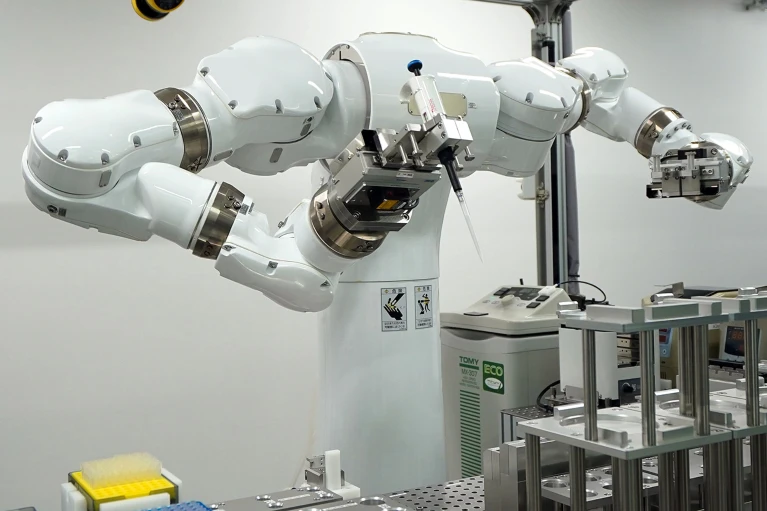
Laboratory robots with built-in artificial-intelligence software can look after stem-cell cultures independently.Credit: Masatoshi Okauchi/Shutterstock
In a biology laboratory in Tokyo, ten two-armed robots run the show. The robots can handle liquids, grow cells on plates and operate scientific instruments, among other basic tasks. The lab does still require some human input to function, but largely frees researchers up to focus on designing experiments and interpreting results. The ultimate goal is to create a “factory-scale” facility with thousands of robots that could be used by local and international scientists by 2040 or 2050, says automation researcher Genki Kanda.
Dwindling daylight hours in autumn usually prompt mosquitoes (Culex pipiens) to head to dark spaces such as caves, where they’ll hide out over the winter. But outdoor lights in urban areas can disrupt that timeline, which means that the insects stay active for longer. A delayed dormancy keeps the window open for longer for the mosquitoes to bite and transmit West Nile virus. It also leaves more time for the insects to reproduce, which could lead to a bigger population in the following spring.
Reference: Journal of Applied Ecology paper
A newly released artificial-intelligence tool called ESMFold2 has generated an atlas of 1.1 billion predicted protein structures and billions more protein sequences. The database, known as the ESM Atlas, vastly increases the known protein universe, eclipsing the AlphaFold Database of predicted protein structures by more than 800 million entries. The freely accessible atlas should be “an extraordinary resource for biology,” says computational biologist Gemma Atkinson. And the open-source nature of ESMFold2 means that it could find wide-ranging uses, says computational biologist Sergey Ovchinnikov.
Reference: biohub preprint (not peer reviewed)
Features & opinion

Illustration: Jasiek Krzysztofiak/Nature. Adapted from photographs by O2O Creative/Getty and Dick DeMarsico/World Telegram
Memories can be flawed, degraded, biased and contaminated — all factors that complicate the reliability of eyewitness testimony. Evidence suggests that some factors, such as an eyewitness’s confidence in a specific memory and how quickly they recognize a suspect, can be strong indicators of the veracity of their account. The evolving landscape of memory science has prompted some jurisdictions in the United States and elsewhere to adapt their methods. But the criminal-justice system can be notoriously slow to change practices, and eyewitness testimony, despite its known flaws, continues to carry considerable weight.
Treating a country’s natural resources such as forests as the economic assets won’t address the worst problems the planet faces, argues statistician Walter Radermacher. Shared resources such as the atmosphere and oceans face the biggest threats, but aren’t controlled by one government or subject to any market. “Addressing planet-wide risks such as climate change or biodiversity loss requires consideration of who is affecting them and how,” Radermacher says. Answers to these inherently political questions are required before markets can produce meaningful prices on natural resources.
To prepare for the FIFA World Cup, event organizers have contracted some of the biggest names in grass science to ensure that the pitches provide the optimum foundation for football. With matches being hosted across the United States, Mexico and Canada, the team had to experiment to find the right mix of species to thrive in the climates of each location. But this experimentation was just the first step. Now, the team must transport each grass to its new home, where its tenacity and game suitability will be put to the test.
Today I’m smirking at a good old photobomb. The eruption of Mayon, the most active volcano in the Philippines, took centre stage on Monday night. Until about 10:30 p.m., that is, when a fireball meteor flew through the sky and stole everyone’s attention. Your feedback on this newsletter has my undivided attention, and is always welcome at [email protected].
Thanks for reading,
Jacob Smith, associate editor, Nature Briefing
• Nature Briefing: Careers — insights, advice and award-winning journalism to help you optimize your working life
• Nature Briefing: Microbiology — the most abundant living entities on our planet — microorganisms — and the role they play in health, the environment and food systems
• Nature Briefing: Anthropocene — climate change, biodiversity, sustainability and geoengineering
• Nature Briefing: AI & Robotics — 100% written by humans, of course
• Nature Briefing: Cancer — a weekly newsletter written with cancer researchers in mind
• Nature Briefing: Translational Research — covers biotechnology, drug discovery and pharma

