


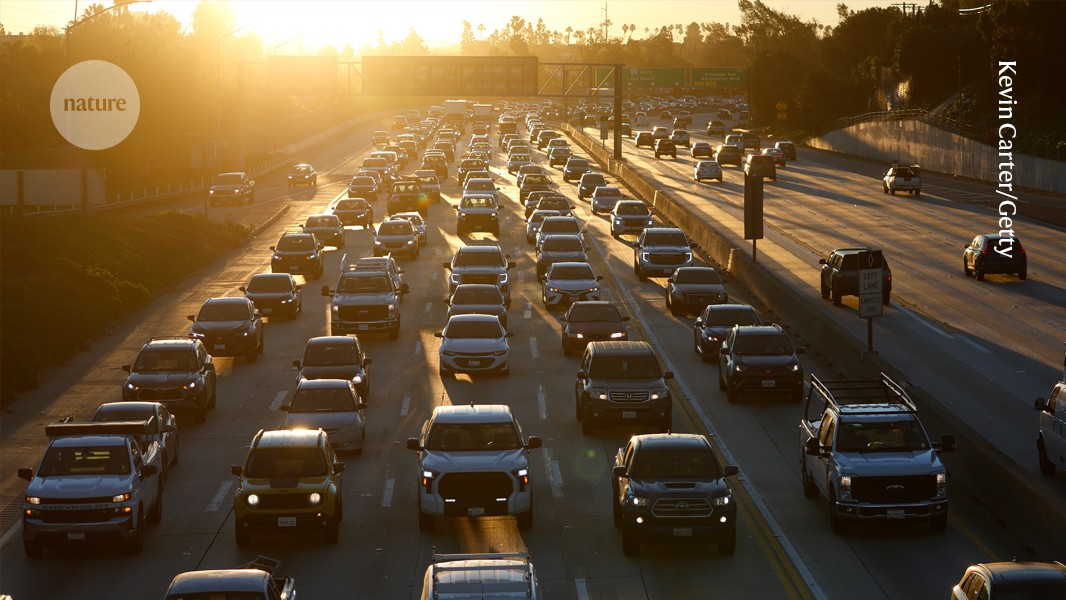

A ruling by the US Environmental Protection Agency opens the door to loosening limits on greenhouse gases emitted by vehicles.Credit: Kevin Carter/Getty
The US Environmental Protection Agency (EPA) has revoked the ‘endangerment finding’, a cornerstone of the nation’s efforts to curb emissions of planet-heating greenhouse gases. Its reversal means that for the first time in 17 years, the EPA will no longer consider greenhouse gases a threat to public health and welfare. EPA head Lee Zeldin said the move would save the United States money by removing excess regulations, but critics say it will put even more lives at risk as climate change intensifies.
The landmark 2009 endangerment finding served as the legal underpinning for US regulations designed to limit emissions. For now, the EPA is capitalizing on the repeal to roll back emissions rules for cars, trucks and other vehicles but might later apply it to other sectors, such as power plants. By several estimates, ending the vehicle regulations alone will add billions of tonnes of greenhouse gases to the atmosphere in the coming decades.

Controversial climate report from Trump team galvanizes scientists into action
Federal law requires the EPA to make decisions based on the best available science, but today’s action is “is a rejection of the most basic laws of physics”, says Friederike Otto, a climate scientist at Imperial College London and head of the World Weather Attribution project, which studies the links between extreme weather and human-caused climate change.
“There is no legitimate scientific rationale” for the EPA decision, says Andrew Dessler, a climate scientist at Texas A&M University in College Station.
In announcing the decision on 12 February, Zeldin did not address the science of climate change, but focused on what he called “the single largest act of deregulation” in the country’s history. “The red tape has been cut,” he said.
Environmental groups are sure to challenge the action in court, and the lawsuits might eventually go all the way to the Supreme Court.
Another rollback
The decision is of a piece with other actions by the administration of President Donald Trump, a Republican, to roll back action on climate change and the planet-heating emissions that cause it. Among other measures, the administration has withdrawn from the 2015 Paris agreement on climate change and opened US public lands to oil exploration and coal mining.
Speaking with Zeldin at the White House announcement, Trump said the endangerment finding “has nothing to do with public health …. This was a rip-off of the country.”
Details of the proposed rule were not immediately available beyond Trump’s and Zeldin’s statements. But in earlier justifications for revoking the finding, the EPA cited a July report written by a panel of academics who are known for their criticism of climate science and were appointed by US energy secretary Chris Wright. The report downplays the risks of climate change and questions established evidence for global warming.
A team of more than 85 scientists submitted a detailed critique of the work of the panel, which has since been disbanded. Last month, a federal judge ruled that the panel had been illegally constituted out of public view. The Department of Energy did not respond to questions from Nature asking about the panel’s legitimacy.
Agency authority lost
The endangerment finding allowed the EPA to implement a wide variety of pollution-control measures, such as strict fuel-efficiency standards for cars and emissions limits on power plants. Rollback of the endangerment finding hugely limits the EPA’s ability to regulate carbon emissions, critics say. “This is the biggest attack ever on federal authority to tackle the climate crisis,” says Meredith Hankins, federal climate legal director at the Natural Resources Defense Council, an environmental advocacy group in New York City.

Coral die-off marks Earth’s first climate ‘tipping point’, scientists say

