


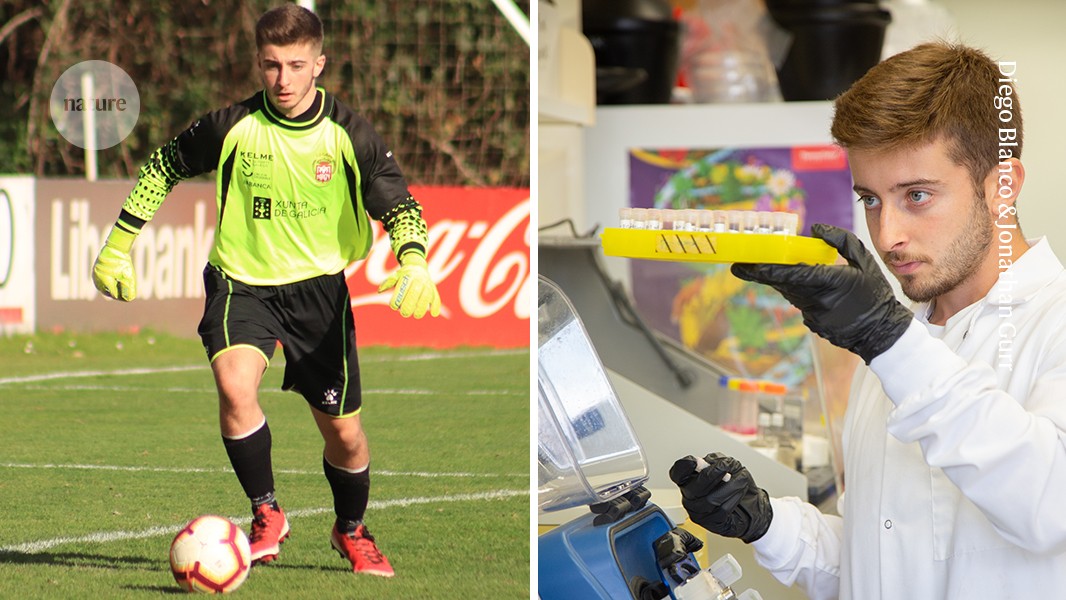

Javier Nion Fieira found that his experiences in elite sport were easier to analyse and process than those in the laboratory.Credit: Diego Blanco & Jonathan Gurr
At 2 a.m. on a frosty February morning, I started what I hoped would be the first big experiment of my PhD-dissertation project: collecting eight lung samples from mice and preparing them for flow cytometry. I’d spent months practising the workflow — washing, then tissue processing, staining and finally analysis — rehearsing it until it felt automatic.
By the time I got home at 8.30 p.m., I felt dizzy from my long day of sustained focus. I hadn’t even stopped to eat. Still, I went to sleep convinced that the effort would translate into clean data to provide the clear phenotype we had been looking for. It would drive my project forwards and ensure that I would graduate on time with a PhD from Louisiana State University Health Sciences Center in Shreveport.
We need to talk about failure in science
That’s not what happened. I finished too late for the flow-cytometry staff to process the samples that evening, so I took them to a specialist first thing the next morning and spent the rest of the day analysing the output. It looked rough: the sample quality wasn’t where it needed to be. A couple of the crucial antibodies that were supposed to anchor the analysis showed a weak signal and the labels that should have clearly marked key cell types barely showed up, so the groups blurred together on the plots. What hit me wasn’t just disappointment that the experiment hadn’t gone the way I’d have liked; it was the lack of an immediate explanation to accompany it.
In my previous career as a goalkeeper, failure felt clearer. Before I did my undergraduate biotechnology degree in Valencia, Spain, I spent two years playing in the División de Honor Juvenil, the top under-19 football league in the country. It’s a league that some of the world’s best footballers have passed through, including one of FC Barcelona’s star players, Lamine Yamal, and Rodri, who was awarded the 2024 Ballon d’Or, a prize that recognizes the world’s best player of the previous season.
Elite prep
The environment is built around elite preparation, with a large coaching staff, constant video reviews of individual and team performance, structured recovery following matches and training sessions, and serious investment in skills development. In my second year there, I started my undergraduate degree; only three of us in the 25-player squad tried to combine football with studying. Most of my teammates committed themselves entirely to sport and some have become successful at the highest levels of the game: for example, I used to play alongside Nico González, now signed to the English Premier League team Manchester City.
In that world, failure can be unforgiving, but usually you get to watch a replay of the match and can work out where you went wrong. For example, in January 2020, soon after I returned from an eight-month knee-injury layoff, I played in an away game against under-19 league leaders Sporting Gijón, which was televised locally. My family and friends were excited for my return, but my knee didn’t feel right in the warm-up and my team lost 4–0.
After the game, sport provided me with clarity. I watched the match six times. Each viewing narrowed the problem to specific, actionable details in my performance — positioning, timing, hesitation — that I could work on. Coaches pointed to them too. The feedback could be harsh, but it was concrete. Even when you fail, you usually know where to start to improve.
My scientific failure, by contrast, didn’t offer that. Some of the read-outs from my mouse experiments were too messy to trust. Instead of having a collection of clear signals with a straightforward interpretation, I was left trying to decide what I could even say with confidence. And instead of a single moment to fix, I had a list of possibilities: handling, dilutions, antibodies, timing between steps, sample stress; all tiny deviations that don’t feel like mistakes while you’re making them.
In football, I could look back on key moment in a match and say, “I was late.” In the laboratory, all I could say was, “Something is off.”

