


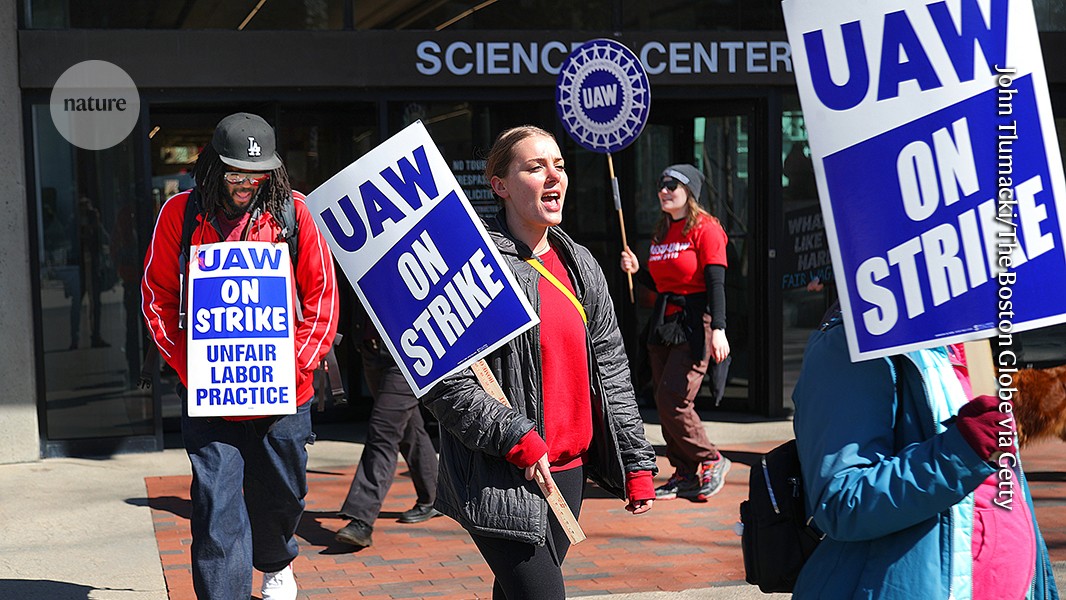
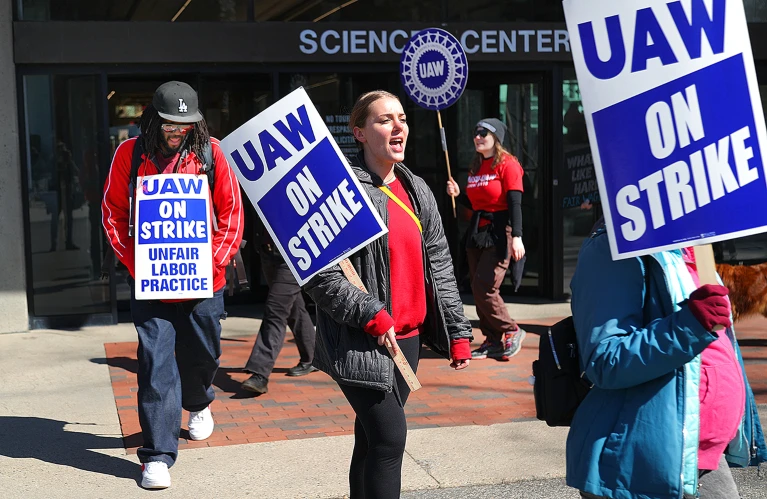
Graduate student workers picket in front of the Harvard Science Center in Cambridge, Massachusetts, on 21 April.Credit: John Tlumacki/The Boston Globe via Getty
Two thousand graduate student workers who went on strike at Harvard University starting on 21 April have brought a sizeable chunk of the institution’s teaching and research to a halt.
Despite the university’s medical school in Boston, being open the next day, the hallways of the Veritas Science Center were deserted. “It was completely empty,” says microbiologist and postdoctoral fellow Adam Sychla. “It’s clear the labs aren’t running.”

US PhD admissions shrink as fears over Trump’s cuts take hold
Representatives of the Harvard Graduate Students Union–United Auto Workers (HGSU–UAW) have been in negotiations with the university for more than a year, calling for higher wages, protections for international students at risk of deportation, reforms to Harvard’s system for handling harassment and discrimination cases and more. But no agreement has been reached, and the previous contract expired last June. Although union members are still being paid, this leaves them without access to certain provisions in their contract, including access to funds that help to pay for childcare and out-of-pocket medical expenses, and without union leverage in personnel matters.
“The richest university in the world should not have its workers in this incredibly precarious situation,” says union president Sara Speller. “A strike was our last resort.”
In October 2025, The New York Times reported that Harvard’s endowment had grown to nearly $57 billion in the fiscal year ending in June, an increase of about $3.7 billion. The university also said it had received a record level of donations during the same period.
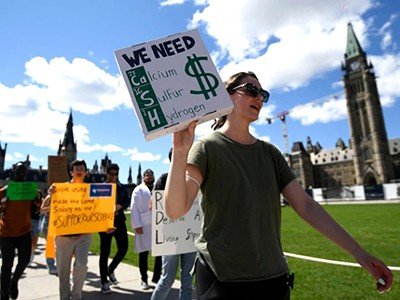
Canadian PhD students and postgrads plan mass walkout over low pay
The aim of the strike is to halt scientific research at the university, says Laila Norford, a PhD candidate who studies biomedical informatics. “We’re doing essential work that is bringing funding into this university,” she says, “and we’re not seeing the respect returned to us.”
Harvard, whose main campus is in Cambridge, Massachusetts, has not publicly commented on the strike since it began. A spokesman did not answer Nature’s queries about union grievances, but pointed to a letter posted on 17 April by provost John Manning and executive vice-president Meredith Weenick that said: “HGSU–UAW members play a vital role in fulfilling Harvard’s teaching and research mission. With appreciation for that role and the work they do, we remain committed to productive bargaining and reaching an agreement.”
According to student newspaper The Harvard Crimson, a separate union, the Harvard Academic Workers Union (AWU) — which represents postdocs, lecturers, teaching assistants and more — could soon join the strike. That union opened a vote for strike authorization on 27 March. If enough members vote yes, it would add another 2,600 workers to the ongoing protest. Sychla, a bargaining committee member for the AWU, wouldn’t comment on the voting results, but said that his union fully supports the graduate workers’ strike.
Demands and negotiations
HGSU–UAW has asked for a minimum annual salary of US$55,000, up from $50,000, for graduate student workers, followed by yearly inflation-adjusted raises. It has also requested an increase in wages for hourly workers, such as teaching assistants, from $21 per hour to $25 per hour. These demands, Speller says, are to ensure Harvard graduate and undergraduate student workers can afford housing, healthcare and childcare in Boston, one of the most expensive cities in the United States.
Not being able to pay for those necessities “is quite frustrating”, says Rochelle Sun, a PhD candidate studying political science. “They’re quite basic needs,” she says.

Harvard vs Trump: what this epic battle means for science
In their letter, Manning and Weenick say that the university proposed a 10% increase during negotiations to “all salaried appointment rates” that would be spread over four years. Speller says that that increase probably wouldn’t even cover yearly increases in inflation.

