


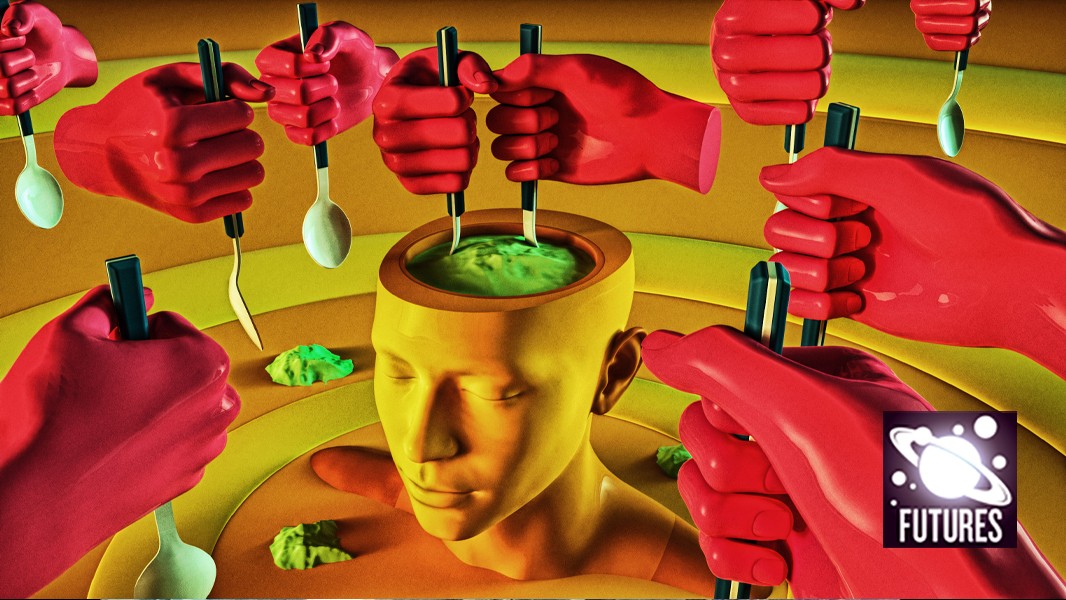
There’s no way to know how or when it happened. When you can’t trust your own memory, how can you know?
It seems like one day I was hearing about it, reading about it online, and the next it was affecting people on campus. My professors forgot their lesson plans, and then rambled on about alien abductions and lizard people. My friends forgot to do their assignments, and then how to get to class, and then who they were. They’d think they were disciples of Jesus, or soldiers in the Civil War, or colonists on the Moon. Anne, the engineering student in the room next to mine, became convinced she was a Lady in the court of Poseidon’s underwater palace. I’d got a bit forgetful myself, but felt I still had a pretty firm grip on reality. But, again … how would I know?
Eventually, things got bad enough that we decided to leave our dorm. There were three of us that night: me, Gene and Arthur. I was a psychology major, Arthur was a med student, Gene was in theology. For some reason, we seemed to be the only ones there who hadn’t completely lost our minds. We huddled under the bare trees behind the building, old snow crunching under our feet.
Gene took a long drag from his cigarette and let it steam out in the frigid air. “Robarts Library is our best bet. I’ve heard it’s a sanctuary. An island of sanity in …” He waved the cigarette. “All this.”
Read more science fiction from Nature Futures
“You can’t believe anything you hear,” Arthur said, voice muffled behind a surgical mask. “Not any more.”
But it made sense. Robarts would have books and records from before — old, physical documents that we could hold in our hands. Those we could believe. And the library itself was built like a fortress.
“Do you have a better idea?” I asked.
Arthur sighed, then shook his head.
“Let’s go, then,” I said, and started walking.
“Uh …” Gene said.
I stopped and turned around. They were looking at me strangely.
“Library is that way.” Gene pointed with his cigarette, in the opposite direction. “You know that. We go there almost every day.”
“Yeah,” I said. “Yeah. Just got turned around.” It was the snow, I told myself. It covered everything, made the landscape new and unfamiliar.
We took an indirect path, cutting through Queen’s Park. Trudging through the snow, we came across a man, shivering and dead-eyed. He was wandering the park, handing out poorly xeroxed flyers that featured a picture of him under the words:
WHO AM I?
I shrugged at him, but politely took the paper, folded it up and put it in my pocket.
Passing between the Conservatory of Music and the Faculty of Law, we found the Conservatory under siege by law students in black robes and white wigs — I wondered where they’d got the wigs. They’d set fire to the building, and thick plumes of smoke rolled up into the grey night. Discordant music came from inside, a booming anthem of tubas and drums. What quarrel the lawyers had with the musicians, I have no idea; maybe they didn’t like their performance.
A few of the robed figures approached us, one of them holding, ominously, a torch.
“Papers,” the man with the torch said.
“Papers?” Arthur repeated.
“You need transit papers to pass through here. It’s the law.”
“Here you are, sir.” I handed him the flyer I’d been given earlier.
The man passed his torch to one of the others, and then unfolded the paper, frowning and scratching his wig like he’d forgotten how to read.
I cleared my throat. “Is everything in order?” I asked.
He gave the paper back to me. “Move along. You can see we’re very busy here.” They turned and left.
Arthur looked at me. I shrugged. We continued on our way.
“I called my parents this morning,” Gene said. “They were going on about how the government was listening in on the line, and monitoring their brainwaves. How the hell did it get so bad, so fast?”

