


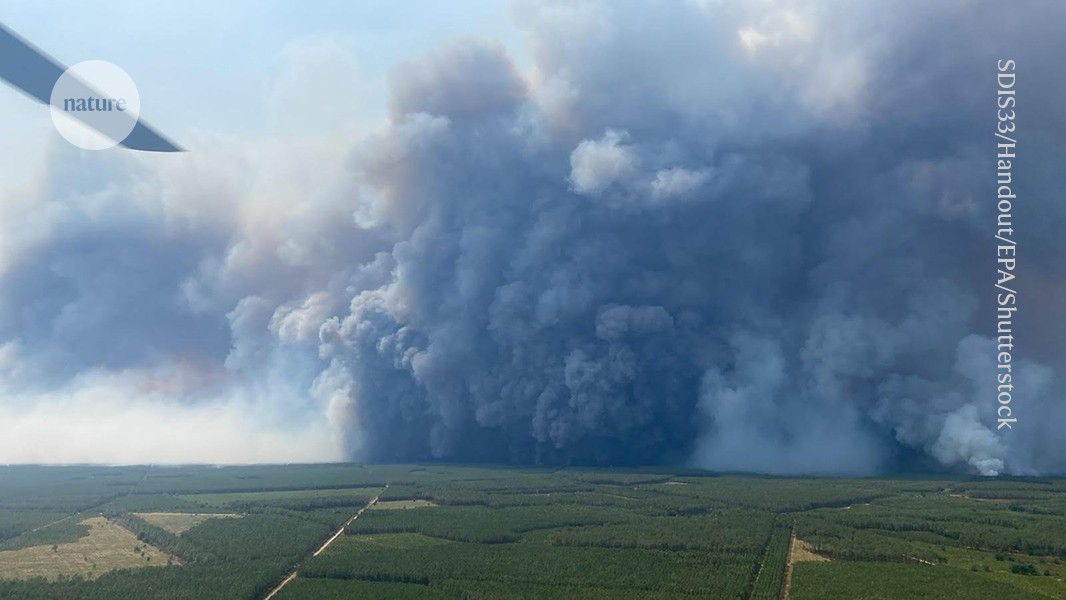

A giant pyrocumulonimbus cloud formed near the village of Saumos in France last week.Credit: SDIS33/Handout/EPA/Shutterstock
In a hangar in Broomfield, Colorado, a Gulfstream V jet plane is getting last-minute checks before it heads out on a daring mission. The aeroplane is part of a NASA campaign that will, for the first time, extensively sample ‘fire clouds’ — towering, mushroom-like formations that reach into Earth’s upper atmosphere above extremely large and hot wildfires, such as those now burning in France, Spain and the Pacific Northwest.
“We’re seeing these intense fires and unpredictable behaviours,” says Teresa Campos, an atmospheric chemist at the US National Center for Atmospheric Research (NCAR) in Boulder, Colorado, who works on the project. “It definitely feels like an important topic to be researching.”

You’re not imagining it: extreme wildfires are now more common
These massive plumes, known as pyrocumulonimbus clouds (pyroCbs), are generated in the hot updraft of the flames and can make their own weather, including winds and lightning strikes that might ignite new fires. PyroCbs also have planetary consequences, lofting smoke into the stratosphere, a layer of Earth’s atmosphere that extends from around 10 to 50 kilometres above the surface. At that altitude, the smoke can spread more readily across the globe, eat away at Earth’s protective ozone layer and influence weather and climate. “We know that they can affect large regions, or even full hemispheres,” says David Peterson, an atmospheric scientist at the US Naval Research Laboratory in Monterey, California, who is the campaign’s principal investigator.
But much about pyroCbs is poorly understood, including how they form, how much smoke they inject into the stratosphere and whether — as many scientists suspect — they are becoming more common as Earth’s climate warms. That’s where the mission, which could see its first flight to fires burning in Oregon as soon as tomorrow, comes in.
So far, scientists have collected only a single sample of fresh smoke in the stratosphere above a pyroCb. All other data come from research planes, flying for other purposes, doing ‘sniff tests’ to measure high-altitude smoke. “This time, it’s going to be more than a sniff,” Peterson says.

INSPYRE’s Gulfstream V sits in a hangar waiting to dive through fire clouds in the coming days.Credit: Alexandra Witze/Nature
Fire chasing
Called the Injected Smoke and Pyrocumulonimbus Experiment (INSPYRE), the campaign aims to get an unparalleled view of fire clouds from the ground up. More than 150 researchers are involved, including scientists at several US universities and staff members at NASA and the US Navy, which is participating because forecasting smoke is important to fly jets.
Air pollution and brain damage: what the science says
The Gulfstream V, which is operated by NCAR, will collect fresh samples of smoke; it has air scrubbers on board to keep things breathable for researchers. Meanwhile, a high-flying jet plane run by NASA will use infrared instruments to scan pyroCbs from above. On the ground, other teams will use technologies such as mobile radars and weather balloons to measure the conditions that fuel the cloud. “It’s effectively fire chasing, the same way you’d go after severe storms,” says Neil Lareau, an atmospheric scientist at the University of Nevada, Reno, who is leading the ground-sensing team.
A group of forecasters will point the fire chasers to where pyroCbs are likely to form. “We’ve been practising all summer” to make better predictions, says Derek Mallia, an atmospheric scientist at the University of Utah in Salt Lake City who is part of the forecasting team. The campaign will run through 10 September, with more field work scheduled next year.

