


You have full access to this article via your institution.
Hello Nature readers, would you like to get this Briefing in your inbox free every day? Sign up here.

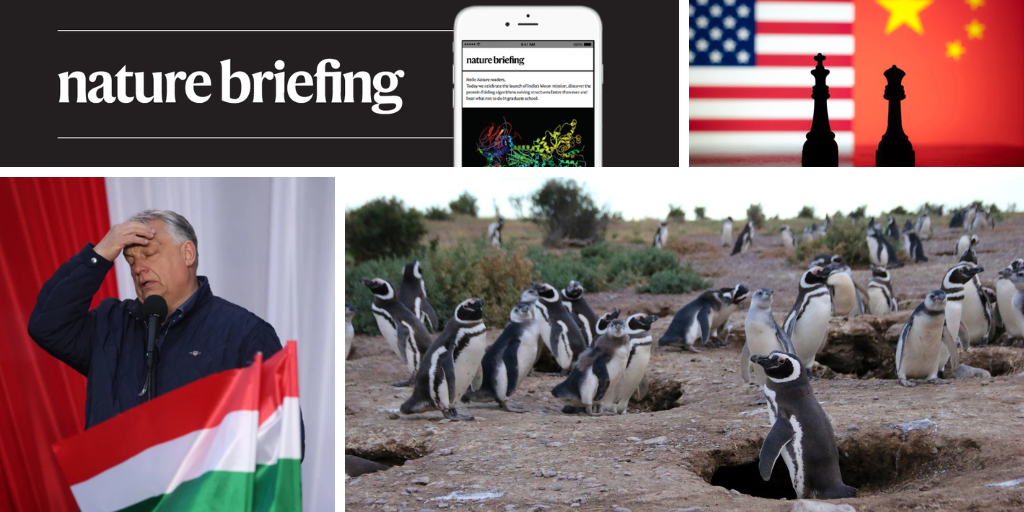
Magellanic penguins join the handful of other species, including dogs and horses, that have been used to monitor the levels of ‘forever chemicals’ in the environment. (Ralph Vanstreels/UC Davis)
A new study in Argentine Patagonia has turned Magellanic penguins (Spheniscus magellanicus) into research assistants. The study equips the birds with silicone anklets that absorb per- and polyfluoroalkyl substances (PFAS) — nicknamed ‘forever chemicals’ — to give researchers an indication of the abundance of these harmful substances in the penguins’ environment. “We have no better way of understanding the ocean [these animals] live in than letting them tell us the story themselves,” says veterinarian and study co-author Marcela Uhart. The penguins “are now our elite team of marine detectives,” she says.
Reference: Earth: Environmental Sustainability paper
The electoral rout of Viktor Orbán after sixteen years in power is being welcomed by many scientists who watched his government dismantle academic freedoms, strip university autonomy and cause Hungary to be blocked from EU funding. “What will happen to Hungarian science now is still very uncertain and unpredictable, but at least we have some hope that the future will bring some change,” says neuroscientist Imola Wilhelm. “What we really need is stability and transparency.”
Read more: Hungarian government takes control of research institutes despite outcry (Nature | 5 min read, from 2019)
A key Chinese research organization is set to boycott the prestigious NeurIPS conference, which is run by a US-based non-profit organization, after a row over a policy that initially banned papers submitted by researchers associated with “US-sanctioned” institutions. The list included major Chinese tech companies such as Huawei, which had previously sponsored the conference. NeurIPS later apologized and watered down the policy. But the China Association for Science and Technology isn’t backing down — it will no longer pay for researchers to attend the conference and will discount NeurIPS papers in crucial researcher evaluations — which is a big deal for a conference for which the lion’s share of first authors are based in China.
A researcher was arrested last month for allegedly taking samples of viruses — reportedly including chikungunya and dengue — from a high-security biosafety laboratory at a leading Brazilian university. The samples were recovered, and were not dangerous, but the event has the Brazilian virology community “perplexed”, says virologist Paulo Sanches. “No sample can be removed from a lab with this biosafety level without authorization.” The news comes as Brazil is building support for the construction of its first BSL-4 lab — the highest level of biosafety facility — only a few kilometres away from the campus where the samples went missing.
Features & opinion
The air around us is teeming with the DNA of various organisms, ranging from people to viruses. Over the past decade, researchers have been learning how to collect airborne DNA and use it to study the movement of individual species, entire ecosystems or even attacks with biological weapons. But some hurdles remain: scientists still aren’t sure for how long DNA can persist in the air, or how far it can travel. And some experts worry that DNA plucked from the air could inadvertently reveal the characteristics of people that haven’t consented to such analysis.
A rise of 0.517 °C in global mean surface air temperature. The melting of enough glacial ice to make a pyramid three times the height of Mount Everest. And thousands of new climate-protecting laws and policies. These are just a few of the notable changes that have occurred since Nature Climate Change was launched in 2011, revealed in a slate of graphics that show some sober statistics in a surprisingly delightful way.
Today I was delighted to discover that scientists have harnessed the urge to try to knock over those precariously balanced rocks dropped by ancient glaciers or left stranded by erosion. Dubbed PBRs — of course — these huge stones are deceptively hard to shift, so it would take a very strong earthquake (or a group of British seamen) to topple one. Recently, researchers looked at the PBRs in the Blue Ridge region of Virginia and found that it would have taken a quake of around Mw 7.5 to knock them over — so an earthshaker that powerful mustn’t have happened within the rocks’ 20,000–40,000-year lifespan.
Help us keep this newsletter balanced — and help us shake things up — by letting us know your feedback at [email protected].
Thanks for reading,
Flora Graham, senior editor, Nature Briefing
With contributions by Jacob Smith
• Nature Briefing: Careers — insights, advice and award-winning journalism to help you optimize your working life
• Nature Briefing: Microbiology — the most abundant living entities on our planet — microorganisms — and the role they play in health, the environment and food systems
• Nature Briefing: Anthropocene — climate change, biodiversity, sustainability and geoengineering
• Nature Briefing: AI & Robotics — 100% written by humans, of course
• Nature Briefing: Cancer — a weekly newsletter written with cancer researchers in mind
• Nature Briefing: Translational Research — covers biotechnology, drug discovery and pharma

