


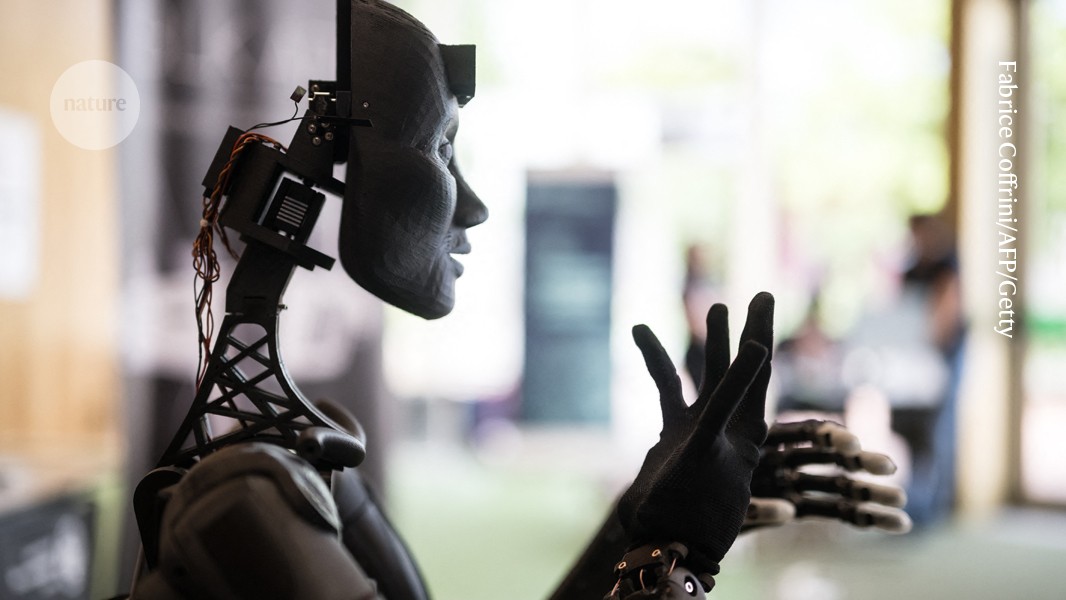

AI co-scientist systems work at a much faster pace than humans can. Credit: Fabrice Coffrini/AFP/Getty
Artificial intelligence is poised to take on a more-active role in the laboratory: two new systems, described today in Nature1,2, use teams of AI agents to develop hypotheses, propose experiments and analyse data.
Each system still relies on human input at various stages, but they boast timelines that can be remarkably shorter than when the process is left to human minds and hands alone. When the systems were asked to identify existing drugs that might be repurposed for different conditions, they arrived at plausible answers in a matter of hours.
“It almost seems like an agentic, in silico implementation of the thought process in a scientist’s head,” says Vivek Natarajan, a researcher at Google DeepMind in Mountain View, California, who helped to develop one of the systems. “The goal is to give scientists superpowers.”
In silico scientists
In one experiment, Natarajan and his colleagues used Google’s Co-Scientist to look for approved drugs that could be repurposed to treat a form of blood cancer called acute myeloid leukaemia1. The system identified a list of candidate drugs, from which human researchers selected five for further study. Three of these showed promise in preliminary studies on cells grown in the lab.
FutureHouse, a non-profit AI research lab in San Francisco, California, developed the second system, called Robin, and instructed it to find drugs to treat an eye condition called dry age-related macular degeneration2.
Robin began by consulting AI agents trained to conduct literature reviews and used their reports to select lab experiments to test a variety of candidate drugs. Humans carried out those experiments and fed the data back to Robin, which then supplied them to an AI agent specialized in analysing data.
Researchers built an ‘AI Scientist’ — what can it do?
Using this procedure, Robin suggested a list of molecular targets for treating dry age-related macular degeneration and identified a drug called ripasudil, which is used to treat the eye condition glaucoma, as a candidate treatment. The system suggested assays to confirm ripasudil’s activity in the lab and then proposed follow-up experiments.
None of the drugs identified by the AI scientists have been fully evaluated, and many drug candidates that pass initial assays in lab-grown cells go on to fail more-stringent assays. But the examples show that these AI systems can arrive at plausible hypotheses, says Karandeep Singh, who oversees AI initiatives and strategy for University of California San Diego Health.
How well the AI assistants perform in day-to-day science in other contexts remains to be seen, he adds. “You don’t know how it works in reality until it’s been made available to a broad set of people,” he says.

