


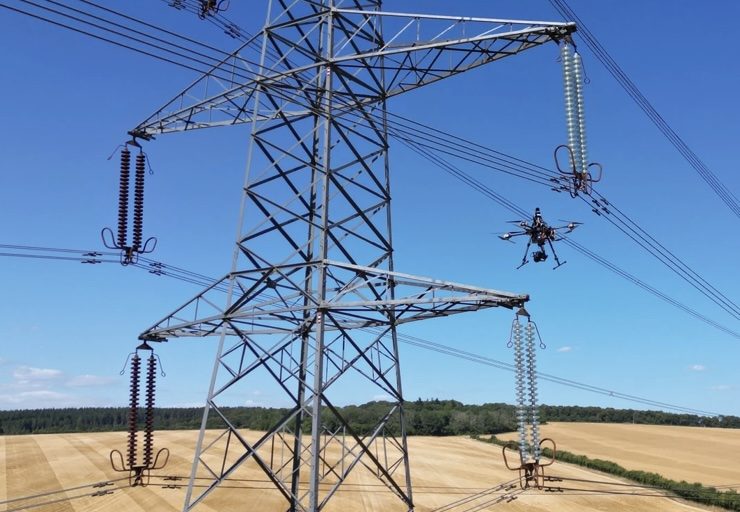
Limited public details raise questions about “v.USA 1.0” and how international companies can meet U.S. security requirements
The Federal Communications Commission (FCC) has granted conditional approval to the Sees.ai v.USA. 1.0 Uncrewed Aircraft System, exempting it from the agency’s Covered List restrictions. The approval, based on a determination by the Department of War (DoW), is valid through December 31, 2026.
The decision places Sees.ai among a small group of companies whose systems have received exemptions as the U.S. tightens rules on foreign-produced drones.
A “Full Stack” Platform
Sees.ai is a UK-based company focused on autonomous drone operations for infrastructure inspection.
The company describes its offering as a “fully integrated autonomous drone inspection platform,” enabling centralized control of multiple missions. It also states that it owns the full technology stack, from the drone and flight systems through to data capture.
This suggests Sees.ai develops an integrated system that includes the aircraft itself. However, the company does not list a standalone drone product and provides limited public detail on its hardware or manufacturing approach.
What the FCC Filing Confirms
The FCC notice provides only basic information, identifying:
- Sees.ai v.USA. 1.0 Uncrewed Aircraft System
- Conditional approval granted by DoW
- Expiration date of December 31, 2026
The FCC states that such approvals reflect a determination that the system does not pose unacceptable national security risks, allowing it to be excluded from the Covered List.
Questions Around “v.USA 1.0”
No additional details about “v.USA 1.0” appear on the Sees.ai website or in public materials. It is unclear whether it is a commercial product or a specific configuration and where the system is manufactured or assembled.
The “v.USA” designation may indicate a U.S.-aligned version of the system, potentially adapted to meet federal requirements.
The approval reflects a broader shift in U.S. policy. While foreign-produced UAS are generally restricted, federal agencies are allowing case-by-case exemptions for systems that meet security standards.
For companies like Sees.ai, which offer integrated platforms rather than standalone products, this approach may provide a path to keep doing business in the U.S. market.
At the same time, the limited public detail around the Sees.ai system highlights the current lack of information as to how these approvals are granted. As more systems are added, the criteria and process may become clearer.
For now, the Sees.ai listing offers a signal of evolving policy.
Read more:
Miriam McNabb is the Editor-in-Chief of DRONELIFE and CEO of JobForDrones, a professional drone services marketplace, and a fascinated observer of the emerging drone industry and the regulatory environment for drones. Miriam has penned over 3,000 articles focused on the commercial drone space and is an international speaker and recognized figure in the industry. Miriam has a degree from the University of Chicago and over 20 years of experience in high tech sales and marketing for new technologies.
For drone industry consulting or writing, Email Miriam.
TWITTER:@spaldingbarker
Subscribe to DroneLife here.

