


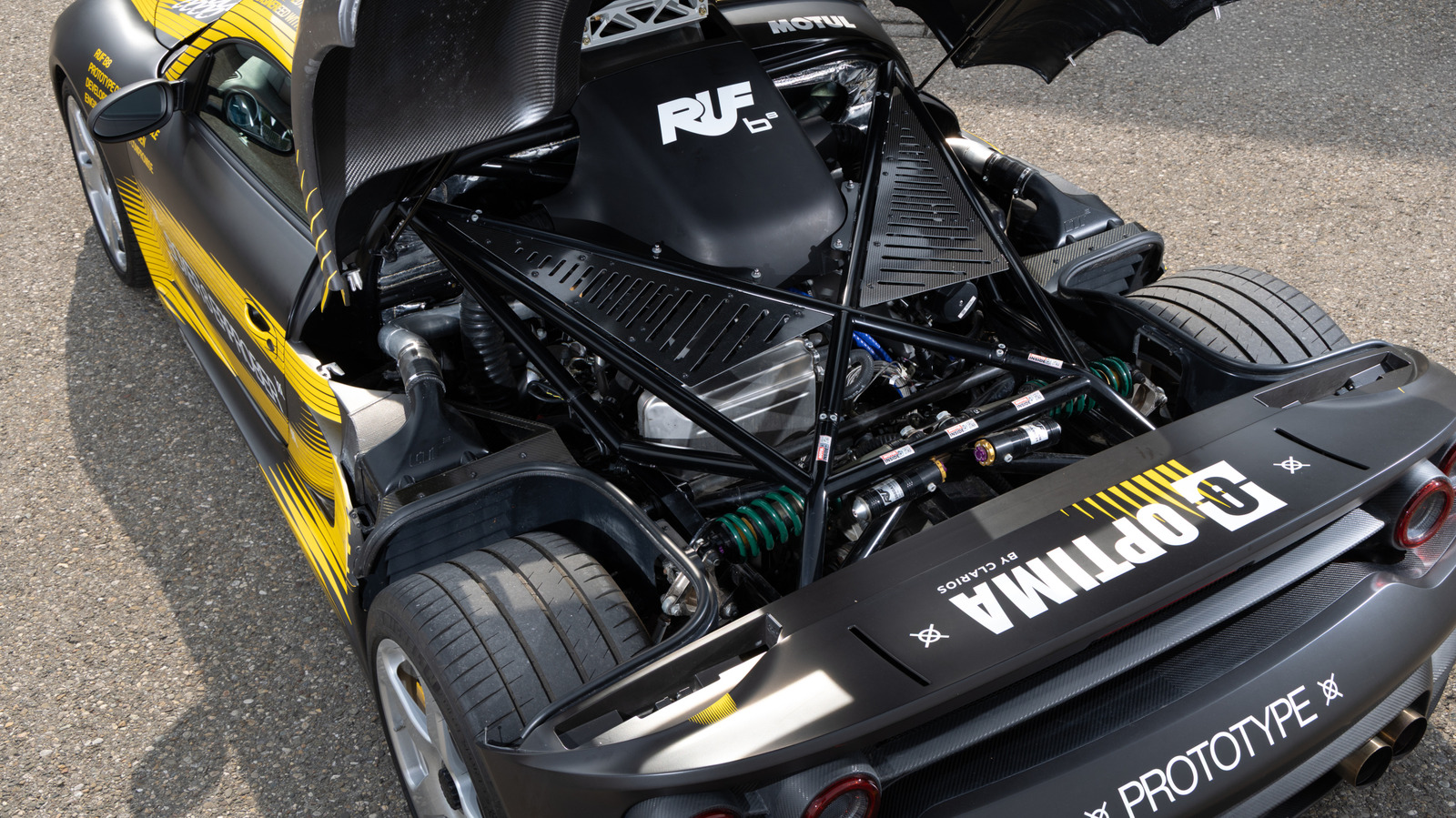
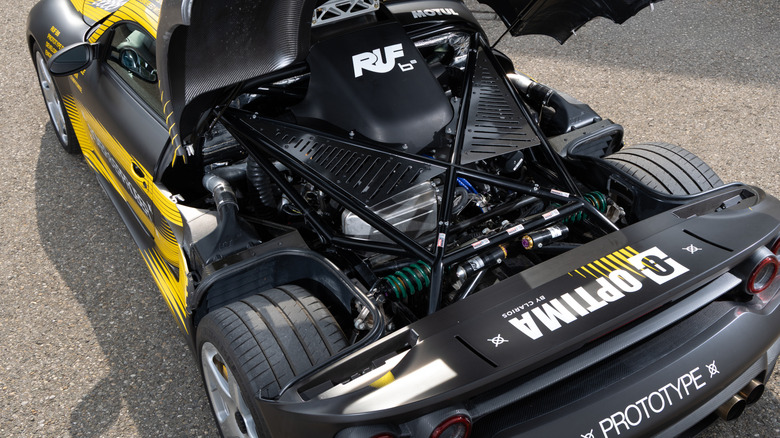
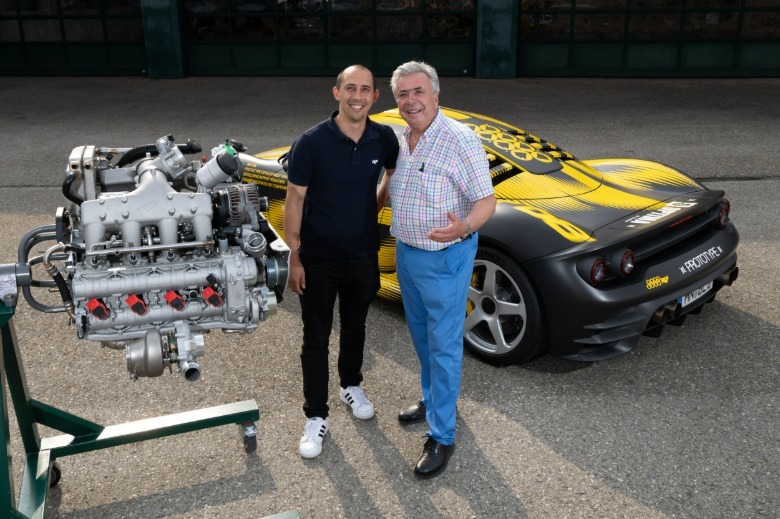
Forget the hybrid systems and electric turbos that other hypercar builders need to get their cars over the four-figure horsepower mark, all the Pfaffenhausen folks need to make big power is an old-school eight-cylinder engine and a pair of gigantic turbochargers. At the Goodwood Festival of Speed, Ruf announced that not only is it making a new flat-eight engine with over 1,000 horsepower and 738 pound-feet of torque, it will actually let you row your own with this new motor. That’s right, it’s mated to a six-speed manual transmission.
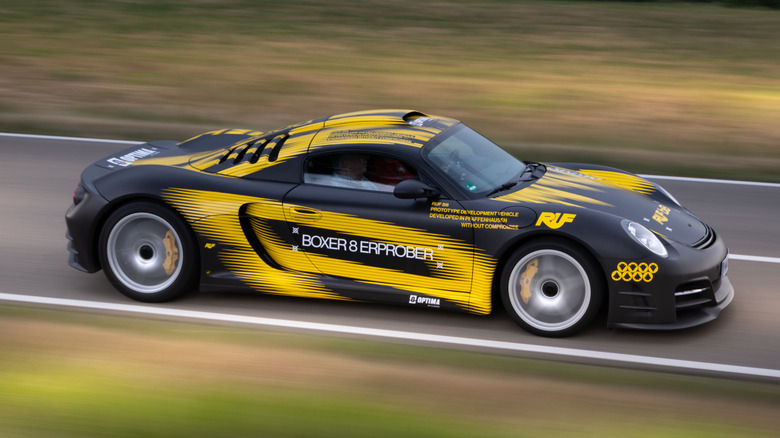
The prototype engine is currently sitting in the middle of an elongated Ruf CTR3 chassis (dubbed Erprober or “The Tester”), though it will almost certainly be the beating heart of Ruf’s next hypercar. In keeping with tradition, the car will hopefully be called CTR4, and it’ll aim to up the ante on Ruf’s top-speed legacy. Is it possible Ruf is aiming for the big 300-mph mark? Erprober will enter the Supercar Run up the Goodwood hillclimb with legendary racer Tanner Foust in the driver’s seat. If you’re going to Goodwood, you’ll get to hear this big boxer eight belt out its baritone, and for that I’m jealous. Said Alois Ruf in the press release:
There are moments in a company’s history that define the future. For RUF, the Boxer 8 is one of those moments. A boxer-eight has never been part of our story, or anyone else’s in this form, so we decided to write a new chapter in automotive history. We look forward to letting the engine speak for itself at Goodwood.
Exact specifications of the engine’s internals haven’t been released, but at a glance it certainly looks to be designed around Porsche’s Mezger engine, like the one found in my 996-generation 911 Turbo, with two additional cylinders added. If that proves to be the case, this engine should be capable of Ruf’s claimed power levels and then some, with the baked-in reliability to cover a million miles.
Ruf has built an eight before
Sixteen years ago, as the 997-generation of Porsche 911 came to a close, Ruf set about building the ultimate version of the car, the GT3-based RGT-8. For 2010, the company built a limited number of lightweight aluminum V8 engines to fit in the rear of the car, making 550 rowdy naturally-aspirated horsepower, good enough for a top speed over 200 mph in the 997 chassis. Unlike the new Ruf-designed flat-eight engine, the RGT-8 was based on existing architecture, namely BMW’s S65. Ruf punched that engine out to 4.5 liters and upped the power significantly. A standard BMW M3 produced just 414 horsepower from four liters by comparison.
The RGT-8 was imbued with race-inspired lightweight materials wherever possible, with Ruf fitting aluminum doors and front trunk lid, and carbon fiber rear lid, as well as carbon ceramic brakes. Like the flat-six-powered RGT models, the V8 monster featured a spartan interior and deleted several components Ruf deemed unnecessary, all in an effort to get the car under 3,000 pounds. With a Ruf/BMW heart transplant, the RGT-8 was capable of sub-four-second 0-to-60 sprints with ease, and sounded great to boot.
While the company has been an independent automaker for almost its entire existence, Ruf typically relied on Porsche for supply of cars to base its creations on. Over the last decade and a half, Ruf has worked toward a goal of reducing its reliance on Porsche for components, building everything from its own carbon composite monocoques and developing its own engines. Both the engines and the cars themselves still look Porsche-inspired, to be sure, but rarely contain many Porsche-developed components. The days of Porsche-derived flat-sixes and BMW-derived V8s seem to be over for Ruf, and aside from the 997-generation based CTR3 hypercar, the chassis are 100% Ruf these days.
Porsche inspiration
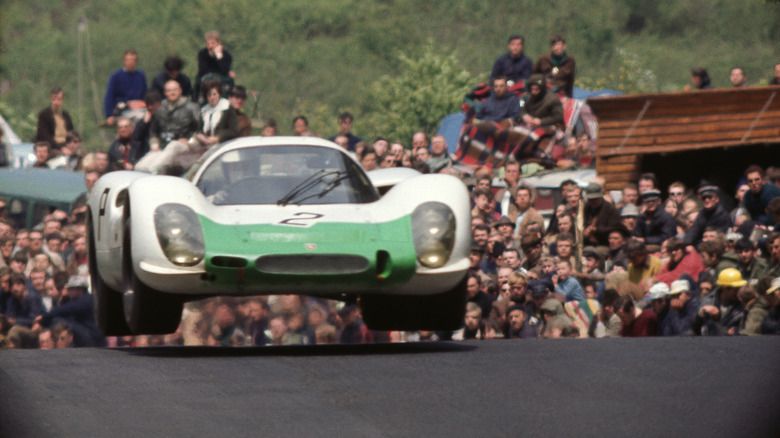
Porsche doesn’t build a flat-eight engine anymore, but this layout was once an important part of the company’s racing efforts. Not only did Porsche develop one for its Type 804 Formula One car of the 1960s, but two different flat eights were developed for sports car racing in the same era. The first, a 2.2-liter version of the F1 engine, including my personal favorite Porsche, the 909 Bergspyder. When Porsche required more displacement for the 908 to run in the 3-liter prototype class at Le Mans in 1968, however, it developed a new flat eight that was basically the 911’s flat six with two pistons tacked on.
The first 908s were long-tail closed coupes like the one pictured above, and proved both aerodynamically slippery and fast enough to win more than half of the World Championship races that year. Porsche later built a lighter open-top 908/02 Spyder, which played counterpart to the larger displacement 917 on tighter tracks more favorable to the nimble 908. In the hands of privateers the 908 raced through the early 1980s, stretching Porsche’s flat-eight legacy.
 Ruf
Ruf
There were rumors of Porsche returning to a flat-eight for a supercar to compete with Ferrari’s 488, McLaren’s 650S, and Lamborghini’s Huracan around 2019, though it never materialized. Porsche wasn’t aiming as high as Ruf, however, allegedly developing just 600 ponies from a naturally-aspirated eight-cylinder.
While Ruf is working to distance itself from Porsche in a parts supply role, the boutique automaker is happy to continue pulling from the legacy of the bigger automaker’s back catalogue and updating it to work in today’s marketplace. Whatever car this monster flat-eight goes into, it’s something I look forward to seeing, and hearing, in person. Alois Ruf (pictured above right) and his daughter Aloisa haven’t made a bad car yet, so I doubt they’re starting now.

