


Percepto launches next-gen inspection software
By DRONELIFE Features Editor Jim Magill
For energy companies, producing actionable data is almost as important as the production of millions of cubic feet of natural gas or megawatts.
Representatives of oil and gas firms and electric utility companies in attendance at this week’s InnovateEnergy Week conference in The Woodlands, Texas were anxious to learn all the new technologies to collect and process vast volumes of data and how to make use of them throughout their organization’s operations.
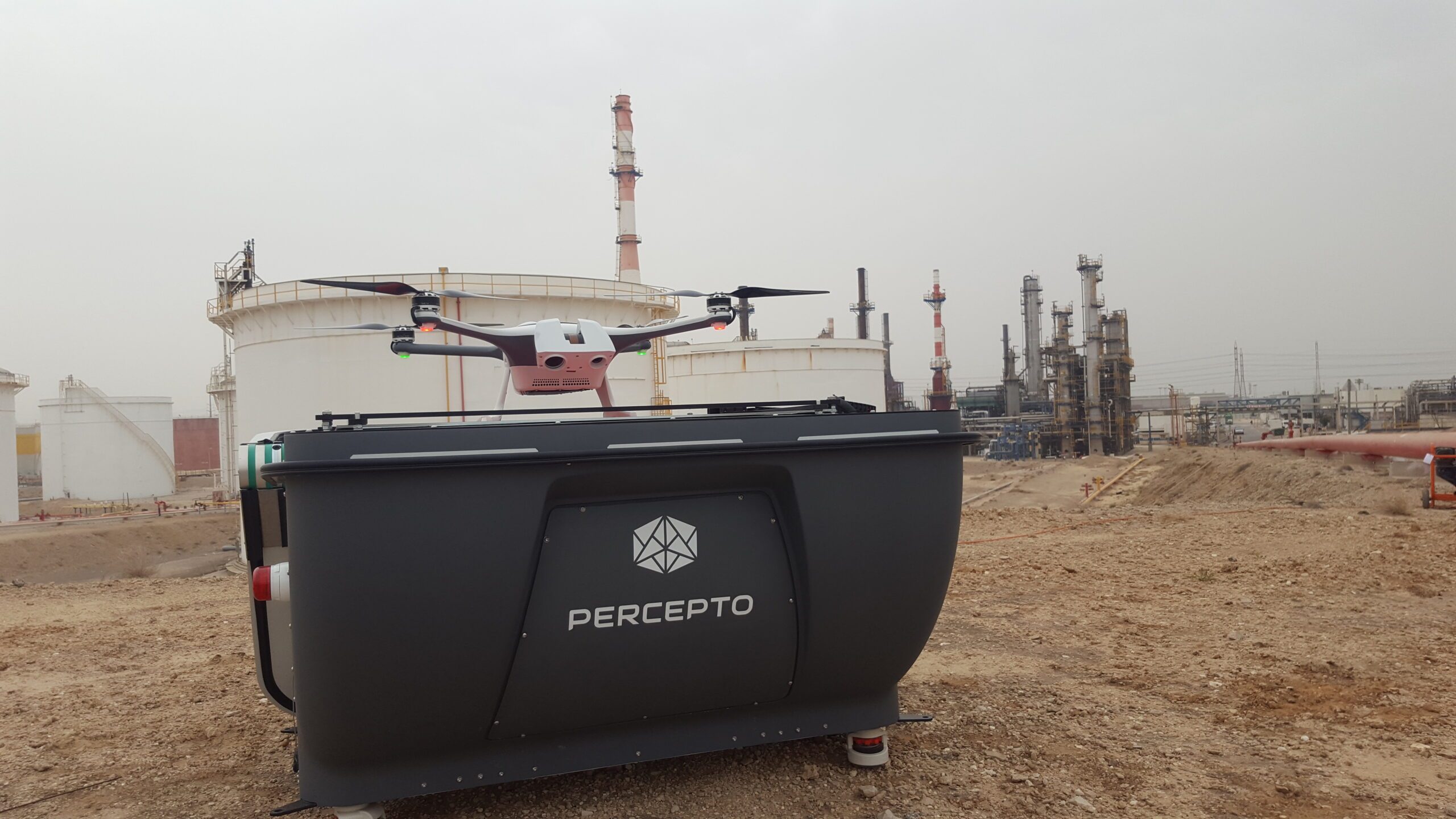
One technology provider with a solid customer base in the energy industry, this week announced an expansion of its data-collection services. In a statement, Austin-based Percepto said it was launching its next-generation of its inspection-intelligence platform for energy infrastructure.
“Percepto’s next generation brings human-level inspection logic into autonomy, enabling operators to capture the right data, connect it to the right asset, and deliver reliable outcomes that teams can act on at scale,” the statement said.
Speaking on the sidelines of the conference, Philip Rogers, Percepto’s vice president of strategic accounts, said the company’s latest big advancement comes on the software front, by increasing the capabilities of Percepto’s proprietary Autonomous Inspection & Monitoring (AIM) software, which enables remote infrastructure inspection and analysis.
Rogers said the software allows energy companies to integrate data collected from Percepto’s drone-in-a-box solution straight into their active workflows.
“It doesn’t have to just be data from a drone; it can be other types of data sets, so static cameras, satellite information, things like that,” he said. The company also is expanding the capabilities of its drones, giving customers the ability to utilize Percepto’s systems to manage their UAV fleets.
The technology allows customers to consolidates all of their information into a single centralized location, “instead of just having data living in a cloud somewhere.”
Percepto’s next-generation platform is designed to augment the work done by human inspectors, by mimicking how they work — knowing what data to capture, how to capture it and determining how the findings should be communicated to the right person.
“The platform combines next-generation Percepto Air drones, inspection-grade onboard autonomy, contextual AI (artificial intelligence), AIM asset intelligence, and managed remote operations to deliver trusted outcomes at scale,” the company statement said.
Percepto focuses on energy-related customers such as oil and gas and electric utility companies, as well as solar energy and construction customers. The company’s next-generation software allows the data to be shared and analyzed seamlessly throughout the customer’s entire operation, Rogers said.
“It allows you to take mass amounts of data in and utilize the AI algorithms that we have that are actively being utilized on our drones,” he said.
The software uses computer vision, machine learning, and advanced sensors to automate the inspections of far-flung assets such as electric transmission lines and utility and telecommunication poles. Drones equipped with AI emissions detection software can utilize an optical gas imaging camera that can detect potentially harmful gases and then issue an alert on any of the anomalies that they see.
During the duration of the UAV flight, the data can reside on the drone, where it can provide real-time AI analytics on the drone itself. Then when the drone lands and connects to its base, it begins downloading the collected imagery and telemetry via a physical or high-speed wireless link. The raw data is then seamlessly uploaded to the cloud and processed by Percepto AIM software.
Percepto’s drones are manufactured in Israel and are compatible with U.S. cybersecurity requirements. The company itself is a U.S.-based entity, with commercial and corporate operations run in the United States.
Requests from customers
Rogers said most of the requests that Percepto receives from its customer involve designing a system that can manage and inspect their infrastructure assets at scale.
“That’s really one of the large areas that we provide a lot of value in. We’re able to do inspection frequencies at a much higher rate than the legacy of a guy in a truck,” he said. “It’s really replacing that model of people in the field, with people driving for hours and putting themselves at risk, where the drone can live in the field and do the inspections for them, at a much higher frequency and at a much better accuracy as well.”
The idea is not to replace the workers in the field, but to optimize their time so they can provide more value to their employer.
“You still need the people, because somebody’s got to go out and fix the problems. But instead of them driving three hours, getting there and seeing nothing is wrong, and then driving three hours somewhere else and seeing nothing’s wrong, now we can allow them to use those actual insights to go where the problems actually are,” Rogers said.
In their keynote presentation at last year’s Energy, Drones & Robotics Summit, representatives from Chevron presented the results of a study of their pilot autonomous drone inspection program using Percepto’s technology. The study found a 52% savings in time allocation for their field teams deploying the system, which allowed the workers to be much more productive. “Instead of finding the problems, they’re now just fixing the problems,” he said.
Rogers said an autonomous system can be used to quickly get out vital information in times of emergency. “But I would say it probably provides more value in just the daily inspections that are happening on the fly to where we can get the alerts out sooner,” he said.
Typically, under its alert timeframe service level agreements (SLA), the customer is alerted to an issue within one hour of the anomaly being detected.
Read more:

Jim Magill is a Houston-based writer with almost a quarter-century of experience covering technical and economic developments in the oil and gas industry. After retiring in December 2019 as a senior editor with S&P Global Platts, Jim began writing about emerging technologies, such as artificial intelligence, robots and drones, and the ways in which they’re contributing to our society. In addition to DroneLife, Jim is a contributor to Forbes.com and his work has appeared in the Houston Chronicle, U.S. News & World Report, and Unmanned Systems, a publication of the Association for Unmanned Vehicle Systems International

