


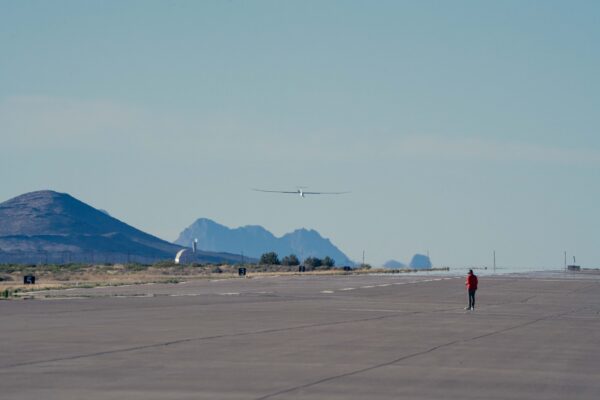
The Fort Worth aeronautics company validates its low-drag airframe at Spaceport America in support of DARPA’s Energy Web Aircraft program.
Otto Aerospace has completed a flight-test campaign for its unmanned laminar-flow drone at Spaceport America in New Mexico. The company announced the milestone on May 6, 2026, from White Sands Missile Range.
The campaign validated the predicted aerodynamic efficiency of the aircraft’s laminar-flow design in flight. Laminar-flow technology reduces drag by maintaining smooth, uninterrupted airflow over an aircraft’s surfaces.
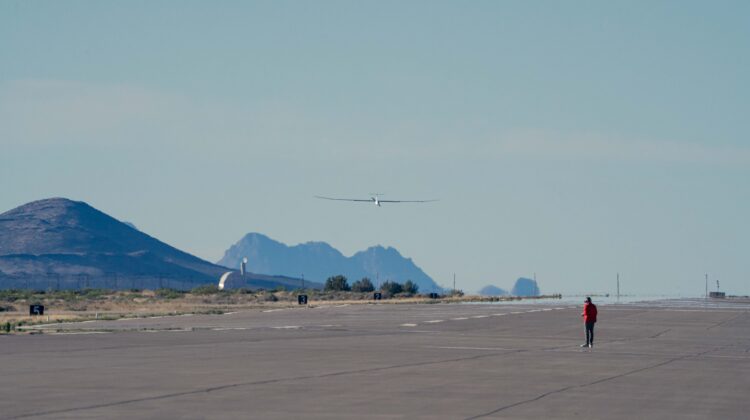
Laminar-Flow Drone Built for DARPA’s Energy Web Aircraft Program
Funding came in part through a 24-month contract with the Defense Advanced Research Projects Agency and the Operational Energy Capability Improvement Fund. The work supports DARPA’s Energy Web Aircraft (EWA) program.
EWA explores laser-based power transfer over long distances. Airborne relays would beam energy to aircraft, potentially keeping them aloft indefinitely.
Otto’s role focused on the laminar-flow airframe itself. The team designed and flew an unmanned vehicle to inform future energy-relay systems and long-endurance platforms. The flight-test campaign announced today was an Otto-funded development effort, conducted independently and outside the scope of the DARPA and OECIF contract.
“This aircraft proved what we’ve modeled for years, that high-efficiency laminar-flow aerodynamics can deliver extraordinary endurance and performance,” said Scott Drennan, president and CEO of Otto Aerospace. “We’re proud that Otto’s expertise helped advance DARPA’s research objectives and equally proud of our team for executing a flawless flight campaign that pushes aerodynamic science forward.”
Swift Engineering Manages Range and Telemetry Operations
Otto partnered with Swift Engineering for vehicle preparation and range coordination. Swift maintains an established presence at Spaceport America and brings years of high-altitude UAV experience, as Dronelife reported during Swift’s earlier HALE drone work with NASA.
The team flew multiple sorties over WSMR airspace.
“Swift is proud to partner with Otto on this breakthrough,” said Hamed Khalkhali, president of Swift Engineering. “The performance demonstrated in flight confirms the promise of laminar-flow aerodynamics to redefine long-endurance efficiency for unmanned systems across defense and commercial applications.”
The demonstrator now serves as a broader validation platform for Otto’s laminar-flow research. Data feeds future energy-relay UAV concepts as well as Otto’s commercial and defense programs.
“The data collected in this test opens new possibilities for energy-efficient aviation,” said Drennan. “From business jets to long-endurance UAVs, we’re showing how laminar flow can change what’s possible in flight.”
Otto Aerospace, based in Fort Worth, Texas, develops next-generation aircraft built around transonic laminar-flow aerodynamics.
More information is available at Otto Aerospace.
Read More

Ian McNabb is a journalist focusing on drone technology and lifestyle content at Dronelife. He is based between Boston and NH and, when not writing, enjoys hiking and Boston area sports.

