


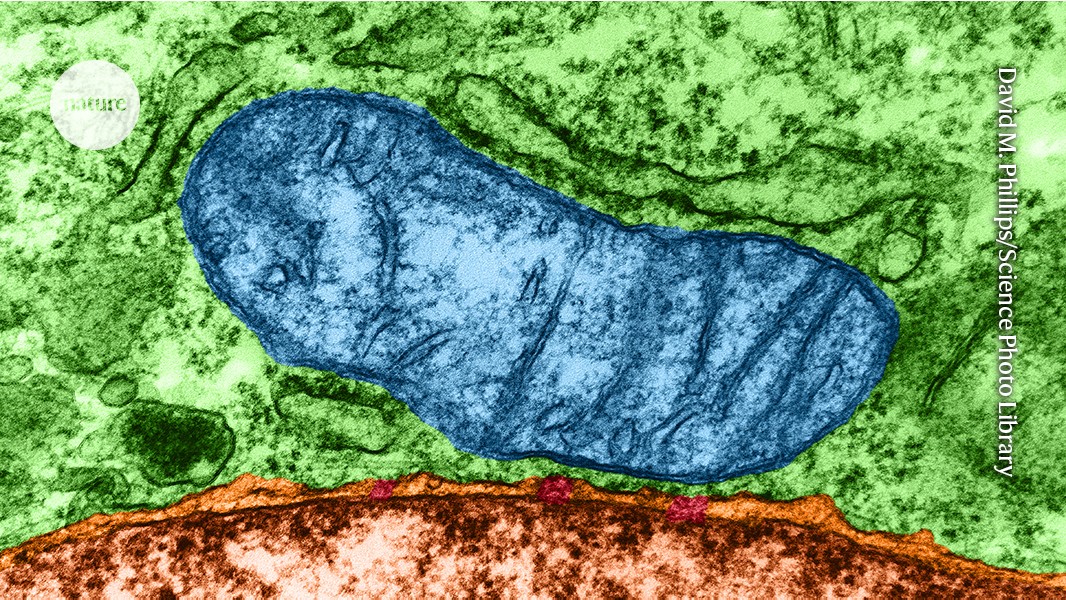
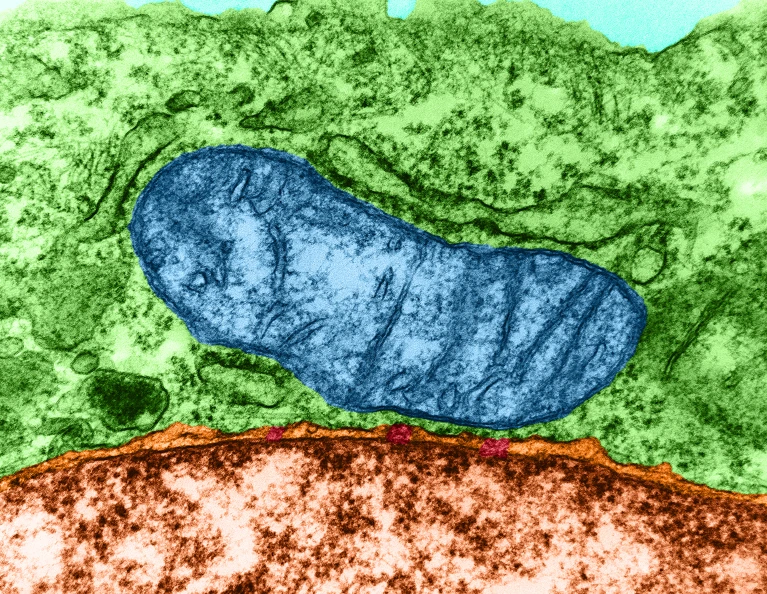
Researchers are discovering that mitochondria (blue), known as cells’ power plants, also play parts in cells’ immune responses.Credit: David M. Phillips/Science Photo Library
When a parasite invades a cell, the cell’s mitochondria react by shedding their outer layers to form brand-new cellular compartments — or organelles — that digest molecular trash.
Cells are swapping their mitochondria. What does this mean for our health?
The team that made the discovery showed that when the mitochondria — best known as cells’ energy producers — form these organelles, it helps the parasite to proliferate, although it isn’t clear exactly how. Maybe the parasite ‘feeds’ off the degraded material inside the tiny compartments, says team leader Lena Pernas, an immunologist at the University of California, Los Angeles.
But one thing is certain, Pernas said when presenting the findings at a Keystone symposium on mitochondrial signalling, held in Colorado in February: “Mitochondria are able to give rise to new organelles during infection.”
The discovery, posted on 24 April to the preprint server bioRxiv1 ahead of peer review, adds to a growing list of roles that researchers are uncovering for mitochondria in immunity, including surveilling pathogens2 and coordinating immune signalling3. It also lends credence to the hypothesis that membrane sacs, or vesicles, shed by the earliest mitochondria gave rise to organelles in eukaryotes — a group of organisms, including plants and animals, whose cells have an enclosed nucleus and other intracellular compartments. If modern-day mitochondria can spawn new organelles, which have specialized jobs inside cells, it’s easy to imagine that their ancestors did, too.
Mitochondria manipulation
Pernas and her colleagues observed the formation of the organelles after infecting human cancer cells with the parasite Toxoplasma gondii, which can lurk in undercooked meat. A protein on the outer surface of the parasite latched onto a protein on the cells’ mitochondria, ‘pinning’ the tiny energy producers to T. gondii. These tethered mitochondria then began shedding their outer membranes, forming what are called structures positive for outer mitochondrial membrane (SPOTs). Remarkably, the SPOTs went on to engulf other organelles in the cells called lysosomes, which are acidified sacs that act as waste-disposal systems.
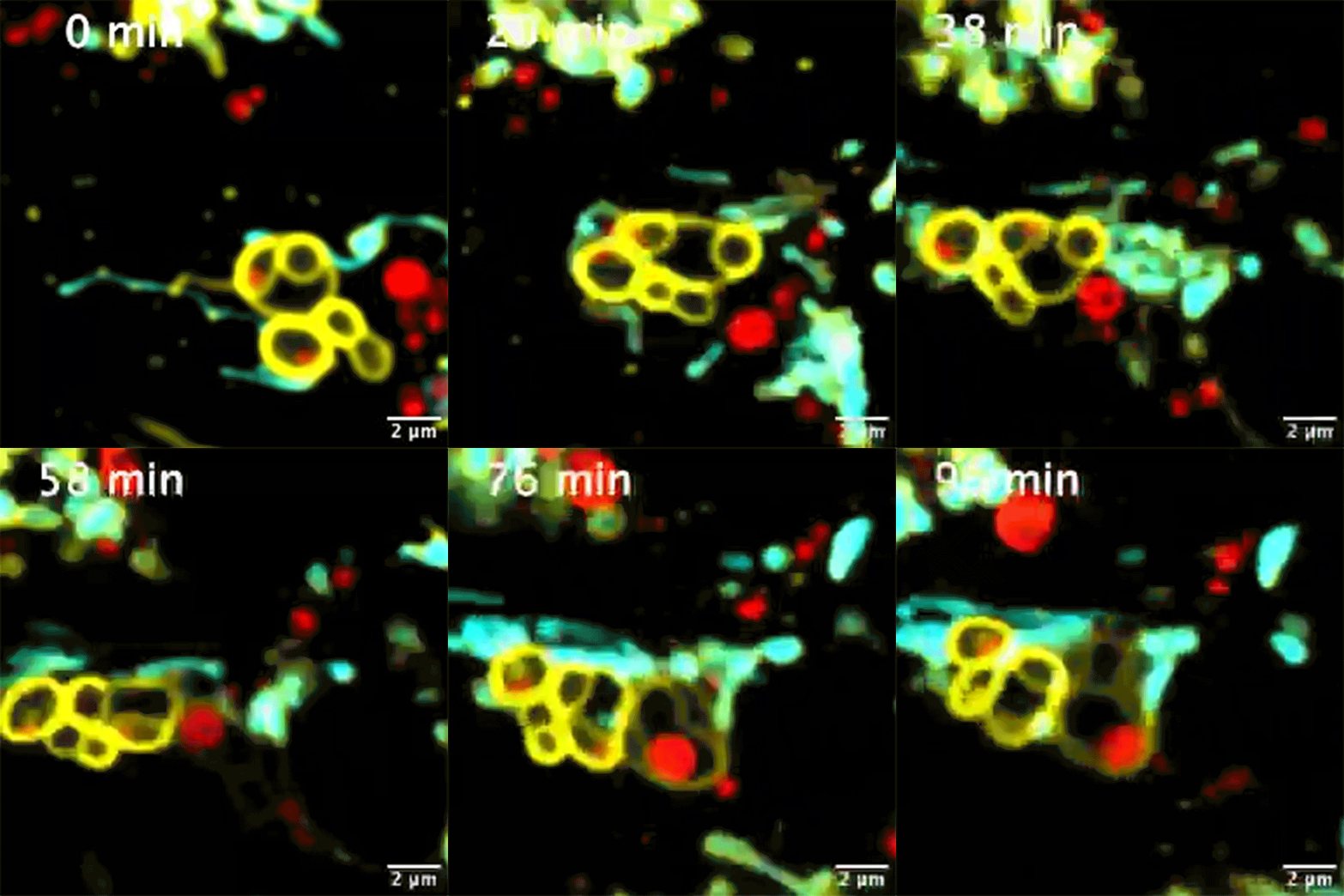
In this video, watch a large lysosome (red, near the centre of the screen) be enveloped by a SPOT (yellow).Credit: Dr. Xianhe Li
This envelopment of the lysosomes is quite the feat, says Shaeri Mukherjee, a cell biologist and immunologist at the University of California, San Francisco. “What is so cool and surprising is the ability of a pathogen to completely, not only manipulate the mitochondria, but use the mitochondria to generate an entire new organelle in the cell, with such precision,” says Shaeri Mukherjee, cell biologist and immunologist at the University of California, San Francisco.
The researchers confirmed that the SPOTs-engulfed lysosomes are a new type of organelle, different from lysosomes: the outer surfaces of the new organelles don’t bear any proteins typically expressed by lysosomes. They also demonstrated that to multiply, T. gondii needs the new organelles. When the researchers used a drug called a proton-pump inhibitor to prevent the SPOTs-engulfed lysosomes from acidifying — and therefore becoming waste-disposal systems — the parasite’s proliferation was impaired.
Interestingly, the SPOTs rarely engulf any other organelles inside cells other than acidified lysosomes. One reason the parasites might create the new organelles is to feed off their digested waste, Pernas says. Another could be that, by forcing the SPOTs to engulf lysosomes, T. gondii neutralizes the tiny waste disposers, which are harmful to pathogens, Pernas says.

