


You have full access to this article via your institution.
Hello Nature readers, would you like to get this Briefing in your inbox free every day? Sign up here.

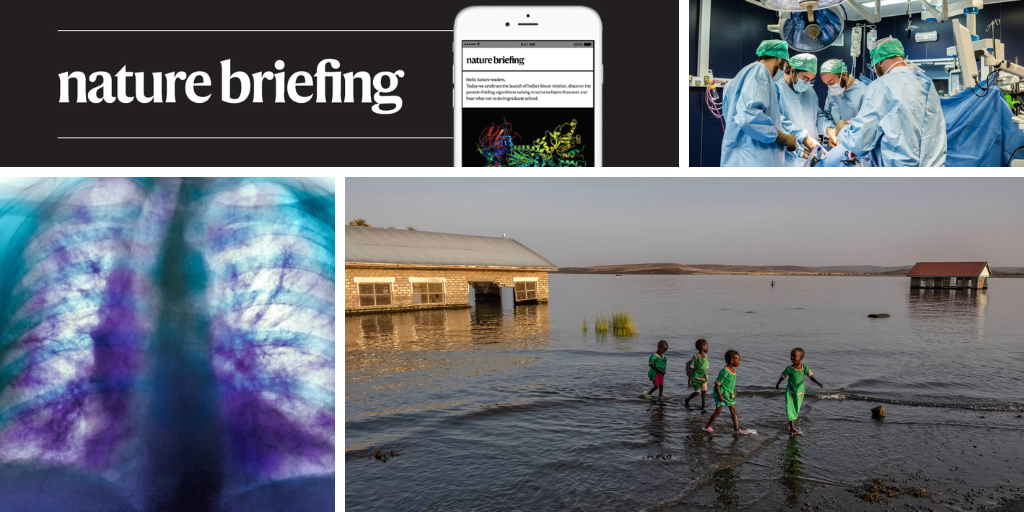
X-ray shows scarring in the lungs that occurs in people with idiopathic pulmonary fibrosis.Credit: SPL
Researchers have identified a genetic link between the lung microbiome and a mysterious lung-scarring condition called idiopathic pulmonary fibrosis (IPF). The team found that mice with a mutation to a gene called toll-like receptor 5 (Tlr5) are more susceptible to IPF than are mice without the mutation. This mutation results in a faulty copy of the TLR5 receptor, which is usually activated in response to lung injury and stops the overgrowth of harmful types of bacteria. A treatment that activated TLR5 prevented some fibrosis in a mouse model of IPF.
Reference: Science Translational Medicine paper
A single dose of engineered immune cells has helped three people with ‘highly sensitized’ immune systems to receive life-saving kidney transplants. People in this group are often ineligible for transplants because their bodies usually reject the donated organ. Researchers engineered the recipient’s own immune cells into chimeric antigen receptor (CAR) T cells that ultimately reduce the trouble-making antibodies that push their immune systems into overdrive. More than a year after receiving the cells, the three people are now living with new kidneys and without notable side effects.
Reference: New England Journal of Medicine paper 1 & paper 2
The administration of President Donald Trump has issued a far-reaching proposal to fundamentally overhaul federal science funding in the United States from 1 October. New proposed rules would put political appointees in control of federal grants; de-emphasize peer review; limit international collaborations; and restrict federal financial support for the publication of US scientists’ results in scientific journals. The proposed changes have been met with alarm by scientists, who are concerned that the moves will politicize research. “If it gets through, we’re screwed,” says psychologist Colette Delawalla, the director of the advocacy group Stand Up for Science.
Tech giant Microsoft has unveiled Majorana 2, a quantum chip that it says keeps the company on track to develop practical quantum computers faster than its competitors. Microsoft scientists report that the chip is able to hold information for more than 20 seconds, which is 1,000 times longer than its predecessor. Some researchers are sceptical. “I believe this is just another step in Microsoft’s almost decade-long track record of publishing unreliable results,” says experimental physicist Vincent Mourik.
Reference: arXiv preprint (not peer reviewed)
Features & opinion

Flooded buildings in Komote, Kenya, such as this primary school, have been overtaken by crocodiles looking for a safe place to breed. (Tommy Trenchard for NPR)
Lake Turkana in Kenya is the largest desert lake in the world and a UNESCO world heritage site. On its shores, the Leakey family and other palaeontologists discovered a trove of hominin fossils that transformed our understanding of human evolution. The lake’s levels have long fluctuated, but since 2018 it has been rising fast, overwhelming villages, drowning schools and destroying pastures. “It’s a complex web of interactions that created this situation,” says lake researcher Kevin Obiero, who points to tectonic activity, changes in weather patterns driven by climate change, and increased sediment flow into the lake caused by deforestation and agriculture.
In 2013, a team of researchers reported that some of the biochemical reactions associated with metabolism continued in soil samples after they’d been totally sterilized. Last year, they published results showing that microbe-free soil can keep these reactions up for a full six years. The findings suggest that some steps of the metabolic process are possible outside the boundaries of a cell — and could even predate life on Earth.
Reference: Biogeosciences paper (from 2013) & Science Advances paper (from 2025)
Some animals, such as mice and people, love to socialize. They love it so much that researchers suggest that the desire to spend time with others is a basic need in these species — with serious health consequences for going without. But exactly how much mingling an animal needs varies greatly between social species, and even within them. Neuroscientists are now searching the brain for the drivers of this need to be sociable, and why the right balance of networking and alone time differs between individuals.
Today I’ve got money on my mind. The Great British pound, to be specific.
The Bank of England have launched a public consultation to determine which of the United Kingdom’s wildlife species will earn a spot on their next cycle of banknotes. The 18 creatures vying for a place were selected by a panel of wildlife experts to avoid the blunders of previous UK-wide polls that sought nominations. I’m looking at you, Boaty McBoatface.
Let us know what you’d pick — along with any feedback on this newsletter — at [email protected].
Thanks for reading,
Jacob Smith, associate editor, Nature Briefing
With contributions by Flora Graham
• Nature Briefing: Careers — insights, advice and award-winning journalism to help you optimize your working life
• Nature Briefing: Microbiology — the most abundant living entities on our planet — microorganisms — and the role they play in health, the environment and food systems
• Nature Briefing: Anthropocene — climate change, biodiversity, sustainability and geoengineering
• Nature Briefing: AI & Robotics — 100% written by humans, of course
• Nature Briefing: Cancer — a weekly newsletter written with cancer researchers in mind
• Nature Briefing: Translational Research — covers biotechnology, drug discovery and pharma

