


Preparation of SWCNTs
If not stated otherwise, all chemicals were purchased from Sigma Aldrich (Germany). Unless specifically stated, all experiments were performed with (6,5)-enriched SWCNTs (Sigma Aldrich, Signis SG65i, CoMoCAT synthesis technology). For DNA-functionalized SWCNTs 150 µl of 2 mg ml−1 single-stranded DNA (for example, (GT)10) in 1× PBS buffer (pH 7.4) was mixed with 75 µl of 2 mg ml−1 SWCNT in PBS and 75 µl PBS, followed by tip sonication (Fisher Scientific, FB120, 120 W, amplitude 35%, 9 s pulse on and 1 s off, 15 min). The obtained solution was centrifuged for 30 min at maximum speed (21,000g), the supernatant was collected, and the procedure was repeated two more times. The final supernatant was stored at 4 °C until further experiments were performed. For (GT)10-SWCNT experiments in D2O, the PBS buffer was prepared with D2O instead of H2O.
The separation via aqueous two phase extraction (ATPE) of (6,4)-SWCNTs was performed according to the following protocol48. (DOC)-SWCNTs were mixed with polyethylene glycol (PEG) (molecular weight 6 kDa, 8% w/v), dextran (Carl Roth, molecular weight 70 kDa, 4% w/v), and the surfactants DOC (0.025% w/v), SDS (0.5% w/w) and SC (ranging from 0.5% to 0.9% w/w in 0.1% increments). The chiralities of SWCNTs in the two phases could be adjusted by adding HCl. Then, a one-step approach was used by adding a specific volume of HCl (hydrogen chloride) and NaClO (sodium hypochlorite) with 10–15% available chlorine for pH-driven and electronic separation, allowing the collection of monochiral (6,4)-SWCNTs in the bottom phase (B3). The solution was then dialysed (using a 300 kDa dialysis bag, Spectra/Por, Spectrum Laboratories) against a 1% DOC solution to remove dextran and obtain a stable 1% DOC-(6,4)-SWCNT solution.
For DOC-SWCNTs, 150 µl 2% (m/v) DOC in H2O was mixed with 150 µl of 2 mg ml−1 SWCNTs (in H2O), followed by tip sonication and centrifugation similar to the conditions for (GT)10-SWCNTs preparation. The acquired supernatant was stored at 4 °C. SDBS- and SC-functionalized SWCNTs were prepared according to the same procedure as DOC-SWCNTs.
Quantum defect introduction was performed according to a previously developed protocol49. Briefly, 20 µl of 4 mM 4-nitrobenzol diazonium tetrafluoroborate diazonium salt (dissolved in water) was added to 20 ml of 10 nM SDBS-SWCNTs solution. Then the mixture was irradiated with green light (550 nm) while stirring for 15 min. The obtained solution was mixed with the same volume of acetonitrile (ACN) and, consequently, the SWCNTs precipitated. The pellet was then washed with H2O two or three times to remove residual SDBS and ACN. Finally, the acquired precipitate was redispersed in 1% DOC by 15 min tip sonication followed by centrifugation for 30 min at 21,000 g. The collected supernatant was used for the experiments. The length of SWCNTs prepared by this procedure is about 600 nm (ref. 25).
All samples were colloidally stable in aqueous solution without signs of aggregation as confirmed by absorbance (Extended Data Figs. 1a and 2, and Supplementary Fig. 1), one-dimensional (1D) (Extended Data Fig. 1b,c) and two-dimensional (2D) fluorescence spectroscopy (Supplementary Figs. 2 and 3) and atomic force microscopy (average SWCNT length of around 600 nm; Supplementary Figs. 4 and 5). We also prepared chirality-pure (6,5)- and (6,4)-SWCNTs to exclude effects from impurities (Extended Data Fig. 2 and Supplementary Fig. 1).
NIR spectroscopy
One-dimensional fluorescence spectra
One-dimensional spectra of 0.5 nM (GT)10-SWCNTs with or without analytes (2 μM riboflavin and 100 μM ascorbic acid in aqueous solution) or 0.5 nM DOC-, SC- and SDBS-functionalized SWCNTs were measured in a custom-built setup based on an Olympus IX73 microscope and a solid-state laser (Quantum gem-561, 561 nm). The emission spectra were captured with an Andor iDus InGaAs 491 array NIR detector coupled to a Shamrock 193i spectrometer (Andor Technology).
Two-dimensional fluorescence spectra
The same setup as for 1D spectra was used. However, to obtain 2D excitation–emission spectra of 2 nM SWCNTs in various surfactants and (GT)10-SWCNTs in 1 × PBS (D2O) at pH 7.4, a monochromator (MSH150) equipped with an LSE341 light source (LOT-Quantum Design) was used for tunable excitation.
FCS measurements
FCS measurements were performed with a MicroTime 200 system (PicoQuant), equipped with pulsed lasers at 485 nm (LDH-C-D-485) and 530 nm (LDH-D-TA-530), an Olympus IX73 inverted confocal laser scanning microscope equipped with a 60× water objective (Olympus, numerical aperture 1.2, UPlanSApo), and single-photon avalanche photodiodes (SPADs) detectors (Excelitas Technologies). We focused on (6,5)-SWCNTs because of the limited sensitivity of the detectors in our FCS setup in the NIR region >1,100 nm. Samples at a concentration of 1 nM were excited with a pulsed laser at 485 nm, operating at a frequency of 40 MHz. DOC-(6,4)-SWCNTs showed weak emission when excited at 480 nm. Consequently, we used the 532 nm excitation. As the 532 nm laser could not achieve higher power levels in pulsed mode, we used CW excitation at 532 nm for this measurement, ensuring that the excitation power remained consistent. The emitted light was separated from the excitation light through a dichroic mirror (R405/488/532/635, Semrock), passed through a 900-nm long-pass filter (Thorlabs) to block the excitation light, and then focused onto a 50-μm pinhole and directed to the SPAD detectors. For DOC-(6,4)-SWCNTs, a 800-nm long pass filter (Thorlabs) was used. The refractive index and viscosity corrections were done by adjusting the collar settings50.
The autocorrelation function of the fluorescence intensity I is defined as
$$G(\tau )=\frac{\langle I(t)I(t+\tau )\rangle }{\langle I{(t)}^{2}\rangle }$$
(1)
G(τ) correlates the fluctuation of the intensity of a fluorophore at time t and after time lag τ.
Fluctuations arise because of the diffusive motion of the fluorophore through the 3D Gaussian confocal volume having widths wz and wxy. The correlation function corresponding to the diffusion is
$${G}_{D}({\tau })=\frac{1}{N}{\left[1+\frac{{\tau }}{{{\tau }}_{D}}\right]}^{-1}{\left[1+\frac{{\tau }}{{w}^{2}{{\tau }}_{D}}\right]}^{\frac{-1}{2}}$$
(2)
where N is the total number of molecules in the confocal volume and τD is the diffusion time of that system. It is linked to the diffusion constant D by
$${\tau }_{D}=\frac{{w}_{{xy}}^{2}}{4D}$$
(3)
The structural parameter \(w=\frac{{w}_{x}}{{w}_{{xy}}}\) was calibrated using the known Atto 488 dye (1 nM) in water (Dt = 400 μm2 s−1) (ref. 51). The calculated excitation volume was 1.5 fl.
To analyse the FCS data, the software Igor Pro 6.34 A and the following equation was used for fitting:
$${G}_{D}(\tau )=\frac{1}{N}{\left[1+\frac{\tau }{{\tau }_{D}}\right]}^{-1}{\left[1+\frac{\tau }{{w}^{2}{\tau }_{D}}\right]}^{\frac{-1}{2}}\,\left[1+\frac{T}{1-T}\exp {\left(-\frac{\tau }{{\tau }_{t}}\right)}^{\beta }\right]$$
(4)
where T is the fraction of the fluorescent molecules in the dark state and \({{\tau }}_{{t}}\) signifies the corresponding lifetime. The stretching exponent β is a marker for the degree of heterogeneity in the associated dynamics52.
FCS control experiments
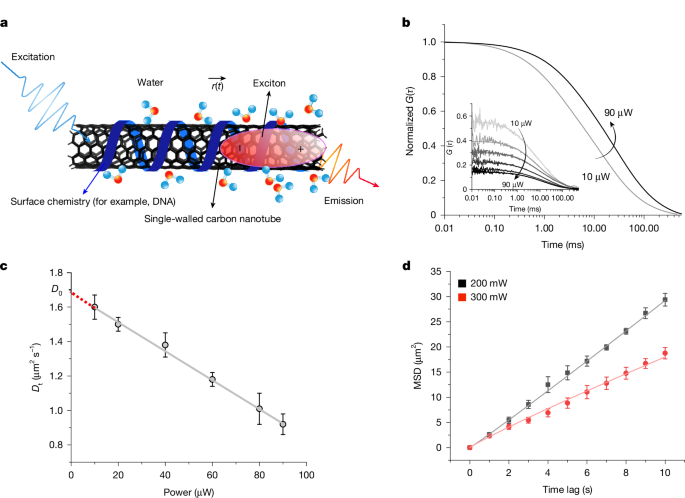
A control experiment under identical conditions was conducted with the dye Atto 488 (Supplementary Fig. 6a) and showed a slight decrease in G(0) value but no change in the normalized autocorrelation functions and the diffusion time (Supplementary Fig. 6b) under the same experimental conditions. This control experiment rules out effects from sample heating, which is known for surface-immobilized emitters53,54. Furthermore, we verified that the temperature of the samples remained constant for both 10 μW and 90 μW (Supplementary Fig. 9). Brightness of (GT)10-SWCNTs also increased linearly with laser power (Supplementary Fig. 7a), indicating the absence of non-linear effects such as exciton–exciton annihilation. The increase in the number of (apparent) fluorescent particles (Fig. 1b) from 3 to 9.3 in the confocal volume with higher laser power (Supplementary Table 1) can be attributed to the relatively small quantum yield of NIR fluorophores such as SWCNTs (refs. 55,56), which means that they are not saturated by excitation. Moreover, the diffusion behaviour of (GT)10-SWCNTs could be reversibly switched by changing the excitation power (Supplementary Fig. 7b). We also performed FCS measurements of chirality-purified (GT)10-(6,5)-SWCNTs and found that the diffusion behaviour was similar to that of the normal (GT)10-SWCNTs (Supplementary Fig. 8 and Supplementary Table 2), which shows that sample purity is high in all cases and does not affect diffusivity.
Although most FCS experiments employed pulsed excitation to collect more information (for example, lifetime), FCS using CW excitation showed the same results (Extended Data Fig. 7a,b and Supplementary Table 14). This finding suggests that the diffusion behaviour of SWCNT (on the ms timescale) is less affected by the excitation timing (ps timescale) but rather the overall absorbed energy.
As a control, to assess whether analytes induce aggregation or dissociation of SWCNTs, we measured the absorbance spectra. They remained unchanged for both analytes (Supplementary Fig. 13). Thus, chemical manipulation affects diffusion the same way it affects exciton concentration (quantum yield). These results allow to exclude that the change in diffusion is an optical artefact. It is distinct from trapping of objects by light with optical tweezers57.
We also investigated a 80% glycerol/water mixture and observed almost no changes in diffusion (Extended Data Fig. 3b and Supplementary Table 4). By contrast, for a 20% glycerol/water mixture, we observed power-dependent changes in the diffusion constant similar to those of water (Extended Data Fig. 3c and Supplementary Table 5). Previous THz spectroscopic studies demonstrated that when the glycerol concentration is below 20%, the number of water molecules hydrogen-bonded to glycerol continues to increase. By contrast, at concentrations above 40%, the number of hydrogen-bonded water molecules decreases because of the overlap of hydration shells58.
To further understand the entanglement of excitation and diffusion in the FCS geometry, the random walk of SWCNTs in a box with a confocal laser volume was simulated (Supplementary Fig. 22). The results (Supplementary Fig. 23) qualitatively confirmed that changes in the diffusion by excitation of excitons in moving and rotating SWCNTs lead to the power-dependent changes of the autocorrelation functions observed in the experiments (Fig. 1).
THz measurements
The OPTP spectrometer was described in detail previously36. In summary, the system uses 50 fs, 800 nm laser pulses generated by a Ti:sapphire-amplified laser to produce a broadband THz probe pulse using a two-colour air plasma filament59. Part of the 800-nm-wavelength laser radiation is frequency-doubled in a BBO (beta barium borate) crystal to generate 400 nm light, which serves as the optical pump. We measure the changes in THz absorption on optical excitation as a function of pump–probe delay, Δt, between 0.25 ps and 300 ps by using a mechanical delay stage. To eliminate interference effects and the excitation of free charge carriers, we used a windowless, free-flowing jet with a thickness of 20 μm as the sample36. An 80 ml solution of SWCNTs (about 100 nM) was circulated in the jet for 96 h. A defoaming agent (BYK 025) was added to the reservoir to prevent foam generation. This defoaming agent remains as a thin film on the surface and does not interfere with the sample measurements. The THz field is detected using electro-optic sampling with a 100 µm thin gallium phosphide (GaP) crystal. For further analysis, the electric fields are Fourier-transformed. The difference in THz transmission before and after optical excitation is expressed as ΔmOD. Positive values indicate a decrease in transmission on optical excitation. The fluence of the blue light was varied from 50 mJ cm−2 to 120 mJ cm−2 and then to 200 mJ cm−2. As a reference, we also measured pure water at a fluence of 200 mJ cm−2. In the plots, we show data for a fluence of 200 mJ cm−2, unless stated otherwise.
Wide-field tracking of SWCNTs
A 2.3 µm Mylar thin film (TF−125-225-F from Fluxana) was used as a spacer and placed between two glass cover slides to create a narrow flow-chamber-like volume. Subsequently, 50 µl of a 0.1 nM purified DOC-SWCNT solution was added. Single-walled carbon nanotube (SWCNT) tracking was performed using a custom-built setup. A 561 nm laser (Cobolt Jive 500, 200 mW, 100 W cm−2) was coupled to an Olympus IX73 microscope equipped with a 100× (UPlanSApo 100×/1.35 Sil, Olympus) oil-immersion objective. Imaging in the NIR was performed with a InGaAs camera (Cheetah, Xenics 640, 640 × 512 pixel, thermoelectrically cooled). A dichroic mirror (VIS/NIR, HC BS R785 lambda/5 PV, F38-785, AHF) and a 900 nm long-pass filter (FELH0900, Thorlabs) were installed in the beam path between the objective and the cameras. The NIR images were typically acquired at 7 frames per second (fps) with a 140 ms exposure time. All analyses were conducted using Python 3.10.5. For particle tracking, the Python library trackpy was used to identify bright spots corresponding to individual SWCNTs. We analysed only traces above a certain length (typically 100 frames). The analysis determines the x and y centre-of-mass coordinates of particle positions. From the trajectories, we calculated the ensemble time-averaged mean squared displacement (MSD)60.
Computation of friction and diffusion in water
The classical atomistic molecular dynamics simulations were run with an open source LAMMPS (Large-scale Atomic/Molecular Massively Parallel Simulator)61 to estimate the interfacial friction coefficient and diffusion of graphene and (6,5)-SWCNTs in explicit water. The models for graphene slab (2.5 × 2.6 nm2) with 1,600 water molecules and (6,5)-SWCNTs (3 × 3 × 4.1 nm3) with 1,100 water molecules systems were created in Material Studio62. For the calculation of the interfacial friction, the graphene system used is periodic in the x–y directions and non-periodic in the direction perpendicular to the surface, whereas all the CNT systems are 3D periodic with an infinite nanotube along the axial direction. Both non-polarizable and polarizable systems are analysed with harmonic consistent valence forcefield (CVFF)63 and interface force field-CVFF (IFF-CVFF)64 parameters, respectively (Supplementary Table 17), which use 12-6 LJ potential for the van der Waals interactions. In the non-polarizable model, the carbon atom C is neutral and only has LJ interactions with the water, whereas in the polarizable model, each carbon is decorated with two flexible negatively charged dummy atoms that mimic the π-orbitals and are perpendicular to the plane of C atoms. The dummy atoms are connected by harmonic bonds and angle restraints (Supplementary Table 17 for parameters). A similar simple model to include the metal polarization, which consists of a LJ potential and a harmonically coupled core–shell charge pair for every atom has been recently developed and proved to reproduce the classical image potential of adsorbed ions as well as surface, bulk and aqueous interfacial properties in agreement with experiments44. Here, two layers of virtual atoms sandwich the carbon layer in between to form a single graphene sheet or SWCNTs (Extended Data Fig. 8a,b). The dummy atoms mimic the π-electron cloud and add polarizability to the carbon atoms43. The polarizable carbon carries a partial positive charge (+2δ) and the two dummy atoms carry a negative half charge (−δ), so the overall C atom is neutral. However, there is an additional dipole contribution to each C atom. Hence, polarizable graphene/SWCNTs also have a columbic interaction with the surrounding water.
The Green Kubo (GK) friction coefficient has been calculated to estimate the strength of the interfacial interaction of water with the graphitic surfaces65,66 (Extended Data Fig. 10e), according to the formula
$${\lambda }_{\mathrm{GK}}=\frac{1}{{An}{K}_{{\rm{B}}}T}{\int }_{0}^{\infty }\langle \mathrm{FL}({\rm{t}})\mathrm{FL}(0)\rangle $$
(5)
where A is the area of the surface, n is the number of dimensions (n = 2 for graphene and 1 for CNT), KB is the Boltzmann constant, T is the temperature and FL is the lateral force acting on the surface for graphene or the force along the axial direction for the CNT. The integral of the autocorrelation of FL is used to compute the GK friction coefficient as per equation (5). The friction coefficient for non-polarizable graphene and (6,5)-SWCNT was computed with the CVFF parameters, and for polarizable graphene and (6,5)-SWCNTs was computed with the IFF-CVFF polarizable model44,64.
We observe a higher friction coefficient of around 6.5 × 10⁴ N s m−3 at the graphene interface with the polarizable model as compared with 2 × 10⁴ N s m−3 for non-polarizable graphene, which is also the typical value observed with other force fields4. Notably, the value for the friction coefficient obtained with our polarizable model is in very good agreement with the ab initio estimates of 4.5 × 10⁴ N s m−3 (ref. 66) and 9.5 × 10⁴ N s m−3 (ref. 67) obtained with revPBE-D3 and optB88-vdw functional, respectively (Extended Data Fig. 8e). We also observed that the friction coefficient increases for water in contact with the external surface of SWCNTs from 6.5 × 10⁴ N s m−3 for the non-polarizable model, to 15 × 104 N s m−3 for the polarizable model. The result for the polarizable model is in good agreement with ab initio molecular dynamics results from a previous study67. Hence, the new polarizable model permits reproducing electronic structure level accuracy at the cost of simple classical force field simulations, introducing the interaction of the polarizable electron cloud with the polar solvent. With the new and improved IFF-CVFF polarizable model, we also estimated the diffusion behaviour of (6,5)-SWCNTs. The latest IFF-CVFF polarizable graphite model (Supplementary Table 17) has been validated with rigour by reproducing bulk properties such as density and bulk modulus, and interfacial properties such as surface energy, hydration energy and water contact angle, which are in excellent agreement with experimental observations and are suitable for model graphitic materials in various applications.
The diffusion constant was computed with a (6,5)-SWCNT of length 4.1 nm placed inside a cubical 3D periodic box of 140,000 water molecules modelled with flexible SPC parameters (CVFF). After pre-equilibration of the simulation box in an isothermal–isobaric (NPT) ensemble, the simulation trajectory was run for another 20 ns with a timestep of 0.5 fs, and a coordinate snapshot was generated every 1 ps. The (6,5)-SWCNT was end-capped with hydrogen atoms and allowed to diffuse inside the box unconstrained with the NPT ensemble at 298 K and 1 atm. Hydrogen parameters are borrowed from the CVFF models. The trajectory was analysed to compute the MSD of the centre of mass of the SWCNT with time. The slope (m) of the MSD compared with time plot was used to evaluate the diffusion constant D = m/6. The diffusion constant was calculated for both non-excited and excited SWCNTs.
The process of exciting the SWCNT, in molecular dynamic simulations with a classical potential, is modelled by introducing an exciton by the addition of an axial dipole along the SWCNT axis, as described in the main text. The charges of 44 virtual/dummy (pi cloud) atoms are modified by ± 0.005 e so that the total charge is 0.22 e (44 virtual sites × 0.005 e per virtual site) in the polarizable case, whereas, for the non polarizable SWCNT model, the annular each region is composed of 22 carbon atoms with a charge of ± 0.01 e each to generate the excited state nanotube (Extended Data Fig. 9). This initial choice was motivated by introducing a moderate perturbation to maintain the stability of the simulation system and avoid crashing by overpolarization. Exact ± 1 would correspond to exactly one exciton present always throughout the experiment. However, smaller values are more likely because of lower exciton density (due to the average of excited and non-excited time periods in pulsed as well as CW excitation schemes and the longer SWCNT length in experiments). We also investigated the friction coefficient for dipole-free excitation of the SWCNT (Extended Data Fig. 10, Supplementary Fig. 21), in which the two outer rings (blue) carry an additional −0.005 e charge on the 44 atoms in each ring, behaving as a delocalized electron. The delocalized hole is modelled using a central ring (red) composed of 44 atoms, each carrying an extra charge of + 0.01 e. In this charge configuration, the SWCNT dipole moment is negligible compared with the excited configuration shown in Extended Data Fig. 9, in which two rings describe a delocalized exciton. The polarizable nature of the electron cloud and excitons is analysed using molecular dynamics. The dynamic nature is captured mildly by separate simulations with 1 nm and 2 nm dipoles, then averaging the MSD. The true translational nature of the exciton along the length of the SWCNT is beyond the scope of molecular dynamics runs, as these studies require (1) extremely long SWCNTs that are hundreds of nanometres long and (2) a special implementation of varying charges with time on atoms in standard simulators such as LAMMPS, both of which are beyond the scope of this work.

