


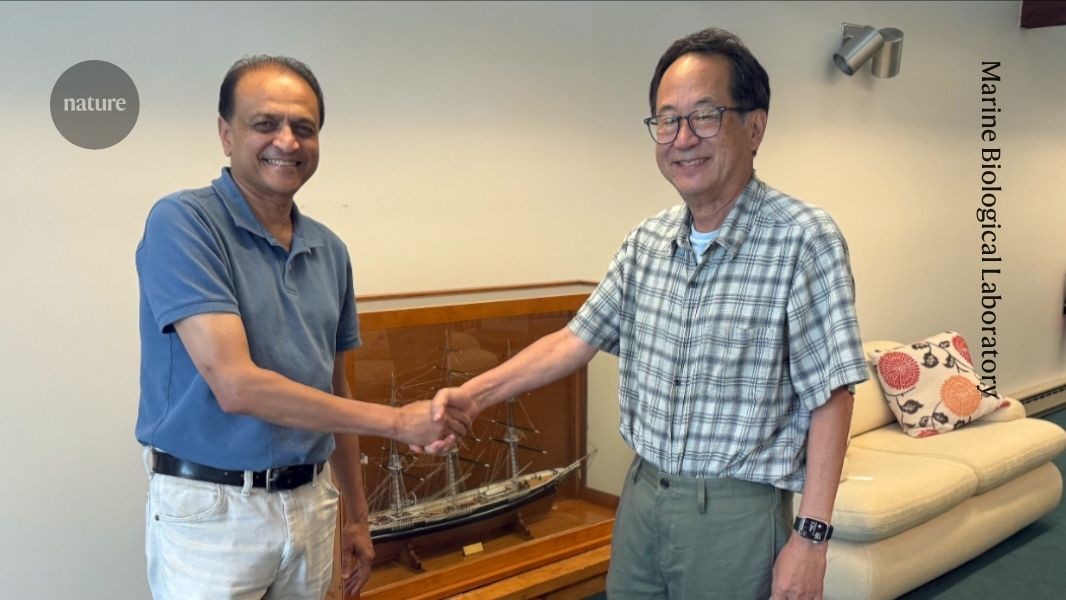
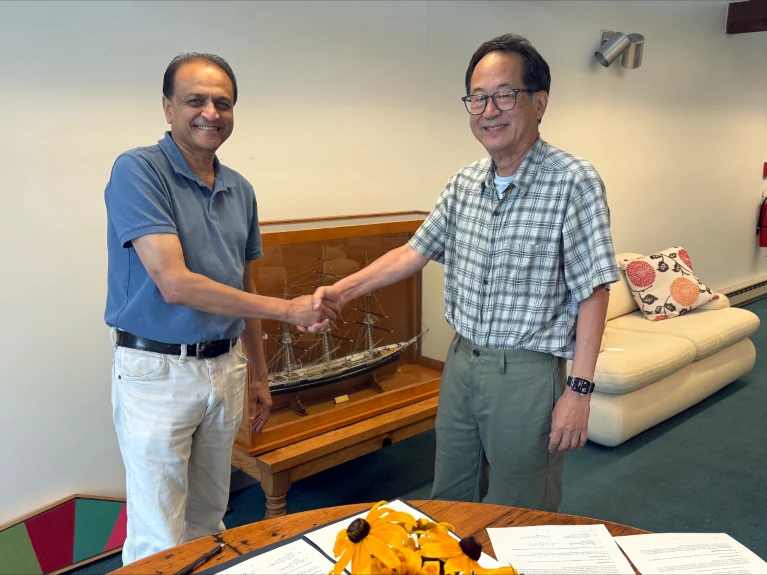
Cell biologist Mark Terasaki (right) has pledged to give US$25 million to the Marine Biological Laboratory in Woods Hole, Massachusetts, over the next five years.Credit: Marine Biological Laboratory
To the people of Woods Hole in Massachusetts, and to the researchers working at the renowned 138-year-old Marine Biological Laboratory (MBL) there, cell biologist Mark Terasaki has become a local celebrity. Since his US$25-million donation to the MBL was announced, people on the streets and at local shops have been stopping him and thanking him for his generous gift. For him, it was an easy decision to give back to an institution and a community that he has been a part of for more than 40 years, and one that has been a leading force in the fields of basic and marine science.
Although he is a faculty member at the University of Connecticut in Farmington, like many scientists around the globe, he rents a laboratory at the MBL every summer to do research. Many researchers see the MBL as a scientific oasis and researcher melting pot of sorts, away from the obligations of their home institutions, and a place to mentor young scholars.
The MBL has a history of nurturing groundbreaking molecular-biology discoveries in its labs and has hosted more than 60 Nobel laureates. Situated on the edge of Cape Cod in Massachusetts and surrounded by water, it is also known for the summer courses and research experiences that it offers to aspiring early-career scientists.
Terasaki did his first stint at the MBL in the summer of 1986. He was a postdoctoral researcher in the structural neuroscience lab of Tom Reese, who was at the MBL and then the US National Institutes of Health in Bethesda, Maryland. Terasaki would go on to spend two full years as well as seven summers working with the Reese lab at the MBL, after which he started his own lab in 1995 in Connecticut. To him, the MBL felt like a “fairy tale” — the epitome of “what science and research should look and feel like when you were aspiring to be a scientist”.
Will the public support basic science? A new non-profit aims to find out
Now, Terasaki’s lab uses high-powered imaging to understand how cells and cell membranes are organized. Last July, Terasaki pledged to bestow the single largest individual donation to the MBL that the institute has ever received. He plans to give $5 million to the MBL annually for the next five years to offset the overhead costs associated with running core facilities and labs, and other financial strains. The donation comes during a turbulent time for research. The administration of US President Donald Trump has terminated thousands of grants and threatened to severely limit overhead costs through grant funding. Some universities have also considered cutting funding for partner research institutions such as the MBL. Terasaki spoke to Nature about what the MBL means to him and his motivations for making the donation.
What is special about the lab atmosphere at the MBL?
In general, the MBL is not modern or fancy; it’s kind of basic. It attracts people who are good at problem-solving and working with what they have, rather than having something already set up for them. There are a lot of interesting people there who come from all over the United States and all over the world. So that’s also very stimulating.
What motivated you to give such a large donation?
The MBL spends around $50 million annually, and over the past decade it has often been around $10 million short of breaking even every year. To cover the deficit, it has been drawing from its endowment and using supplemental funding from the University of Chicago in Illinois for the past 14 years. Just by happenstance, I have money that I can donate. I have such positive feelings about the MBL, but I’m not the only one. So, I’m doing this on behalf of a whole bunch of people, who I know would do the same thing if they could.
My father, Paul Terasaki, an organ-transplant scientist, was energetic, productive and really good at managing people. When he was 55, he started a biotechnology company called One Lambda. It was very successful and, after my father died, my family received a lot of money that had come from the sale of the company.

