


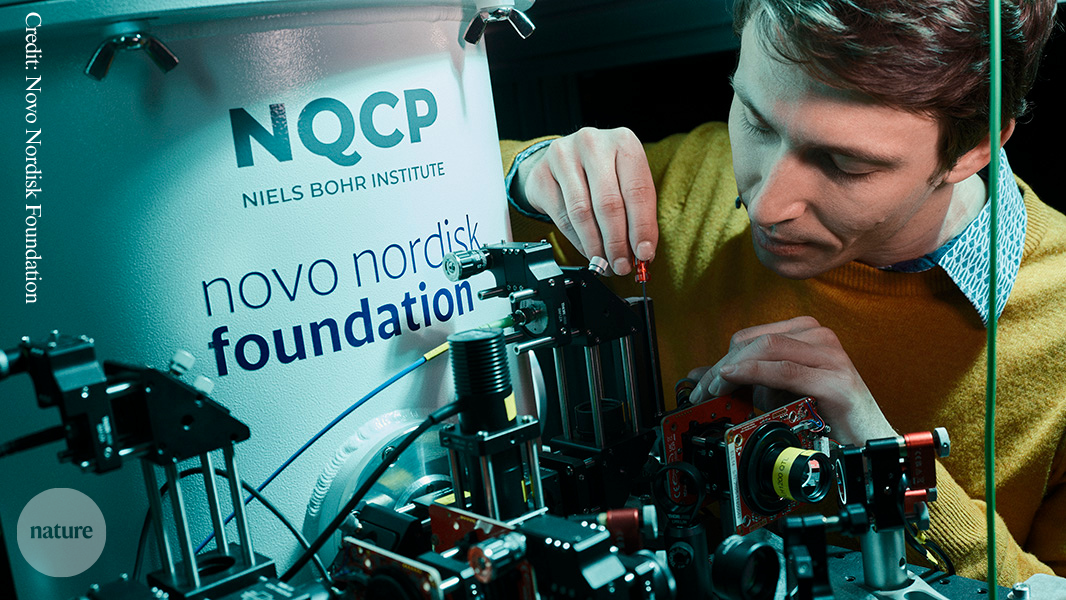
The Novo Nordisk Foundation is one of the philanthropic organizations funding research, such as that at the Niels Bohr Institute, Copenhagen.Credit: Novo Nordisk Foundation
Jim Simons, a US hedge-fund manager, used mathematical modelling and algorithms to make huge returns on financial investments. By the time Simons died in 2024, he was worth an estimated US$31 billion. In 1994, he and his wife, the economist Marilyn Simons, established the Simons Foundation, a major philanthropic funder of mathematics and basic science in the United States. By contributing billions of dollars to the foundation and other philanthropic causes during his lifetime, he hoped to continue generating scientific returns on his investment for many years after his death.
For decades, philanthropic organizations have been growing in importance as a source of science funding. Between 1980 and 2023, the share of funding for basic and applied research done at US universities and non-profit research organizations provided by philanthropic foundations increased from 10% to 16%, and the federal government’s contribution fell from 66% to 50%, according to the Science Philanthropy Alliance, a New York City-based coalition of private philanthropic funding organizations. Across the Atlantic, spending on medical research by members of the Association of Medical Research Charities in the United Kingdom grew from less than £1.3 billion (US$1.7 billion) to almost £2 billion between 2012 and 2022.
Nature Spotlight: Philanthropy and awards
Several factors are probably behind the rise in philanthropic funding, says network scientist Louis Shekhtman at Bar-Ilan University in Ramat Gan, Israel. “These include the concentration of wealth in the hands of a few individuals, some of whom have made money through technology and science and are wanting to give something back,” he says, as well as a reduction of US government funding on an inflation-adjusted basis. There is also an increase in the number of organizations providing support. The Science Philanthropy Alliance, for example, has grown to more than 40 member foundations since it launched in 2014. But competition for the research funding that foundations provide is also on the rise.
Wellcome, the largest independent science-funding foundation in the United Kingdom, for example, received almost 4,300 applications for grants through its open competitive schemes in the 2024–25 period (October 2024 to September 2025), up from around 2,700 the previous year (see go.nature.com/4snk2kd). Ben Murton, who runs Wellcome’s funding for early- and mid-career researchers, says that as well as rising demand, a small part of this increase could be due to variations in the numbers and types of scheme on offer. “We are one of many research funders seeing an increase in grant applications,” he says. “The intel we’ve got is that the number of applicants has been going up across the sector in recent years.”
As both the number of philanthropic foundations and the demand for their support grows, it has become increasingly important for researchers to understand these organizations’ funding processes. Nature spoke to representatives of three foundations to identify the type of research they prioritize and how those seeking this financing can maximize their chances of success.
Models of support
The levels of support that scientists receive from philanthropic foundations vary a lot by country. So, too, do the ways in which the foundations fund research. Philanthropic funding can include grants to universities and institutes; funds for cutting-edge equipment and facilities; payouts from endowments to institutions; and competitive funding opportunities open to individuals or project-based collaborations.
Foundations also have varying priorities when it comes to the disciplines and subjects that they support. “Learn as much as you can about the foundations that are relevant to your research, and identify which ones have visions and missions that your work can contribute to,” says Steffen Pierini Lüders, chief corporate affairs officer at the Novo Nordisk Foundation, a philanthropic organization in Hellerup, Denmark, which owns 28.1% of the Danish pharmaceutical company Novo Nordisk.
The Novo Nordisk Foundation’s three focus areas are health, sustainability and the local life-science ecosystem. Wellcome divides its funding grants between solutions-orientated projects in three priority areas — climate and health, infectious diseases, and mental health — as well as a separate stream of discovery research to improve human life, health and well-being. And the Alfred P. Sloan Foundation (known as the Sloan Foundation) in New York City focuses its support on topics including astronomy, economics and origins-of-life research .

Fermentation experiments at the Technical University of Denmark in Lyngby, where the Novo Nordisk Foundation has funded many research projects.Credit: Novo Nordisk Foundation
Whereas government funding bodies are constrained by regulatory oversight and can be risk-averse, philanthropic organizations have greater freedom to take risks and address contemporary challenges, says Evan Michelson, a Sloan Foundation programme director. “Foundations have a degree of flexibility that can be challenging for government funders, and so may be better placed to support timely research more quickly.”
For example, there are widespread concerns about the rapid growth of energy use by data centres, mainly as a result of the recent artificial-intelligence boom. Last year, anthropologist Kristin Phillips at Emory University in Atlanta, Georgia, and her colleagues were awarded $1 million by the Sloan Foundation to study the costs and benefits of new data centres in Georgia, Tennessee and Virginia. Phillips’s team, which includes environmental and human geographers, received funding through the Sloan Foundation’s open call for interdisciplinary research projects.
“Bringing together researchers from different disciplines leads to much more interesting and innovative scholarship,” says Michelson. “Organizing around interdisciplinary problem spaces is one of the things foundations can often do better than can government funders whose funding structures are often set up along disciplinary lines.”

Meeting the moment: how scientific philanthropies are expanding their reach
Michelson, who wrote the 2020 book Philanthropy and the Future of Science and Technology, says that foundations are also well placed to support other categories of research that can fall outside remits of government funding bodies. “They have greater flexibility to focus more on catalytic research, which begins an investigation into a new field or set of questions, and gap-filling research — components within a project or a field that don’t fit into the priorities of research-funding agencies.”
For example, until a few years ago, many people working in industry and government in the United States generally assumed that the burning of methane that is produced as a by-product during offshore oil and gas production through ‘flaring’ was 98% efficient in destroying the gas, on the basis of studies at onshore sites. After receiving a Sloan Foundation award of more than $1.4 million, engineer Eric Kort, now at the Max Planck Institute for Chemistry in Mainz, Germany, and his colleagues showed that flares broke down methane with 91% efficiency. Therefore, they showed that real-world offshore emissions were around five times higher than previously thought (G. Plant et al. Science 377, 1566–1571; 2022).
Researchers in the United States applying for funding should also know that many foundations prefer to support projects close to home. Shekhtman and his colleagues found that around 35% of grants and 49% of funds from philanthropic organizations go to recipients in the same state as the donor (L. M. Shekhtman et al. Sci. Rep. 14, 9397; 2024). “That may be because of social networks, alumni effects or because they have secondary aims, such as supporting the local economy,” says Shekhtman.

Physicist Luciano Masullo received an early-career award from the UK foundation Wellcome.Credit: Maxi Masullo
Some foundations focus explicitly on supporting early-career researchers. In 2021, Wellcome reduced its discovery-funding streams to three based on career levels, with one dedicated to early-career researchers. The change was designed to give researchers flexibility in the amount and duration of funding that they apply for.
Earlier this year, physicist Luciano Masullo began setting up his own group at the Institute of Biology and Experimental Medicine in Buenos Aires, after receiving a five-year Wellcome early-career award. He is using advanced imaging tools to investigate aspects of cell signalling, particularly receptors known as glycoimmune checkpoints, which could be targeted to address resistance to certain cancer immunotherapies. “I’m excited the award will enable me to build a state-of-the-art lab and an interdisciplinary team to do super-resolution, molecular-scale imaging at a level that is not currently possible anywhere in Latin America,” says Masullo.
Planning your strategy
Applicant success rates for fellowships and competitive funding calls vary between foundations, but across many programmes and organizations, they are falling owing to increased competition. In its open competitive schemes, Wellcome funded 16.6% of applicants in 2024–25, down from 22.3% the previous financial year. Last year, the Sloan Foundation received more than 1,430 nominations for the 126 two-year, early-career researcher fellowships it offers annually — the most it has received since launching the programme in 1955, and 26% up on 2024.

