


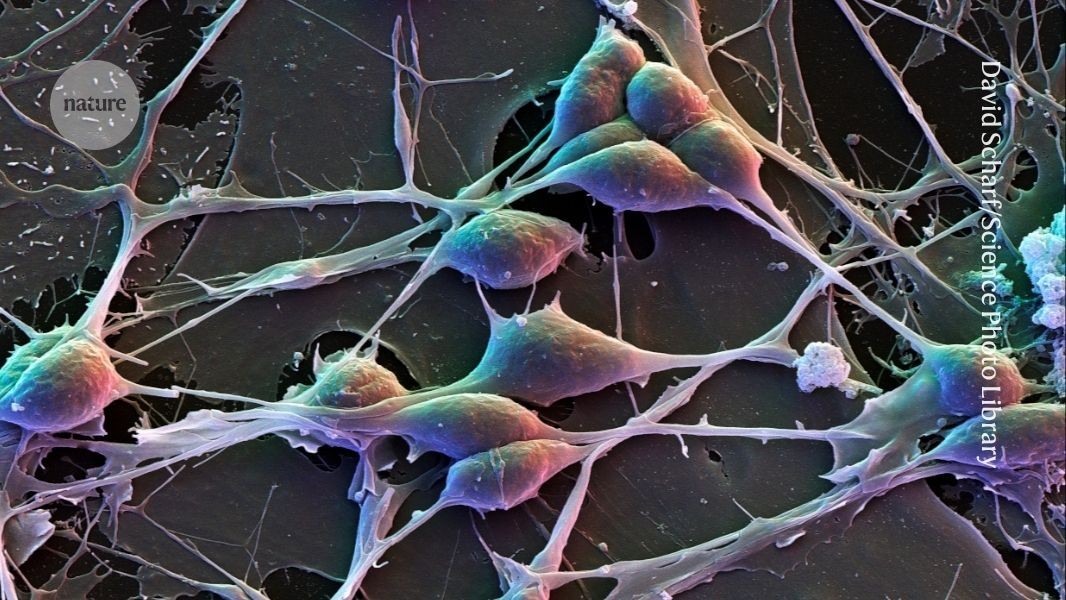

Researchers found sex differences in the activity of genes within cortical neurons (pictured) and other brain cells.Credit: David Scharf/Science Photo Library
By analysing more than a million brain cells, researchers have uncovered widespread differences in patterns of gene activity between male and female brains.
The work, which defined sex on the basis of a person’s combination of sex chromosomes, could help to explain why the risk of developing some brain conditions — such as schizophrenia and Alzheimer’s disease — differs between males and females.

First atlas of brain organization shows development over a lifetime
Although the differences were subtle, the team identified more than 100 genes that showed consistent variation in their expression between males and females across several brain regions. The work was published on 16 April in Science1.
“Having these gene-expression signatures provides a molecular handle to understanding the biology of how the brains of men and women might be functioning slightly differently in the context of the different hormonal environments that their bodies produce,” says Jessica Tollkuhn, a neuroscientist and molecular biologist at Cold Spring Harbor Laboratory in New York. She adds that “understanding sex differences in disease susceptibility could lead to better treatments to benefit everyone”.
Subtle differences
Previous studies2,3 have documented sex differences when it comes to a person’s risk of developing various neurological conditions. For example, schizophrenia, attention deficit hyperactivity disorder (ADHD) and Parkinson’s disease are more common in biological males — who typically have XY sex chromosomes. By contrast, Alzheimer’s disease and mood disorders such as depression and anxiety tend to be more common in females, whose sex chromosomes are usually XX.
“What underlies that has been a central question,” says Tollkuhn. Sex differences in the brain tend to be “extremely subtle”, she explains. “Most of the brain doesn’t show sex differences in its day-to-day function.”
However, molecular-level differences in the expression of genes between male and female brain cells could “modulate the impact of disease variants”, says study co-author Alex DeCasien, a computational and evolutionary biologist at the US National Institute of Mental Health in Bethesda, Maryland.
How fast your brain ages is affected by these 64 genes
To explore this, DeCasien and her colleagues studied cells from six regions of the brain’s cortex, identifying some 680,000 excitatory neurons and 290,000 inhibitory neurons, as well as 270,000 glial and other cells in tissue samples from 30 people.
In an analysis of more than 4,300 genes, the team reported that sex accounted for less than 1% of variation in gene expression across the brain cells. “This finding fits with what we already know about human variation — there is a lot more variation within a sex than between sexes,” says Donna Maney, a neuroscientist at Emory University in Atlanta, Georgia.

