


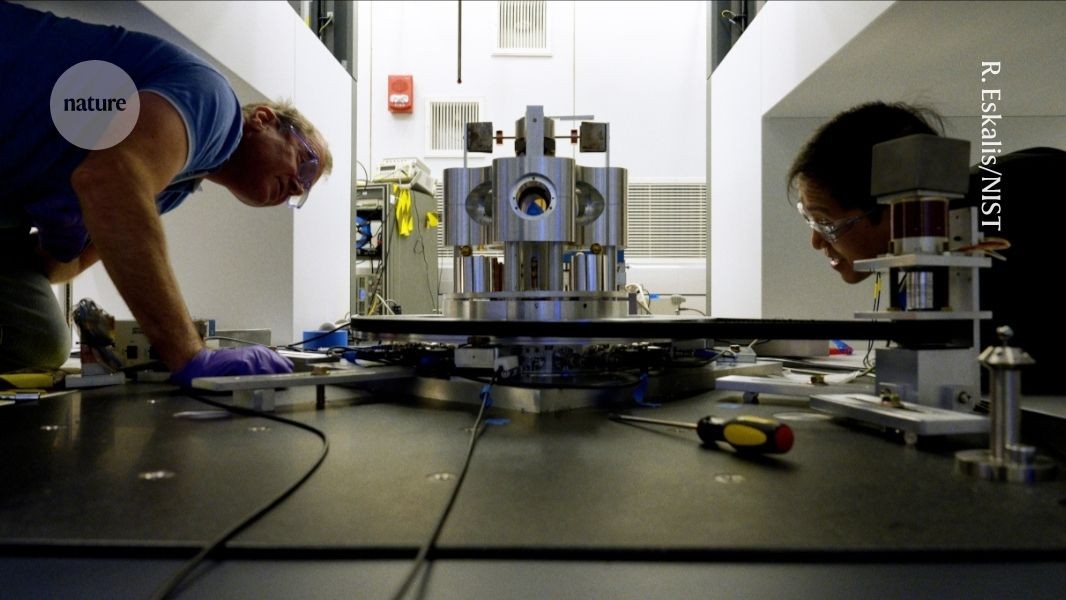
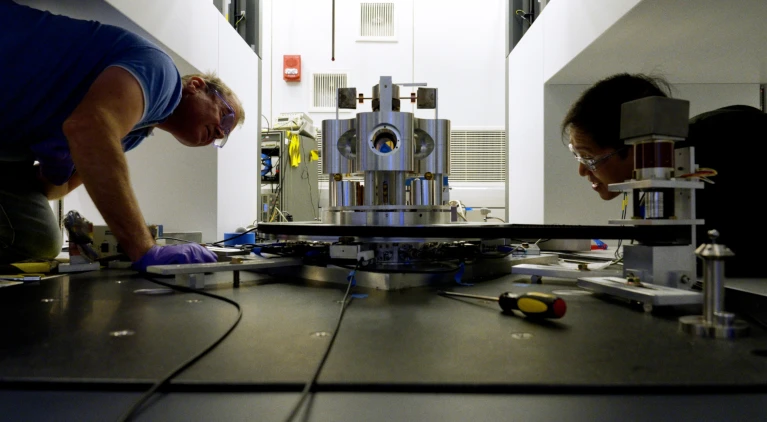
Stephan Schlamminger (left) and colleague Vincent Lee with the equipment used to measure big G.Credit: R. Eskalis/NIST
The value of the constant that describes the gravitational pull between objects, Big G, continues to baffle scientists. A decade-long replication experiment1 that involved moving equipment across the Atlantic has resulted in a number that disagrees with previous results, and also differs from the current best estimate of G.
The new measurement gives important clues as to where the original experiment, conducted by researchers at the International Bureau of Weights and Measures (BIPM) in Paris and published in 2013, went wrong. But its failure to match the internationally agreed CODATA value has left physicists no closer to pinning down G’s true value.
Is gravity quantum? Experiments could finally probe one of physics’ biggest questions
The work is “soul draining”, says Stephan Schlamminger, a physicist at the US National Institute of Standards and Technology (NIST) in Gaithersburg, Maryland, who led the latest work. But he says he is driven by the challenge. “It must be possible for humans to measure this number.”
Studies of G have also often had to be a side hustle for scientists because, although it describes the strength of gravity, its value is rarely needed in practice. Most applications, such as calculating the motions of planets, only require the value of G multiplied by a mass, such as that of the Sun, and measurements can determine the combined value to high precision.
Although hunting for G helps to “sharpen your axe” for other precision experiments, right now “it’s a pretty useless number”, says Schlamminger.
The “meticulous” work of the NIST team should help future experimenters, says Richard Brown, a metrologist at the UK National Physical Laboratory in Teddington. The work “is a great leap forward in this respect,” he says.
Fiendish force
Efforts to measure the gravitational constant date back to 1798, and since then have expanded to a variety of methods, involving swinging pendulums, balancing masses and charting the paths taken by atoms. “In my opinion, it is the most challenging laboratory experiment of all,” says Christian Rothleitner, a physicist at the German National Metrology Institute (PTB) in Braunschweig.
Part of the problem is that, compared with the other forces of nature — electromagnetism and the strong and weak nuclear forces — gravity is trillions of trillions of times weaker; pick up any object and you defy the pull of an entire planet. It is also impossible to shield experiments against unwanted gravitational forces, which makes G hard to isolate.
With an uncertainty of about 1 part in 5,000, Big G remains the fundamental constant that is known least precisely today, and known experimental errors cannot account for the spread of values.
Crisis measures
The NIST replication effort came out of a crisis meeting held at NIST in 2014, which brought rival experimenters together to try to hash out a way forward. Schlamminger was “roped in” to try to work out why the 2013 BIPM result was such an outlier, says Jens Gundlach, an experimental physicist at the University of Washington in Seattle. “The Big G community begged him to do this and he begrudgingly took on this job.” BIPM’s apparatus was shipped to NIST in 2016.
The oldest way to determine Big G, and the one applied by Schlamminger’s team and the BIPM, involves measuring the gravitational attraction between two masses — which sit at either end of a suspended rod — and two larger nearby masses, by gauging how much the pull causes the rod to twist. The most recent version involves two concentric rings of masses and used multiple ways of gauging the pull.
To avoid unconsciously skewing the results, the team blinded the experiment by having an independent outsider add an unknown offset, which was only removed by the team at the end.

