


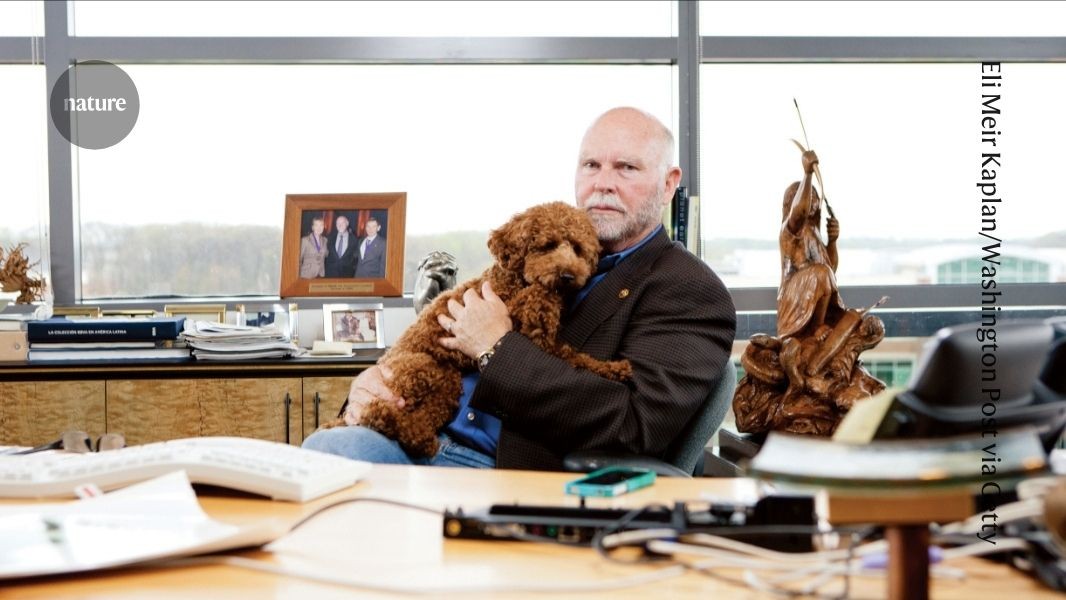
The ‘maverick’ scientist Craig Venter — who led a race to decode the human genome, pioneered a genome-sequencing method still used today, created the first organisms with synthetic genomes and sailed around the world recording microbial diversity — died on 29 April, aged 79.
Venter is most well-known for leading a commercial effort to generate the first human genome sequence in the 1990s, racing against the US$3 billion global, publicly funded Human Genome Project (HGP). But Venter’s scientific legacy extended well beyond the ‘genome wars’, say scientists who knew, admired and competed with him.
“He is a true pioneer and maverick who revolutionized genomics by enabling new sequencing methods and trying to create synthetic cells,” says Tae Seok Moon, a synthetic biologist at the research centre Venter founded in 2006, the J. Craig Venter Institute (JCVI) in La Jolla, California. “It’s a huge loss for all genomics and synthetic biology researchers.”
Shotgun sequencing
Venter’s scientific career started in academic and government labs, where he developed a way to uncover functional genes, one of the first applications of automated DNA sequencing1.
In 1992, he co-founded the Institute for Genomics Research (TIGR) in Gaithersburg, Maryland with microbial genomicist Claire Fraser (to whom he was married for 23 years). In 1995, their team generated the first-ever genome sequence of free-living organism, the 1.8 million DNA letters of the bacterium Haemophilus influenzae2.
They developed a revolutionary method called whole genome shotgun sequencing, in which short, random strands of genomic DNA are sequenced and then computationally assembled into contiguous genome sequences. In 1998, Venter co-founded a company, Celera Genomics, to apply this method to the 3.1 billion-nucleotide human genome.
How diplomacy helped to end the race to sequence the human genome
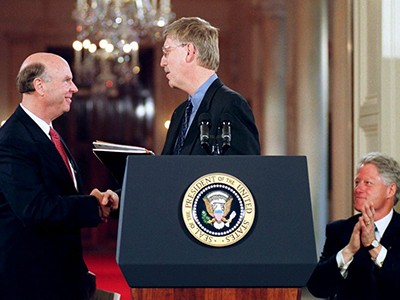
The approach contrasted with that of the public effort, led by scientists in the United States and United Kingdom, which sequenced the human genome in smaller, organized segments. Venter vociferously criticized the HGP as slow, wasteful and costly. After US President Bill Clinton helped to broker a truce between the two initiatives in 2000, a tie was declared at a White House ceremony on 26 June and competing draft sequences were published the following year3,4.
“Together, we were part of an era that transformed how we understand biology, and I will always respect the intensity, ambition, and vision he brought to that work,” says Fraser. “He leaves behind a legacy that changed the trajectory of genomics and biomedical research.”
Tom Ellis, a synthetic biologist at Imperial College London who worked on the HGP at the Sanger Institute in Hinxton, UK, on weekends when he was 16, says that there was no love lost between the teams. “Venter was definitely not on my Christmas card list,” he says.
Synthetic biology
But Venter’s rebel image softened after the genome-sequencing race, says Ellis, when he turned his attention to synthetic biology. After establishing JCVI, Venter led an effort to synthesize an entire bacterial genome. When he and his colleagues ‘rebooted’ that genome in another microbial cell, work reported in 20105, they claimed it was the first example of synthetic life — a characterization some scientists quibbled with.

