


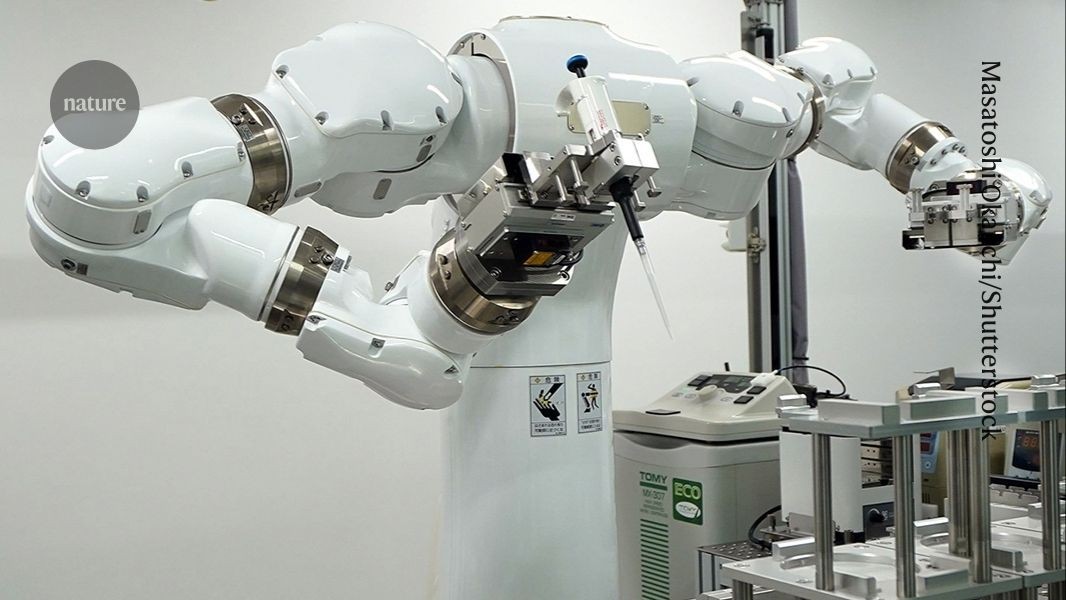
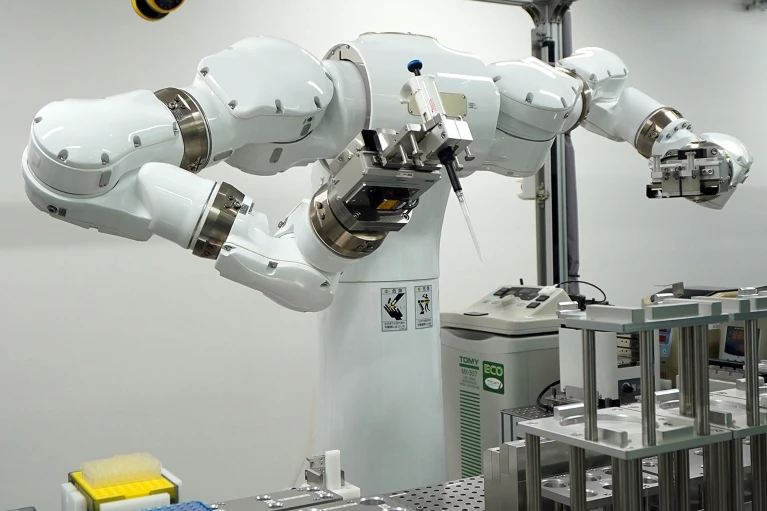
Laboratory robots with built-in artificial-intelligence software can look after stem-cell cultures independently.Credit: Masatoshi Okauchi/Shutterstock
In a biology laboratory in Tokyo, ten robots conduct experiments, using their two arms to handle liquids, grow cells on plates and operate scientific instruments, among other basic tasks.
The Robotics Innovation Center at the Institute of Science Tokyo opened its automated laboratory in April. Later this year, the lab will be made available for use by other researchers at the institute, says Genki Kanda, an automation researcher who works at the robotics centre. He says that the lab’s ultimate goal is to create a “factory-scale” facility with thousands of robots that could be used by local and international scientists by 2040 or 2050.
A laboratory with that many robots would be exciting, says Yan Zeng, a materials scientist at Vanderbilt University in Nashville, Tennessee. “I will be curious to see how soon they are really going to achieve that goal,” notes Zeng, who hopes that the lab could be used by scientists globally, like other leading scientific facilities such as Europe’s particle-physics lab CERN.
Researchers in the life sciences have been automating lab work for at least a decade. Some facilities have one-armed robots that can handle samples in experiments, for instance. But two-armed robots can do more complicated and sophisticated tasks, says Zeng.
The robots in the Tokyo lab also contain artificial-intelligence software that enables them to make some decisions themselves. The robots aren’t just automating the work, they can analyse and improve on experimental methods, says Andrew Cooper, a chemist at the University of Liverpool, UK.
The robots can make decisions about the experiments, says Kanda. For example, an AI program used by Kanda and his team identified and tested 144 experimental conditions in 111 days to work out the optimal conditions for culturing human stem cells. In another experiment, an AI program was able to image cells being cultured on a dish, predict how the cells would grow over time and then work out the best time to harvest them. The robots also looked after the cell cultures continuously for eight days while researchers were away on holidays.
Kanda says that the robots save researchers time by doing repetitive tasks, allowing them to focus on designing experiments, interpreting results and generating fresh ideas.
Humans are still needed
Kanda’s team still need to do some tasks, he says, such as preparing reagents and materials for the robots to use, as well as troubleshooting and cleaning up after experiments. They also need to refill reagents and consumables mid-experiment if many of them are used, he notes. Humans need to fix problems with the equipment and have to step in when the robots make mistakes. His team is working to automate these tasks by integrating software into the robots that can act like an AI scientist, making decisions when errors occur and adapting protocols according to the lab set-up and what resources and equipment are available.
But Cooper says that fully autonomous labs are still a while away, because integrating AI software into physical robots is challenging and requires advanced programming skills. AI-enabled robots could potentially identify and correct mistakes, such as dropping a vial, without a person intervening. However, that work is still in the proof-of-concept stage, he adds.

