


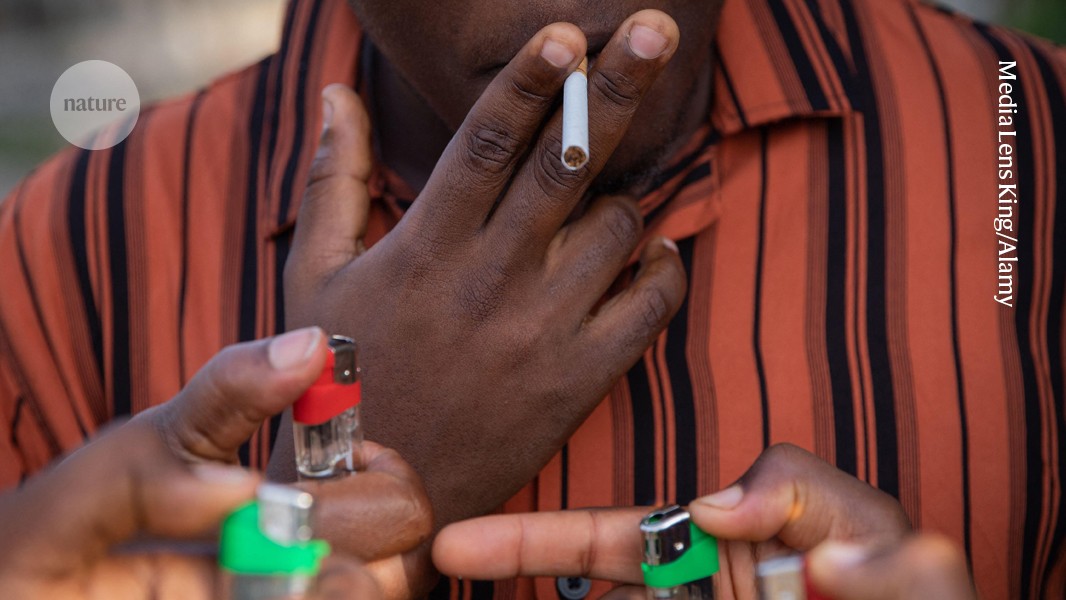

The number of smokers in Africa continues to grow despite a global decrease.Credit: Media Lens King/Alamy
China — a country where more than 40% of men smoke — has become the epicentre of the global lung cancer epidemic.
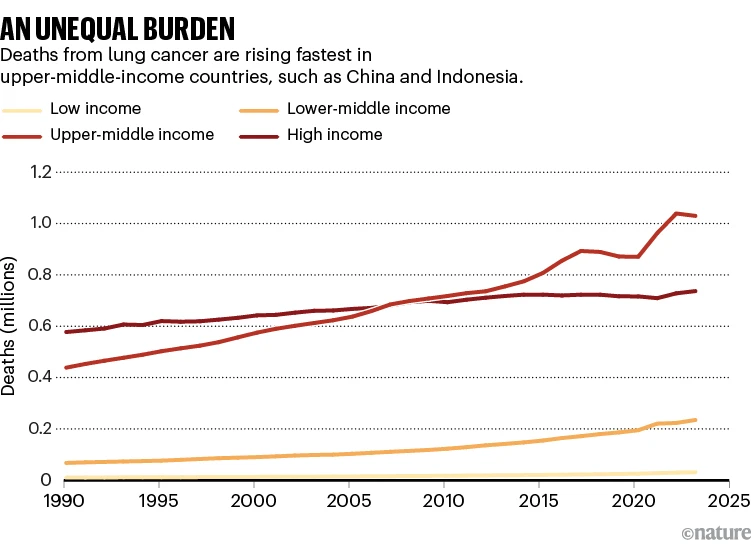
Historically, lung cancer has been predominantly a disease of rich industrialized nations. But the burden of disease in China is indicative of a global shift, with middle-income countries facing the greatest increase in cases as high rates of smoking combine with rapid population growth, urbanization and the associated air pollution.
The trend is most dramatic in upper-middle-income countries, as defined by the World Bank, including China, Brazil and Iran. Between 2003 and 2023, yearly deaths from tracheal, bronchus and lung cancers (lower respiratory tract cancers for which data is typically combined by health-tracking organizations because the causes are so similar) grew by almost two-thirds while populations grew by only about 16% in upper-middle-income countries (see ‘An unequal burden’). A similar pattern is evident in lower-middle income countries in Asia and Africa — particularly India and Nigeria. There, the number of tracheal, bronchus and lung cancer deaths more than doubled while populations increased by just over one-third.
Source: Institute of Health Metrics and Evaluation
The main driver is tobacco smoking, which contributes to 85% of lung cancer cases. “This is the next wave of the tobacco epidemic,” says Yannick Romero, who advises governments on lung cancer policy at the Union for International Cancer Control in Geneva, Switzerland.
China, the world’s second most populous country, has the highest number of smokers. In 2023, around 40% of the world’s two million lung cancer deaths occurred in China. “The influence of smoking is so strong,” says David Lam, a lung cancer specialist at the University of Hong Kong’s School of Clinical Medicine.
Smoking rates in China have begun to fall. In 2024, 23% of the country’s population smoked, down from 27% in 2018. But lung cancer cases will take decades to follow, owing to “the latency between the time you smoke and the time you have an onset of the cancer”, Romero says. Indeed, although global smoking rates have been falling since the 1980s, lung cancer death rates have continued to rise (see ‘The smoking disconnect’).

Source: Institute of Health Metrics and Evaluation
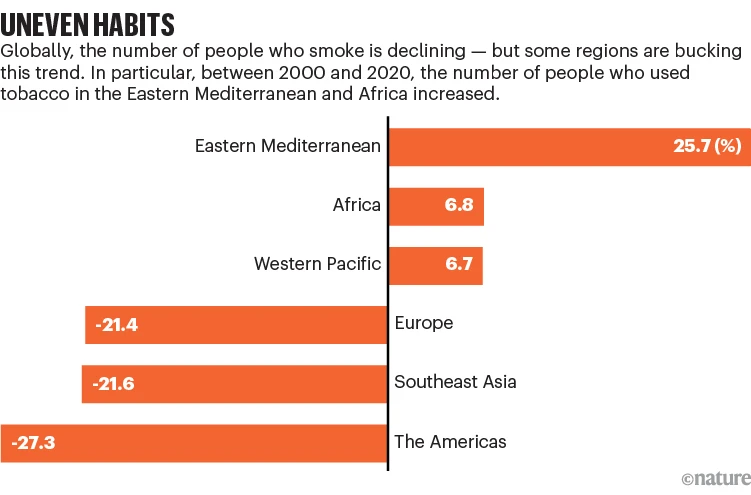
Despite the global decrease in smoking, some regions are bucking that trend. In particular, the overall number of smokers in Africa is growing. This is driven mostly by rising populations (see ‘Uneven habits’).
Source: WHO
A lack of resources, as well as the influence of the tobacco industry, means that many low-income countries are not implementing recommendations outlined by the World Health Organization (WHO), such as raising taxes and banning adverts for smoking. Public policies in these countries are partly to blame, says Romero. “They don’t have, for instance, tobacco taxes that are high enough, so tobacco is still affordable for people,” he says. The WHO suggests that taxes make up 75% of the retail price of tobacco products, but in the WHO African region, only 2% of countries met this recommendation in 2024 — the lowest percentage of any region.
Tip of the iceberg
A lack of access to medical facilities in sub-Saharan Africa means that lung cancer cases are under-recorded, suggesting there could be a hidden epidemic in this region.
“In many African countries, you’re lucky if you have access to an X-ray, never mind a CT [computed tomography] scan,” says Coenie Koegelenberg, a lung cancer specialist at Stellenbosch University in South Africa. As a result, he adds, cancer rates in Africa are “grossly under-reported”.
Nature Outlook: Lung cancer
One problem is a dearth of cancer registries in the region. For example, in generating its most recent report on global cancer incidence in 2022, the WHO’s International Agency for Research on Cancer was forced to base estimates of cancer rates in 19 countries in sub-Saharan Africa on data from neighbouring countries. Another is the lack of medical carers and facilities. “Cancer in sub-Saharan Africa looked like a death sentence just because of the lack of capabilities we had to address it,” says Elvis Obomanu, a lung cancer specialist at Jefferson Einstein Philadelphia Hospital in Pennsylvania.
The paucity of facilities and personnel means that often the cause of death isn’t recorded because people turn to traditional healers instead, explains Catherine Egbe, a tobacco-control specialist at the South African Medical Research Council in Cape Town. “Most of the time, when they get to the point where the doctors say there’s nothing they can do, then they turn to traditional means,” she says.
South Africa — the continent’s most industrialized country — is the exception, according to Egbe. She points out that many more lung cancer cases are being captured there because health workers typically fill out a form when someone dies that includes a statement of whether the person had ever smoked.
It means that the number of lung cancer deaths in South Africa is likely to be much more accurate than it is in many other countries in the region. Compared with the rest of sub-Saharan Africa, the death rate from tracheal, bronchus and lung cancers in South Africa was more than four times higher in 2023 — the most recent year recorded by the Global Burden of Disease study (see go.nature.com/4mz4woy; see ‘An African illusion’).

Source: Institute of Health Metrics and Evaluation
Egbe is concerned about the effects of a lack of action in sub-Saharan Africa: “If we are not intentional about making sure that our smoking rates or tobacco-use rates remain low, then we run the risk of being the epicentre of the tobacco epidemic,” she says.
It’s not just smoking that is driving lung cancer rates in the region. People in sub-Saharan Africa are more likely to be living in extreme poverty than anyone else in the world. This means that the roads in the region are filled with older, polluting vehicles and people — often women — have little choice but to cook over open fires.
These types of pollution increase exposure to particles with diameters of 2.5 micrometres or smaller (PM2.5), which are especially dangerous because they can penetrate deep into the lungs (see ‘The particles problem’). Inhalation of PM2.5 is a known cause of lung cancer.

Source: Our World in Data
The link with poverty means that air pollution is a harder problem to tackle than is tobacco use in low-income regions. “In tobacco control we know what we have to do,” Romero says. “In air pollution it is quite difficult with the current global context.”
In middle-income regions, policies to tackle air pollution are starting to pay dividends.
In China, for example, where around 40% of lung cancer cases occur in non-smokers, particulate-pollution levels are decreasing. In 2020, China had an average concentration of PM2.5 of 35 micrograms per cubic metre, a drop of 40% from the high of 58 micrograms per cubic metre it recorded in 2013. And in its latest report, China’s Ministry of Ecology and Environment said that pollution in large cities was continuing to fall and it had achieved a 2.7% reduction in PM2.5 in 2024 compared with 2023 (see go.nature.com/48rlq3t). The trajectory is encouraging, but the lower level is still much higher than the WHO’s guideline of 5 micrograms per cubic metre.
The drivers of lung cancer are starting to ease in many middle-income regions: fewer people are smoking and the air is becoming cleaner. But this is not true in many low-income regions. And owing to the time it takes for lung cancer to develop, the health effects in these regions will play out for decades.

