


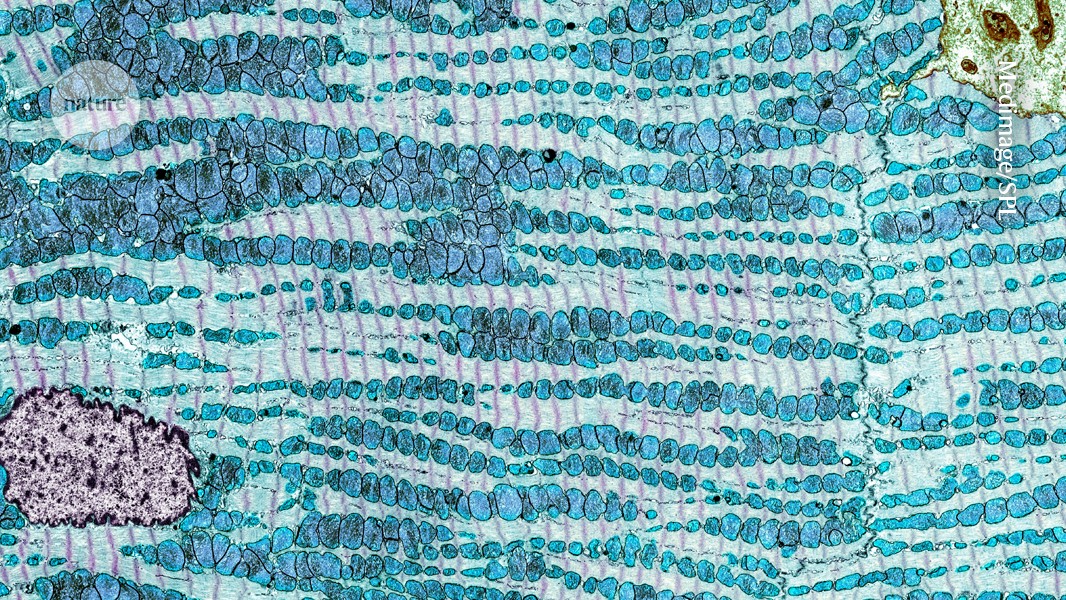
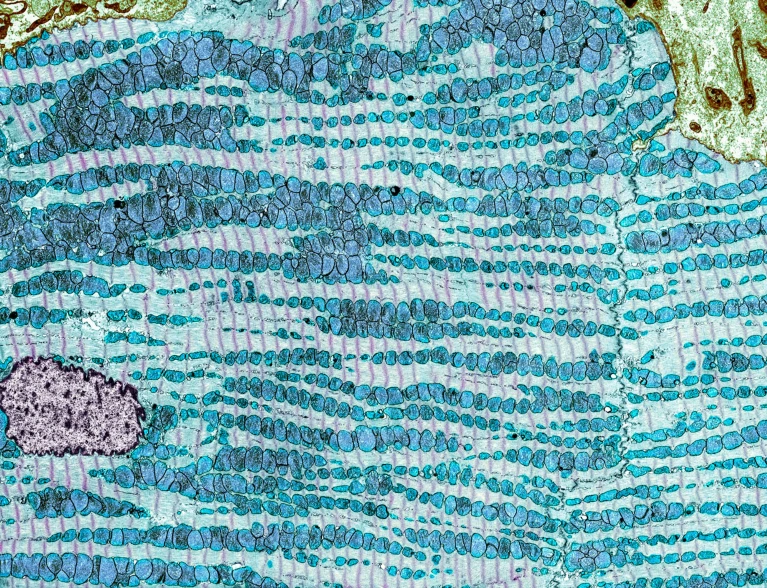
Heart-muscle cells (in close-up, artificially coloured) do not normally proliferate in adult mammals, but scientists are trying to coax them into doing so. Credit: Medimage/SPL
Scientists are developing a new wave of gene therapies to regenerate the heart — offering hope for treating heart failure, a debilitating and common condition.
The first clinical trial aimed at growing new heart-muscle cells is now under way, and companies are developing at least four other regenerative gene therapies for heart conditions.
“These are [the] first-in-human studies to take regeneration into the clinic,” says Andrew Baker, a gene-therapy researcher at the University of Edinburgh, UK, who is unaffiliated with the efforts. “It’s a very exciting time.”

Ranking the risk of heart disease
But the excitement is tempered with caution. The mammalian heart is bad at repairing itself and “is notoriously unwieldy when it comes to efforts to try to get it to regenerate”, says Sean Wu, a cardiologist at Stanford University in California. Some scientists are unconvinced that the data underpinning the existing clinical trial show true regeneration in the form of cell division. And efforts to regenerate the heart are still haunted by a controversy that led to the retraction of at least a dozen papers and the closure of a high-profile laboratory.
Developing a gene therapy in this field will be difficult, says Antonio Abbate, a cardiologist at the University of Virginia in Charlottesville. But “we have to do research because, eventually, we’ll get it right”.
A common failing
Heart failure occurs when the organ can’t pump enough blood for the body’s needs. The condition is becoming increasingly common in some nations. In the United States, for example, the prevalence is expected to rise by 50% in the next 15 years1. The few existing drugs treat symptoms without fixing the root of the problem: the heart is either too stiff to properly fill with blood or too weak to pump it.

How RNA therapies could be used to tackle the world’s biggest killer
The first trial of a gene therapy for heart failure, launched in 2007, was not aimed at regenerating the heart. Instead, it tried to improve the ability of heart-muscle cells, or cardiomyocytes, to contract2 — a movement that drives the heart’s pumping action. Participants received a dose of viruses containing a gene that helps to improve cardiomyocytes’ ability to store calcium, which is crucial for the cells’ contraction. But the therapy did not extend participants’ lives. The trial’s academic developer attributes its failure to the fact that virus-making technology was still at an early stage at the time, and started two more trials of therapies targeting the same pathway in 2020 and 2024.
Now, researchers are striving not just to improve cardiomyocytes’ function but also to coax these cells to proliferate, in the hope that bulking up the heart will restore its vigour. The first such regenerative therapy to reach clinical trials uses a virus to ferry snippets of RNA into cardiomyocytes. The RNA binds to a gene called SAV1, which encodes a protein that limits cell division. The binding prevents the gene from being expressed at a high level, thereby releasing a brake on cell proliferation.
Better beats
In mice and pigs treated with this method, cardiomyocytes were seen to divide, says James Martin, a regenerative biologist at the Texas Heart Institute in Houston who led the work. Martin is also the chief scientific officer at Medley Therapeutics, a biotechnology company in Laguna Hills, California, that aims to develop the therapy. In a pig model of heart attack, the therapy improved the heart’s ejection fraction, a measure of how much blood is pumped by each beat, by 14%, according to a study co-authored by Martin3.
Such data helped to convince US regulators to approve a clinical trial, which began in June. Some academics have praised this study and related work4. “All the small-animal data that I’ve seen looks — and I’m familiar with the work — really good and convincing,” says Deepak Srivastava, president of Gladstone Institutes, a biomedical research organization in San Francisco, California.
But some researchers are sceptical. Martin and his team rely in part on observations of replicating DNA to conclude that the cardiomyocytes in their pig models are dividing. But cardiomyocytes sometimes form a second nucleus to increase their protein production, and it can be difficult to distinguish such cells from those that have formed a second nucleus to prepare for cell division, some researchers say. Abbate notes that many studies, including Martin’s, compare treated animals with those that received no treatment, rather than ones that received the standard of care.
Backdrop of controversy
Martin acknowledges that some researchers would like to see more evidence for cell division and that his control animals did not receive medications that are the standard of care. He says he used the best available methods and that the technology has matured enough that human trials are the only way to provide answers.
The concerns don’t surprise Martin. “The reality is — some people you will never convince,” he says. In part, he says, that’s because of the field’s controversial past.

