


You have full access to this article via your institution.
Hello Nature readers, would you like to get this Briefing in your inbox free every day? Sign up here.

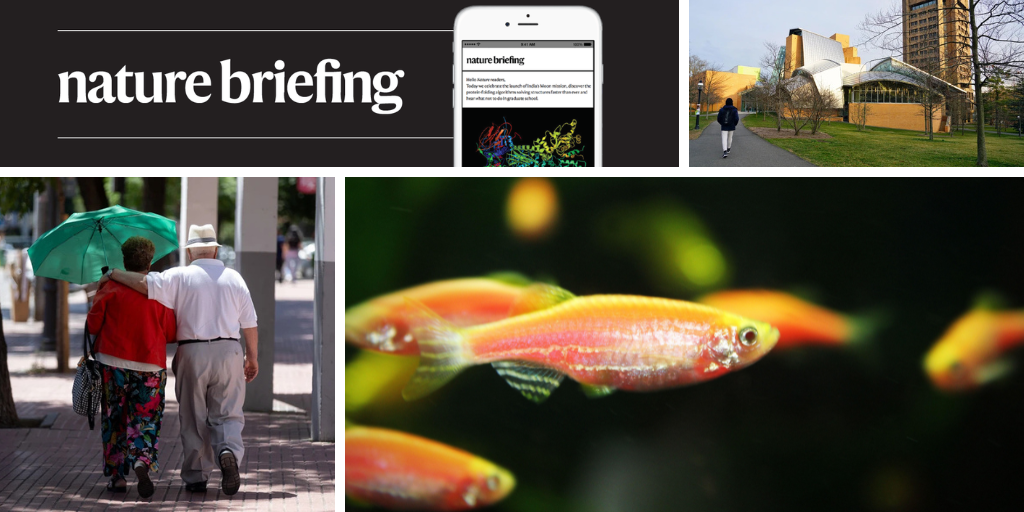
Zebrafish’s bodies are transparent for their first few weeks of life, which gave researchers a window into the fish’s brains while they slept. (WireStock via Alamy)
Zebrafish (Danio spp.) sleep in different stages that resemble the ‘cycles’ of sleep described in people. By tracking the eye movements of snoozing fish, researchers identified four ‘substates’ of sleep — three associated with nighttime slumber and one with short naps during the day. Identifying these distinct sleep states could help researchers to untangle what purpose they serve in fish and other animals. “It’s like a lot of things in biology: The more we look under the hood, the more complex it is,” says marine ecologist Michael Heithaus.
The New York Times | 3 min read
Reference: Nature Communications paper
A powerful molecular clock calibrated using gene-activity data can predict biological ageing in rodents, monkeys and humans — and time to death in people. Although it isn’t ready for medical use, the tool could eventually be a boon to biologists keen to learn which drugs or lifestyle changes might mitigate ageing’s myriad effects on the body. A gene-activity clock could be more sensitive than those based on molecular changes to DNA, which are slower to respond and might not capture the impacts of environmental changes, says computational biologist and study co-author Alexander Tyshkovskiy.
The US National Science Foundation (NSF) — a major funder of basic research — has restricted the flow of new research grants to four elite universities. According to internal agency documents seen by Nature, the NSF’s grants-management office put limits on new awards to Duke, Harvard, Yale and Princeton at the beginning of April, and little funding has been made available to these institutions since then. It’s not clear why the NSF has put these restrictions in place, or when it will lift them.
Some spinosauruses (Spinosauridae) might have had a specialized gland that enabled them to purge salt from their bodies. Researchers noticed grooves in the fossilized skulls of spinosaurs such as Baryonyx walkeri and Irritator challengeri in around the same place that the salt gland rests in modern bird species such as seagulls (Larinae). The findings suggest that these dinos might’ve had a similar organ, and lend support to the theory that spinosauruses were at least semi-aquatic. “If they’re in the water a long time, they need a salt gland,” says palaeontologist David Martill.
Reference: Historical Biology paper
Features & opinion
Artificial intelligence models shouldn’t be trusted to conduct systematic reviews of scientific literature on their own, argues Rupa Sarkar, editor-in-chief of the Cochrane Collaboration, which produces gold-standard reviews of medical literature. Conducting systematic reviews isn’t a purely computational task and requires nuanced human expertise that models don’t often possess. AI tools can lighten some of the load of conducting a review, such as compiling structured data sets from disparate sources, but they should be used to support, not replace, scientists, Sarkar writes.
Mutations might lay the foundations for lung cancer, but evidence suggests that inflammation is what sparks the first stages of tumour development. “Stopping mutation is something very difficult. However, we know how to stop inflammation,” says physician-scientist Miriam Merad. Researchers are now investigating the use of anti-inflammatory drugs to nip lung cancer in the bud — a burgeoning field known as cancer ‘interception’.
This article is part of Nature Outlook: Lung cancer, an editorially independent supplement produced with financial support from Daiichi Sankyo and MSD.
Infographic of the week

Figure 2 | Spatial transcriptomic maps of human embryos. Each spot is coloured according to the tissue type inferred from the gene-expression profile measured at that location. Each of the 50 colours represents a different developing organ. (Adapted from Fig. 1b of ref. 1.)
Using a technique called spatial transcriptomics, researchers have compiled an atlas of gene expression in 4- to 8-week-old human embryos that captures the early growth of 50 different organs, each indicated here in a different colour. The atlas could be used to identify how genetic variants affect development in people with congenital conditions, or help to explain why fetuses are susceptible to infections with, for example, Zika virus. (Nature News & Views | 4 min read)
Today I’m taking penguin-anatomy lessons. By examining macaroni penguins (Eudyptes chrysolophus), researchers have finally put a name to a muscle in the birds that’s puzzled their predecessors for decades: m. adductor tibialis.
The muscle, which extends from the penguins’ torsos into each leg, appears to hold the birds’ legs together to streamline their bodies during dives, and helps them keep their balance while they waddle.
Help us keep this newsletter streamlined by sending your feedback to [email protected].
Thanks for reading,
Jacob Smith, associate editor, Nature Briefing
• Nature Briefing: Careers — insights, advice and award-winning journalism to help you optimize your working life
• Nature Briefing: Microbiology — the most abundant living entities on our planet — microorganisms — and the role they play in health, the environment and food systems
• Nature Briefing: Anthropocene — climate change, biodiversity, sustainability and geoengineering
• Nature Briefing: AI & Robotics — 100% written by humans, of course
• Nature Briefing: Cancer — a weekly newsletter written with cancer researchers in mind
• Nature Briefing: Translational Research — covers biotechnology, drug discovery and pharma

